
How Long Does App Development Take: A Step-by-Step Timeline
Most people expect a simple answer on how long an app takes to build, but the truth is, it never starts with a number; it starts with clarity. Before you talk timelines, you need to understand what you're actually building and why it matters.
The Short Answer: How Long does an App Take to Develop
Short answer is it depends, but a useful ballpark is this:
- A basic app with minimal screens and no external integrations can often be up and running in 6 to 10 weeks.
- A moderately complex app with logins, user flows, backend services, and maybe payments or data sync usually takes about 3 to 6 months.
- For feature-rich or enterprise-level apps, those with real-time data, heavy integrations, complex workflows, or high security compliance expect 6 to 12 + months.
But the reality is, those are not magic numbers; they're the outcome of three clear things- scope, clarity, and planning.
What Influences App Development Time
The timeline of any app isn't defined by a single decision rather, it is shaped by a mix of moving parts that determine how fast your team can move. Think of it as the foundation. If these elements are straightforward, timelines tighten. If they're complex or unclear, the build naturally stretches.
Feature depth: Every additional feature adds screens, flows, and logic. A simple login is quick, but a multi-role authentication system with permissions is not.
Design complexity: Clean, minimal UI takes less time than motion-heavy interactions, custom components, or brand-first visuals. The design system you choose directly impacts your speed.
Platform choices: Building for one platform (iOS or Android) is faster than building for both. A cross-platform approach can shorten or extend timelines depending on the toolkit and features.
Integrations and APIs: Payments, maps, CRMs, ERPs, analytics, and AI services each external system adds coordination, testing, and troubleshooting to the timeline.
Backend architecture: A lightweight backend is quick. A system with advanced analytics, role management, and real-time sync needs more engineering cycles.
Compliance and security: Fintech, healthcare, and enterprise apps often require encryption layers, data compliance, and audit-ready builds, all of which take time.
Team structure: A focused, experienced team moves faster. Slow feedback loops, unclear decisions, or shifting priorities extend timelines more than people expect. The timeline is less about how "big" your idea is and more about how clearly defined and technically grounded it is from day one.
Stages of App Development: Step-by-Step Timeline
Every app looks different on the surface, but behind the scenes, they all follow the same build rhythm. Once you understand that rhythm, the timeline stops feeling mysterious.
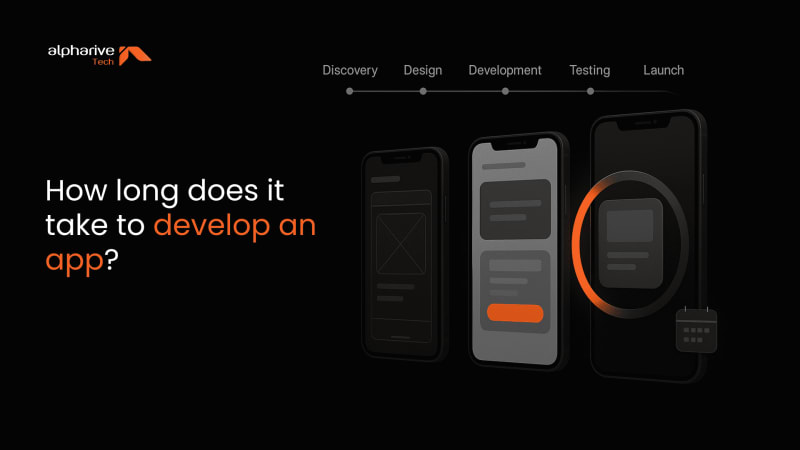
Discovery & Planning: This is where your app idea turns into a clear plan. The team defines what the app needs to do, who will use it, and which features matter most. Getting this part right, makes the rest of the project move much smoothly alongside timelines and feature scope, launch preparation may include simple content planning using tools such as an Instagram Post Generator.
UX Research & Wireframes: User flows and layouts are mapped to remove guesswork. Wireframes make design and development faster and more aligned.
UI Design: This is where the look and feel of the app comes together. Screens, colors, layouts, and interactions are designed. Simple designs move fast, while highly customized visuals take more time.
Development: This is where the app is actually built. The frontend screens are created, the backend is set up, and all features and APIs are connected. It's usually the longest and most hands-on phase.
Testing: Now the app is checked on different devices to make sure everything works as expected. Bugs are found and fixed, and the app becomes more stable and ready for launch.
Deployment: The final build is prepared and submitted for App Store and Play Store review before going live.
Timeline by App Complexity
Complexity is one of the biggest factors shaping an app's timeline. Two products can follow the same idea yet take completely different amounts of time to build simply because the depth of features, workflows, and architecture isn't the same. Once you know where your app sits on this spectrum, estimating its timeline becomes far more straightforward.
Simple Apps
Simple apps focus on core features and clean, minimal flows. They often include a few screens, straightforward navigation, and light backend logic. When everything is well-defined, these apps usually come together in 6 to 10 weeks. They're ideal for MVPs or early-stage validation where speed matters more than scale. Most of the work goes into getting the basics right without overcomplicating the build.
Medium Apps
Most apps you see in the market land here. They involve user accounts, dashboards, payments, data sync, and moderate custom UI. With these additional layers, the timeline typically stretches to 3 to 6 months, depending on design and integration depth.
Complex Apps
Apps with real-time features, multi-role systems, AI components, or enterprise-level workflows require deeper planning, larger architecture, and comprehensive testing. These builds generally fall in the 6 to 12 month range.
They also involve higher security standards and more rigorous testing cycles, which add additional time. The complexity is not just about technical, it is also about operational and careful decisions at every stage.
Popular App Types and Time it Takes to Build an App
Every app category carries its own set of workflows, integrations, and compliance needs. Understanding where your idea fits is the quickest way to estimate how long the build will take. Here's how long the most common app types typically take to build.
| App Type | What They Usually Include | Estimated Timeline |
| Social Media Apps | Need feeds, profiles, chat, media uploads, and real-time updates. | 6–10 months |
| E-Commerce Apps | Include product listings, carts, payments, and order tracking. | 4–8 months |
| Marketplace Apps | Connect buyers and sellers with listings, payments, and dashboards. | 5–9 months |
| On-Demand Delivery Apps | Require real-time tracking, bookings, and dual user flows. | 5–9 months |
| Fintech Apps | Need secure payments, KYC, identity checks, and compliance workflows. | 6–12+ months |
| Healthcare Apps | Offer telemedicine, appointments, EMRs, and strong privacy protections. | 6–12 months |
| Fitness & Wellness Apps | Include workout tracking, progress dashboards, and reminders. | 4–7 months |
| EdTech Apps | Provide courses, videos, live classes, tests, and teacher dashboards. | 5–9 months |
| Enterprise SaaS Apps | Handle workflows, analytics, dashboards, and role-based access. | 6–12+ months |
| Travel & Booking Apps | Require listings, filters, booking flows, maps, and payments. | 5–9 months |
What Slows Down or Speeds Up Your Timeline?
An app's timeline usually slows down when the basics aren't clear. If the feature list keeps changing, designs aren't final, or the team is unsure how certain parts should work, development here takes longer. Delays also occur when feedback arrives late or when decisions take too long. These small pauses add up and stretch the project more than most people expect.
On the other hand, timelines move faster when the foundation is solid. A defined scope, finalized designs, and early technical alignment give development a stable path. Teams accelerate even further when they rely on reusable components, well-documented APIs, and consistent communication loops. These reduce friction, shorten feedback cycles, and eliminate unnecessary rework.
What this really means is that predictability isn't about rushing the build; it's about removing uncertainty. When product, design, and engineering move in sync, timelines stop slipping and start becoming reliable.
Related Article: Mobile App Development Cost
Smarter Way to Predict Your App's Development Time
Estimating an app's timeline becomes much easier when you break the project into smaller pieces instead of trying to guess the full duration at once. Start by listing the core features you need for launch and set aside the nice-to-have ideas for later so the core product isn't overloaded before development begins. This gives the team a realistic foundation instead of an inflated feature list that disrupts planning.
From there, estimate the effort feature by feature. Short, iterative sprints help reveal the team's actual delivery velocity, letting you adjust the schedule based on real progress rather than assumptions. It also exposes bottlenecks early, when they're easiest to fix. Adding a buffer for testing and revisions is equally important; every project needs it, regardless of complexity. When these steps come together, your timeline becomes less of a guess and more of a measurable plan you can rely on.
The Real Work That Starts After Launch
Launching an app isn't the finish line; it's when real-world usage begins to shape the product. Even with thorough testing, users will always interact with the app in ways your team didn't anticipate. This is where the first wave of improvements surfaces: bug fixes, performance tuning, and adjustments to features that behave differently under real traffic.
Post-launch is also when you begin planning the next phase of growth. User feedback reveals what needs refinement and which features should move up the roadmap. Analytics start showing where users drop off, what they value most, and where the experience can be tightened. The apps that continue to evolve after launch, rather than treating it as an endpoint, are the ones that scale smoothly and stay competitive.
The Bottom Line on App Development Timeline
App development timelines aren't determined by guesswork; they're shaped by clarity, planning, and the decisions made at every stage of the process. When the scope is defined, the design direction is stable, and the technical foundations are aligned early, even complex products can move with predictability. When those pieces are missing, timelines stretch, and the build becomes harder to control.
At Alpharive as an end-to-end mobile app development company, we've seen this pattern across projects of every scale. The teams that move fastest aren't the ones trying to rush development; they're the ones who invest upfront in understanding what they're building and how it should evolve. A solid roadmap, structured execution, and continuous alignment across product, design, and engineering make the timeline more than a projection by making it a reliable path to launch.
For founders and teams planning their next digital product, the takeaway is simple - build with clarity, iterate with purpose, and choose partners who understand how to turn complexity into forward momentum.