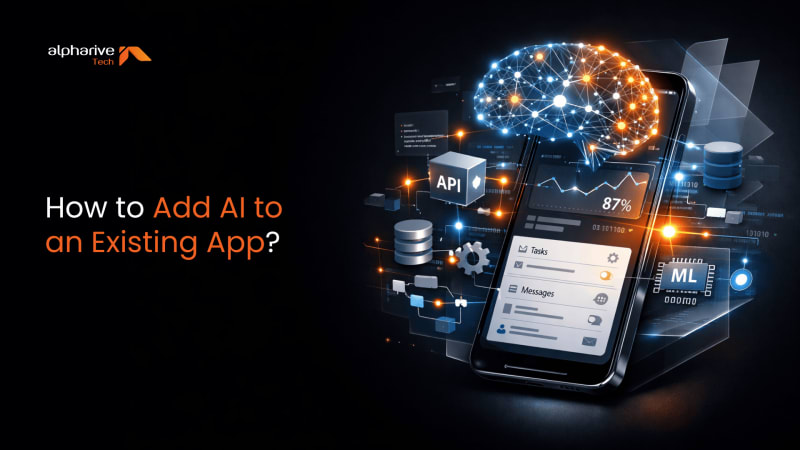
AI integration today is no longer about building entirely new products from the ground up or replacing systems that already work well. Instead, it focuses on upgrading existing apps with intelligent capabilities that enhance how they operate and deliver value. Businesses are using AI to make their software smarter, more efficient, and more responsive by adding features like automation, personalization, predictive insights, and real-time decision support.
This approach allows organizations to protect their existing investments, avoid unnecessary redevelopment, and introduce AI in a controlled, scalable way. By layering intelligence onto proven applications, companies can improve user experiences, optimize internal processes, and unlock measurable business outcomes without disrupting their core systems.
Can AI Be Added to an Existing App Without Rebuilding It?
Adding AI to an existing app is entirely possible, and in most cases, it does not require rebuilding the entire system. Modern AI integration relies on modular AI agent architecture, APIs, and cloud-based services that can be layered onto current applications. This allows businesses to introduce intelligent features while keeping their core product stable.
In practice, AI is treated as an extension rather than a replacement. Existing databases, workflows, and user interfaces remain intact, while AI models operate in the background to analyze data, automate decisions, or enhance user interactions. This approach reduces risk, shortens timelines, and keeps operational disruptions to a minimum.
Why Businesses Add AI to Existing Apps Instead of Building New Ones
AI integration into existing apps has become the preferred path for businesses aiming to stay competitive without unnecessary reinvention. Established products already have users, data, and proven workflows, making them ideal candidates for AI-driven upgrades. Instead of starting over, organizations focus on improving efficiency, personalization, and decision-making within systems they already trust.
Beyond cost savings, this strategy offers faster returns. Businesses can launch AI-powered features incrementally, validate impact, and scale based on results. This measured approach resonates strongly across global markets where stability, reliability, and long-term value matter more than rapid experimentation alone.
Common AI Features Businesses Add to Existing Apps
AI features are typically added to solve specific operational or user-experience challenges, rather than to follow trends.
Customer Support and Conversational AI
Many businesses integrate AI chat and voice assistants to handle routine queries, provide multilingual support, and reduce response times without increasing support headcount. This is widely used in SaaS platforms, mobile apps, and enterprise systems to improve customer experience at scale.
Recommendation and Personalization Engines
Personalized content, product suggestions, and user journeys help applications improve engagement and conversions by adapting experiences based on behavior and preferences. These engines are commonly added to eCommerce, media, and subscription-based platforms.
Predictive Analytics and Forecasting
AI-driven analytics enable apps to anticipate demand, identify risks, and support better decision-making using historical and real-time data. Businesses use this capability to improve planning, optimize operations, and reduce uncertainty across functions.
Image, Video, and Document Intelligence
From document verification to visual inspections, AI helps automate tasks that previously required manual review, improving speed and accuracy. This is especially valuable in industries where large volumes of visual or unstructured data are processed daily. For example, an AI-powered feature like a social media post generator can be added to an existing app to help users automatically create engaging captions and content based on simple prompts.
Job Application and Hiring Workflow Automation
Businesses also integrate AI-powered job application APIs into existing websites and HR systems to streamline hiring without building new platforms. These integrations enable resume parsing, skill matching, and automated routing of applications to the right teams, reducing manual effort and improving time-to-hire. By layering AI through APIs, companies modernize recruitment workflows while keeping their existing apps and processes intact.
Fraud Detection and Anomaly Monitoring
AI models can continuously monitor activity patterns, flagging unusual behavior and reducing exposure to fraud or system misuse. This capability is critical for applications handling transactions, sensitive data, or high user activity.
Which Types of Apps Are Best Suited for AI Integration?
AI integration solutions works best for applications that already handle meaningful data and user interactions. Mobile apps often use AI to enhance personalization, automation, and engagement across platforms. SaaS products rely on AI to improve insights, recommendations, and operational efficiency.
Web-based dashboards and enterprise systems benefit from AI-driven analytics and automation, while even legacy software can be upgraded using API-based integration layers. The key factor is not the age of the application, but the clarity of business goals behind AI adoption.
Step-by-Step Process to Add AI to an Existing App
The AI integration process begins with understanding both the application and the business context, allowing intelligence to be added incrementally without disrupting existing workflows.
- Evaluating the Existing Application Architecture - This step reviews the current tech stack, data flow, and scalability to determine how AI components can be introduced without affecting performance or stability.
- Identifying High-Impact AI Opportunities - Not every feature needs AI, so the focus remains on areas where automation, prediction, or intelligence can deliver measurable business value.
- Selecting the Right AI Models or APIs - Based on requirements, teams choose between pre-trained models, custom-built solutions, or third-party AI APIs that align with performance and scalability needs.
- Preparing and Connecting Data Pipelines - Clean, well-structured data is essential, and existing data sources are securely connected to AI systems for training, inference, and ongoing learning.
- Integrating AI Using APIs or Microservices - AI capabilities are introduced through modular services, enabling flexible deployment, easier maintenance, and future expansion.
- Testing, Monitoring, and Scaling AI Features - Once deployed, AI features are tested for accuracy, continuously monitored, and refined over time to ensure reliability as usage grows.
AI Tech Stack Commonly Used for Existing App Integration
AI integration for existing apps typically relies on a layered tech stack designed for flexibility and scalability. At the core are machine learning models, which may be pre-trained or custom-built, supported by API layers that allow AI capabilities to connect seamlessly with existing applications, ultimately strengthening AI Visibility by ensuring content, data, and user interactions are optimized for intelligent search and AI-driven discovery systems.
Data pipelines handle the flow of structured and unstructured data, while cloud infrastructure provides the compute and storage needed to run AI workloads efficiently. MLOps tools support model monitoring, updates, and performance management, and security layers ensure data privacy, access control, and compliance across environments. Rather than relying on a single tool or platform, successful AI integration focuses on building a modular stack that can evolve as business needs grow.
How Much Does It Cost to Add AI to an Existing App?
The cost of adding AI to an existing app depends on scope, complexity, and data readiness rather than a fixed price. Simple AI features such as chatbots, search enhancements, or recommendation engines usually require lower investment, while advanced analytics, automation, or enterprise-scale AI systems involve higher costs.
Key factors that influence pricing include the number of AI features, data volume and quality, integration complexity, security requirements, and ongoing maintenance. Many businesses start with a focused AI use case to control costs, validate impact, and then expand capabilities gradually as value becomes clear.
How Long Does AI Integration Take for an Existing App?
The timeline for AI integration varies based on how deeply AI is embedded into the existing app. Basic AI features can often be introduced within a few weeks, while more advanced implementations involving custom models or complex data pipelines may take several months.
Projects that require high accuracy, large datasets, or strict security and compliance standards typically need additional time for testing and optimization. A phased rollout approach helps businesses deliver early improvements while preparing for broader AI adoption over time.
Key Challenges and Risks of Adding AI to Existing Apps
AI integration comes with challenges that must be addressed early to ensure long-term success. Data quality issues can impact model accuracy, while performance considerations must be managed carefully to avoid slowing down the app. Security and privacy remain critical, especially when handling sensitive or regulated data across systems.
Long-term success also depends on maintaining AI models over time, ensuring they adapt to changing data and business conditions without introducing bias or reliability issues. With the right planning and monitoring, these challenges can be managed effectively without disrupting existing applications.
How Businesses Across Global Markets Are Integrating AI Into Existing Apps
Across global markets, businesses are taking a practical and outcome-driven approach to AI integration solutions. Mature organizations focus on reliability, scalability, and measurable results, while fast-growing companies prioritize speed and flexibility when introducing AI capabilities. Enterprise AI solutions place strong emphasis on security, compliance, and seamless integration with existing workflows.
Despite regional differences, the dominant global trend is consistent: businesses prefer upgrading proven systems with AI rather than replacing them entirely, allowing them to preserve stability while unlocking new value.
Why Choose Alpharive for AI Integration in Existing Apps?
Alpharive brings experience across AI and custom software development services to help businesses integrate AI into real, production-ready applications. The approach focuses on understanding existing systems first, then adding intelligence in a secure and scalable way that aligns with business goals, supports global users, and delivers long-term value without unnecessary complexity.
Conclusion
Adding AI to an existing app is no longer a future consideration, it is a practical step toward smarter, more efficient software. With the right strategy, businesses can enhance their applications with intelligence that scales across markets and evolves with user needs. Talk to the experts of Alpharive, a leading AI Development Company and explore how AI can upgrade your existing app without rebuilding it.