

/ TRUSTED BY GLOBAL BRANDS




Build intelligent, scalable, and compliant AI healthcare software solutions that enhance clinical decisions, streamline operations, and redefine patient care experiences.
Get a Quote
AI in healthcare refers to the use of artificial intelligence technologies to analyze medical data, support clinical decisions, and improve how healthcare systems operate. It brings together machine learning, deep learning, natural language processing, and computer vision to process complex datasets such as patient records, imaging scans, and clinical notes. Instead of relying only on manual analysis, healthcare providers can now use AI to detect patterns, predict outcomes, and assist in faster and more accurate decision-making.
Beyond diagnostics, AI integration addresses one of the healthcare industry's most significant challenges: operational inefficiency. From automating administrative scheduling and billing to optimizing hospital bed management through predictive analytics, intelligent systems are removing the administrative burden from doctors and nurses. This means medical professionals can refocus their time on what truly matters: delivering empathetic, high-quality care to patients.
Key AI technologies used in healthcare form the foundation of intelligent systems that power diagnostics, decision-making, and patient care innovation.

Machine learning forms the foundation of AI in healthcare by enabling systems to learn from historical data and improve performance over time. It is widely used for predictive analytics, patient risk assessment, and population health management.

Deep learning, an advanced subset of machine learning, is designed to process complex datasets using neural networks. It plays a critical role in medical imaging, helping identify patterns in scans with high precision.

Natural language processing allows AI systems to understand and interpret unstructured clinical text such as doctor notes and patient conversations. This makes documentation, coding, and data extraction faster and more accurate.

Computer vision enables AI to analyze visual medical data like X-rays, MRIs, and pathology slides. It supports faster diagnosis and enhances accuracy in detecting conditions that may be missed during manual review.
- Market Size and Global Growth
AI in healthcare is becoming one of the fastest-growing sectors globally, driven by the need for smarter, data-driven medical systems and improved patient outcomes. The market has already reached significant scale and is expected to grow rapidly over the next decade, supported by advancements in technology, increased digital adoption, and rising healthcare demands. From diagnostics to drug discovery and hospital operations, AI is being widely adopted across multiple areas, making it a key driver of innovation in modern healthcare systems.
At the same time, global adoption varies across regions, with North America leading due to strong infrastructure and early adoption, while Europe focuses heavily on compliance and ethical AI practices. The Asia-Pacific region is seeing the fastest growth, fueled by large populations and expanding digital health initiatives. Emerging markets are also turning to AI to improve healthcare access and efficiency, creating strong demand for scalable and cost-effective AI healthcare software solutions.

- Real-World Use Cases
AI in healthcare is transforming clinical processes, research, and operations by enabling intelligent systems that improve efficiency, accuracy, and overall patient care.
AI analyzes medical images like X-rays and MRIs to detect diseases faster, improve accuracy, and support clinical decision-making.
AI accelerates drug discovery by analyzing biological data, identifying compounds, predicting outcomes, and reducing time, cost, and research complexity significantly.
AI enhances robotic surgery by improving precision, reducing errors, supporting surgeons with real-time guidance, and enabling minimally invasive procedures.
AI uses patient data and genetic information to create personalized treatment plans, improving effectiveness, outcomes, and overall patient care experience.
AI monitors patient health using real-time data from devices, detecting early risks and enabling proactive care through remote healthcare solutions.
AI automates scheduling, billing, documentation, and workflows, reducing administrative burden, improving efficiency, and allowing staff to focus on patient care.
AI in healthcare delivers real-world value by improving accuracy, efficiency, and personalized patient care across modern medical systems.
AI helps detect diseases earlier and with higher precision by analyzing complex medical data faster than traditional methods.
Real-time insights from AI systems support doctors in making quicker, data-driven decisions during critical care situations.
Automation of routine tasks lowers administrative expenses and minimizes inefficiencies across healthcare workflows.
AI-powered tools enable better patient engagement, smoother interactions, and more responsive healthcare services.
Advanced analytics allow healthcare providers to identify risks early and prevent potential health issues before they escalate.
AI enables tailored care by analyzing individual patient data, ensuring treatments are more effective and targeted.
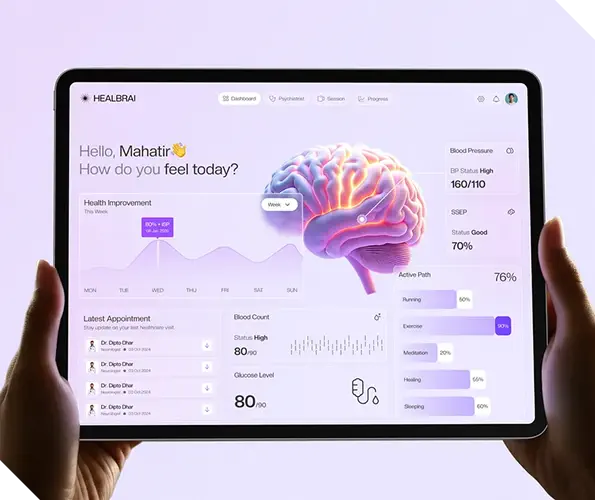
AI in healthcare brings significant advancements, but it also introduces challenges that organizations must carefully address before implementation. One of the biggest concerns is data privacy and security, as healthcare data is highly sensitive and subject to strict regulations. Ensuring compliance with frameworks like HIPAA and GDPR requires strong data protection measures, secure architectures, and controlled access to patient information throughout the system.
Another major challenge lies in algorithmic bias and system integration. AI models trained on limited or unbalanced datasets may produce inaccurate or unfair outcomes, impacting patient care. At the same time, integrating AI solutions with existing legacy systems can be complex and time-consuming, often requiring custom development and interoperability planning. Addressing these risks early plays a key role in building reliable, ethical, and scalable AI healthcare solutions.
AI in healthcare implementation requires a structured approach that aligns technology with real clinical and operational needs.
Clearly identifying a specific clinical or operational challenge ensures the AI solution addresses measurable outcomes and delivers real value to healthcare providers and patients.
Gathering high-quality, compliant, and well-structured healthcare data is essential for training accurate AI models and ensuring reliable system performance across different medical use cases.
Choosing the right AI technologies, frameworks, and infrastructure depends on the problem type, data availability, and the level of scalability required for deployment.
Building and validating AI models involves training algorithms on relevant datasets while ensuring accuracy, reliability, and fairness before introducing them into real-world healthcare environments. As an AI development company, Alpharive focuses on building reliable AI models that are ready for real-world healthcare applications.
Integrating AI into existing healthcare systems requires seamless deployment strategies that align with workflows, ensuring minimal disruption and maximum usability for healthcare professionals.
Continuous monitoring and improvement help maintain model accuracy, adapt to new data patterns, and ensure long-term effectiveness in dynamic healthcare environments.
AI in healthcare is moving beyond early adoption and entering a phase where it is becoming a core part of everyday medical systems and workflows. One of the most significant trends is the rise of generative AI, which is being used for clinical documentation, patient communication, and medical research analysis. These systems are helping reduce the administrative burden on healthcare professionals while improving the speed and quality of information processing.
At the same time, advancements in automation and intelligent systems are shaping a more connected and accessible healthcare ecosystem. From AI-powered assistants that support clinicians in real time to technologies that expand healthcare access in underserved regions, the impact is growing globally. As innovation continues, healthcare organizations are focusing on building scalable, compliant, and future-ready AI solutions that can adapt to evolving medical needs and technologies.

AI in healthcare compliance ensures that software solutions remain secure, ethical, and legally approved for real-world medical use by aligning with regulations like HIPAA, GDPR, FDA, and the EU AI Act. These frameworks govern how patient data is handled, how AI systems are developed, and how they operate within clinical environments. Beyond meeting legal requirements, compliance also builds trust among healthcare providers and patients, making it a critical part of developing reliable and scalable AI healthcare software solutions.
Ensures protection of patient health information through strict data privacy, encryption, access control, and secure handling practices across all AI healthcare software systems.
Regulates how personal health data is collected, processed, and stored, requiring transparency, user consent, and strong data protection mechanisms in AI-driven healthcare applications.
Governs AI-based medical devices by requiring clinical validation, safety checks, and approval processes before deployment in real-world healthcare environments and patient care systems.
Defines interoperability standards that enable seamless data exchange between AI systems and existing healthcare infrastructure like EHRs and hospital management platforms.
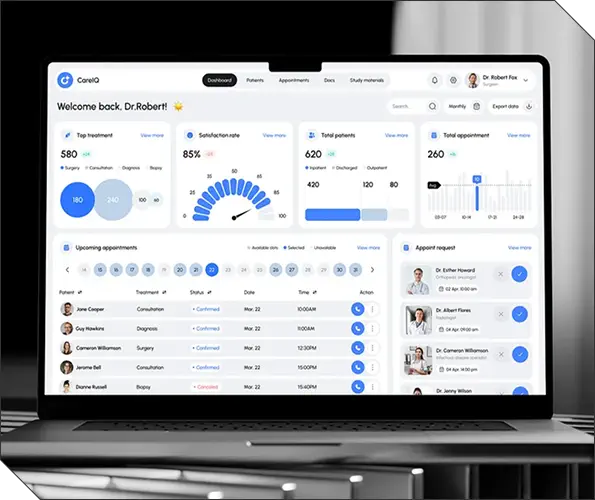
AI healthcare software solutions require a balance of technical expertise, domain understanding, and strict compliance, which is where Alpharive software solutions stand out. The focus is on building scalable, secure, and high-performance systems tailored to real healthcare environments. From initial concept to deployment, every solution is designed to align with clinical workflows, ensuring that technology integrates smoothly without disrupting existing operations.
Beyond development, equal importance is given to compliance, data security, and long-term scalability. Each solution is built with regulatory standards in mind, including HIPAA and GDPR, while also ensuring interoperability with modern and legacy healthcare systems. This approach allows healthcare organizations, startups, and enterprises to adopt AI with confidence, knowing their solutions are reliable, adaptable, and ready for real-world use.