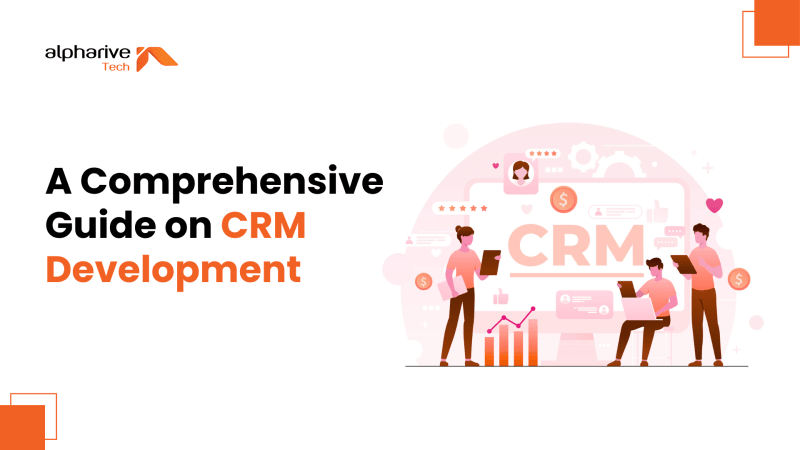
A Comprehensive Step-by-Step Guide on CRM Development
Build a custom CRM system that goes beyond adding contact lists and dashboards, creating a platform that adapts to your business and improves how teams work with customers. The process involves careful planning, the right technology, and also the security features along with scalability. At Alpharive, we not only build CRM platforms tailored to your business goals but also ensure they integrate smoothly with your existing systems, so you get a solution that actually works along with your team to help your business grow.
Define Objectives and Core Features
The first stage in CRM development is setting clear objectives and identifying the core features that align with business goals. A business may need tools for lead tracking, contact management, pipeline visualization, or task automation, but not every feature is relevant for every use case. By focusing only on essential functionality, you avoid complexity and build a CRM that directly supports daily operations. This clarity forms the foundation for the entire development process and ensures the system delivers measurable business impact.
Choose the Right Tech Stack
Choosing the right tech stack is one of the most important decisions in CRM development. It determines how well the system performs, scales, and integrates with future updates. Businesses need to consider languages, frameworks, and databases that align with both current requirements and long-term goals. A strong backend ensures smooth data handling and security, while the frontend technologies should support responsive and intuitive user interactions. Database selection is equally critical since the CRM must process large volumes of data with speed and reliability. The right stack lays the foundation for a system that is stable today and adaptable for tomorrow.
Design CRM Architecture and Database
The strength of a CRM depends heavily on its architecture, which defines how modules, services, and data flows connect within the platform. This stage showcases how different modules, services, and data flows connect within the platform. A well-structured architecture supports modular growth, smooth integration, and efficient handling of real-time processes. Alongside this, database design plays a vital role, since the CRM must store and retrieve customer data without delays or errors. Choosing between relational or NoSQL databases depends on how the system will scale and what type of data it needs to manage. Managing all these helps to build a reliable structure for CRM that keeps performance consistent as user demands grow.
Build the Backend and APIs
The backend is where the real functionality of a CRM takes shape which handles user authentication, data processing, business logic, and secured storage, making it the backbone of the entire system. Along with this, APIs play a critical role by enabling communication between the frontend, database, and any third-party services that need to connect with the platform. Designing scalable and well-documented APIs ensures that the CRM remains flexible for future integrations, whether it's connecting to email, payment systems, or advanced analytics. This stage lays the technical foundation for a reliable, high-performing CRM.
Develop the Frontend Interface
The frontend is where the CRM connects directly with its users, so it must be designed with both clarity and efficiency in mind. This stage focuses on building responsive dashboards, structured workflows, and role-based views that allow teams to quickly access the data they need. Every interaction from creating new leads to checking reports should be smooth and consistent across web and mobile platforms. A well-developed frontend makes sure the system is not only visually clear but also supports the business processes it is built to serve.
Integrate Third-Party Tools and Services
A CRM delivers its full value when it works seamlessly with the tools a business already relies on. This stage involves connecting email services, marketing automation platforms, payment gateways, and analytics tools directly into the CRM environment. Proper integration ensures data moves without any loss reducing manual entry, and gives teams a single source of data. The focus is not just on technical connectivity but on creating a unified system where every department can operate with complete visibility.
Implement Data Security and Compliance
A CRM system manages sensitive customer data, so security cannot be treated as an afterthought. This stage includes encrypting stored and transmitted information, setting role-based access controls, and enforcing multi-factor authentication. Compliance with standards like GDPR or HIPAA is equally important, ensuring the system can legally operate across regions and industries. By embedding these measures directly into the development process, the CRM remains trustworthy and protects both customer relationships and business reputation.
Run Testing and Quality Assurance
After development, the CRM goes through multiple testing cycles to ensure every feature works as expected. Functional testing checks each module, performance testing validates system stability under load, and security testing verifies data protection. User acceptance testing is equally critical, confirming that workflows align with real business use. Each round of QA helps identify and fix issues early, preventing costly failures after launch. A carefully tested CRM gives businesses the confidence to rely on it for daily operations without disruption.
Deployment and Cloud Setup
Once the CRM passes all testing stages, it is deployed on the chosen environment, often a secure and scalable cloud platform. The process involves setting up servers, configuring databases, and ensuring continuous integration pipelines for smooth updates. Load balancing and auto-scaling are configured to handle user growth without performance drops. Proper monitoring tools are also set up to track uptime, performance, and errors in real time. This ensures that the CRM is not only accessible but also reliable from day one of deployment.
Continuous Updates and Maintenance
CRM development does not end with deployment, it requires ongoing updates and maintenance to stay effective. Regular updates help in fixing bugs, improving performance, and introducing new features based on business needs. Security patches are also applied continuously to protect sensitive customer data and ensure compliance with evolving standards. Monitoring usage patterns helps in optimizing system performance and enhancing user experience. This ongoing process ensures the CRM remains reliable, scalable, and aligned with the growth of the business.
Related Article: Cost of CRM Development
Why CRM Matters for a Business?
A CRM system plays a major role in managing customer relationships, streamlining communication, and improving business efficiency. It helps businesses track leads, organize sales pipelines, and maintain detailed customer data in one place. With better visibility into customer interactions, teams can make informed decisions and deliver personalized experiences. It also reduces manual effort by automating routine tasks, which saves time and improves accuracy. For growing businesses, CRM acts as the backbone that supports scalability and ensures that customer engagement remains consistent and effective.
Alpharive - Your CRM Development Partner
Alpharive's crm software solutions are planned for your requirements and fits every unique needs of your business. As a custom CRM development company, Alpharive creates systems that are scalable, secure, and easy to use. From defining requirements to post-launch support, we handle the complete process to ensure your CRM delivers measurable results. If you are ready to build a system that helps you manage customers better and grow faster, connect with our experts and they will bring you the best CRM solution your business needs.