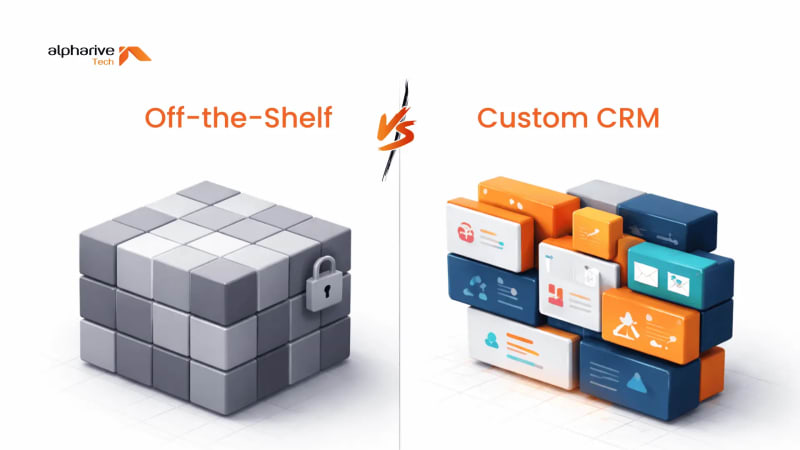
Custom CRM vs Off-the-Shelf CRM
When businesses start looking for a CRM software, they usually face one key decision early, which CRM should they use either an off-the-shelf CRM or invest in a custom-built solution? Both options serve valid purposes, but they are designed for very different business needs.
Off-the-shelf CRMs offer speed and simplicity, while custom CRM systems focus on flexibility, scalability, and long-term alignment. Understanding how these options differ across cost, customization, ownership, and growth potential helps businesses avoid choosing a system they will quickly outgrow.
This guide breaks down the differences between custom CRM and off-the-shelf CRM so decision-makers can choose the right approach with clarity and confidence.
What Is an Off-the-Shelf CRM?
An off-the-shelf CRM is a ready-made software product designed for broad use across industries. These systems are typically offered as subscription-based tools and come with predefined features, workflows, and dashboards.
Businesses use off-the-shelf CRMs to manage contacts, sales pipelines, and customer communication without needing custom development. They are popular among startups and small teams that want fast deployment and minimal setup.
However, many organizations initially rely on spreadsheets or Excel-based systems before transitioning to off-the-shelf CRMs. Over time, limitations in flexibility and scalability become more apparent, especially when compared to structured CRM solutions. This transition phase often mirrors challenges discussed in excel based crm.
What Is a Custom CRM?
A custom CRM is built specifically around a business's workflows, data structure, and operational goals. Instead of adapting processes to software limitations, the CRM adapts to how the business actually functions.
Custom CRMs are owned by the business, allowing full control over features, integrations, data models, and system evolution. They are designed with scalable architecture so functionality can expand as the organization grows.
Unlike off-the-shelf tools, custom CRM systems are not limited by licensing tiers or predefined modules. They are developed to support long-term strategy rather than short-term convenience. A deeper explanation can be found in what is a custom crm blog.
Key Differences Between Custom CRM and Off-the-Shelf CRM
At a high level, the difference between custom and off-the-shelf CRM systems comes down to alignment and control.
- Customization: Custom CRM systems adapt fully to business workflows, while off-the-shelf CRMs offer limited configuration
- Cost structure: Off-the-shelf CRMs use recurring subscription fees; custom CRMs involve upfront development with long-term ownership
- Scalability: Custom CRMs scale without forcing system changes; off-the-shelf tools scale within fixed constraints
- Data ownership: Custom CRM data is fully controlled by the business, not tied to vendor platforms
These differences become increasingly important as operations grow more complex.
Custom CRM vs Off-the-Shelf CRM: Feature Comparison
| Feature | Off-the-Shelf CRM | Custom CRM |
| Flexibility | Limited to predefined workflows | Fully aligned with business processes |
| Integration | Restricted or add-on based | Built to integrate with existing systems |
| Reporting | Standard dashboards | Business-specific insights |
| Security | Vendor-defined controls | Custom access and compliance design |
| Scalability | Tier-based scaling | Architecture-driven scalability |
This comparison highlights how off-the-shelf CRMs prioritize speed, while custom CRMs prioritize long-term fit.
Advantages of Off-the-Shelf CRM
Off-the-shelf CRM systems offer several advantages, particularly for early-stage businesses. Deployment is fast, often requiring little more than account setup and basic configuration. Upfront costs are lower compared to custom development, making these tools accessible to small teams.
Many off-the-shelf CRMs also include built-in features such as email tracking, pipeline management, and basic automation. For businesses with standardized sales processes and limited customization needs, off-the-shelf CRMs can provide sufficient functionality without added complexity.
Limitations of Off-the-Shelf CRM
As businesses grow, the limitations of off-the-shelf CRM systems become more noticeable. Workflows are constrained by predefined logic, forcing teams to adapt processes instead of optimizing them. Integrations may be limited or require additional tools, creating data silos. Reporting often fails to reflect real operational metrics, leading to decisions based on incomplete insights.
Cost creep is another concern. As user counts increase and advanced features are added, subscription fees rise steadily. These challenges often push businesses toward more flexible solutions discussed in why choose a custom crm.
Benefits of a Custom CRM
Custom CRM systems are designed for alignment rather than generalization. They support tailored workflows that reflect how teams actually operate. Performance is optimized because the system includes only what the business needs, not unused features. Long-term scalability is built into the architecture, allowing businesses to expand without switching platforms.
A custom CRM also creates competitive advantage by enabling better customer experiences, deeper insights, and operational efficiency. These benefits align closely with the broader value outlined in benefits of crm software.
Which CRM Is Better for Growing Businesses?
The right CRM choice depends largely on business stage and growth trajectory. Startups often benefit from off-the-shelf CRMs due to low cost and fast setup. Mid-sized companies begin experiencing workflow complexity, integration needs, and reporting gaps that standard tools struggle to handle. Enterprises typically require custom CRM systems to manage scale, governance, and performance. Choosing the right CRM path is easier when guided by frameworks outlined in how to choose the best CRM.
Custom CRM vs Off-the-Shelf CRM by Industry
Different industries place different demands on CRM systems. Healthcare organizations require secure data handling, compliance-ready workflows, and long-term relationship tracking, which often favor custom CRM approaches. Real estate businesses rely on operational CRM capabilities to manage leads, properties, and transactions efficiently.
Finance, forex, and education sectors also benefit from CRM systems tailored to regulatory and workflow-specific needs. Industry-focused solutions such as healthcare crm and real estate crm demonstrate how CRM requirements vary by domain.
When Should You Switch From Off-the-Shelf to Custom CRM?
The right time to switch is when an off-the-shelf CRM begins to slow operations instead of enabling growth. This usually happens as customer data becomes more complex, integrations with internal systems are no longer seamless, and teams rely on manual workarounds to maintain basic workflows. Inaccurate reporting, limited visibility, and rising subscription costs without proportional operational value are also clear signals. At this stage, businesses benefit from evaluating a structured guide to building a CRM to understand how a custom system can better support long-term scalability and efficiency.
Is a Custom CRM Worth the Investment?
A custom CRM is worth the investment when customer data, automation, and workflows are critical to business success. The value comes from improved efficiency, reduced operational friction, and long-term ownership rather than short-term savings. While off-the-shelf CRMs may appear less expensive initially, custom CRM systems often deliver stronger ROI over time by eliminating recurring limitations. Evaluating this decision becomes clearer when paired with a realistic understanding of custom CRM development cost.
Alpharive Builds Custom CRM Solutions That Scale With Your Business
Choosing between custom CRM and off-the-shelf CRM is ultimately about long-term alignment, not just features. Alpharive designs custom CRM solutions that align with real business workflows, support secure and scalable architecture, and integrate seamlessly with existing tools. Instead of forcing businesses into rigid software models, CRM platforms are built to evolve alongside growth. Build a CRM solution that supports today's operations and tomorrow's expansion. Talk to experts and build your solution with us.