Retail businesses today face growing pressure from customer retention challenges, omnichannel selling, and increasing support demands. Customers interact across physical stores, websites, mobile apps, and social platforms and they expect a seamless experience every time.
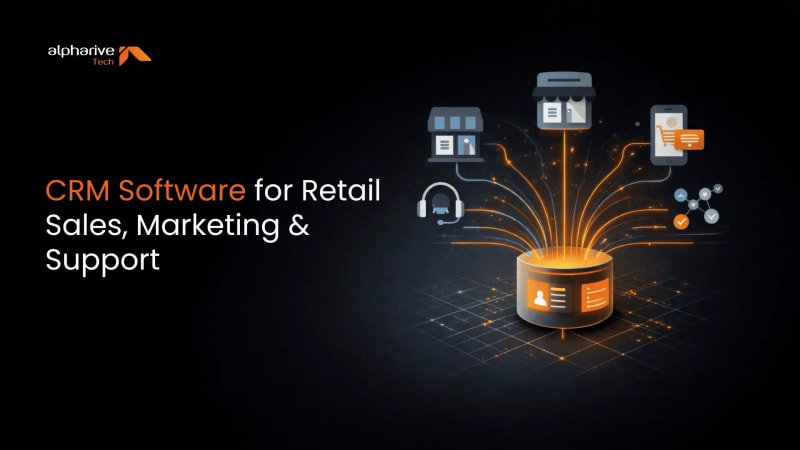
A CRM system brings sales, marketing, and customer support together into one centralized platform. Instead of managing scattered data and disconnected tools, retail teams gain a unified view of customers, purchases, and interactions. This guide focuses specifically on retail CRM use cases, showing how CRM systems support modern retail operations at scale.
What Is a Retail CRM System?
A retail CRM system is a customer relationship management platform designed specifically for retail workflows. It helps businesses manage customer profiles, purchase history, loyalty data, and support interactions within a single system.
Unlike generic CRM software, retail CRM systems account for repeat purchases, seasonal buying behavior, promotions, and multi-channel engagement. They connect customer data across in-store, online, and support channels to deliver consistent experiences. Businesses exploring CRM fundamentals often begin with understanding what a CRM system is.
Why Retail Businesses Need a CRM System
Retail businesses generate large volumes of customer data, but that data often lives in disconnected systems. Sales transactions, marketing campaigns, and support tickets are handled separately, leading to fragmented customer views.
Without a CRM system, retail teams struggle to personalize experiences, track customer lifetime value, or respond quickly to inquiries. Manual sales and support processes further slow operations and increase error rates. A well-designed CRM system helps retail businesses centralize data, streamline workflows, and create consistent customer journeys that support growth.
Related Article: How CRM Helps Business Grow
CRM for Retail Sales Management
Retail CRM systems play a critical role in managing sales activity across channels and touchpoints. They enable teams to track leads and customers from first interaction through repeat purchases. Purchase history and customer preferences are stored centrally, allowing sales teams to identify upselling and cross-selling opportunities based on real behavior.
Sales pipeline visibility improves forecasting and inventory planning. Instead of relying on disconnected POS data and spreadsheets, retailers gain actionable insights that improve efficiency and revenue. These outcomes align closely with the broader benefits of CRM software.
CRM for Retail Marketing Automation
Marketing automation is one of the strongest advantages of CRM systems in retail environments. Retail CRM platforms support customer segmentation based on purchase behavior, location, preferences, and engagement history. This allows marketers to deliver personalized campaigns rather than generic promotions.
Email and SMS automation improve campaign timing and relevance, while loyalty programs track rewards, redemptions, and repeat engagement. When combined with analytics and AI-driven CRM software, it helps retail brands optimize campaigns continuously. Retailers can also use dynamic QR codes to capture in-store engagement and sync it directly with CRM marketing workflows.
CRM for Retail Customer Support
Customer support plays a direct role in retail brand loyalty. CRM systems centralize all customer support interactions, ensuring support teams have full context before responding. Retail CRM systems manage customer tickets across email, chat, phone, and social channels. This omnichannel approach reduces response times and prevents customers from repeating information.
Faster issue resolution improves satisfaction and retention, especially for high-value or repeat customers. Choosing the right CRM structure for support workflows is often guided by frameworks found in how to choose the right CRM.
Key Features of a Retail CRM System
A retail CRM system includes features tailored to the unique demands of retail operations. Customer profiles store contact details, preferences, and interaction history in one place. Order and purchase tracking connects transactional data to customer records. Inventory integration aligns sales activity with stock availability.
Marketing automation supports targeted promotions and loyalty programs. Analytics and reporting provide visibility into sales trends, customer behavior, and campaign performance. Together, these features create a system built for retail complexity rather than generic use cases.
Benefits of Using CRM in Retail Business
Using a CRM system in retail delivers measurable benefits across operations and customer experience. Customer retention improves as personalized engagement replaces one-size-fits-all communication. Sales efficiency increases through better visibility into buying behavior and pipeline activity. Customer experience improves when sales, marketing, and support teams work from the same data. Retail leaders also gain data-driven insights that support smarter decisions around promotions, inventory, and staffing. These outcomes directly support business growth.
Retail CRM Use Cases Across Different Business Models
Retail CRM systems adapt to different retail business models with varying needs. Brick-and-mortar stores use CRM to track in-store purchases, loyalty programs, and customer preferences. E-commerce retailers rely on CRM to manage digital touchpoints, abandoned carts, and repeat purchases.
Omnichannel retail brands use CRM systems to unify online and offline data, ensuring customers receive consistent experiences across channels. Businesses planning these implementations often consult a guide to building a CRM.
Custom CRM vs Ready - Made CRM for Retail
Ready-made retail CRM solutions offer fast setup and standard features, but they often struggle with unique workflows and complex integrations. Custom retail CRM systems are built around specific sales models, POS integrations, and operational requirements. They eliminate unnecessary features while supporting deep customization, scalability, and data ownership. For retailers with growing complexity, custom CRM systems offer greater flexibility and long-term value compared to rigid tools.
Related Blog: Broader comparison on Custom CRM vs Off the shelf CRM
When Should Retail Businesses Consider a Custom CRM?
Retail businesses should consider a custom CRM when off-the-shelf systems start limiting growth. This typically happens when operations scale across locations, channels, or regions. Complex integrations with POS systems, ERPs, and payment platforms also signal the need for customization. Unique retail workflows, promotional models, and loyalty strategies often require deeper flexibility than standard tools can provide.
How a Custom Retail CRM Can Support Business Growth?
A custom retail CRM supports growth by unifying sales, marketing, and support into a single system designed around real retail workflows. Custom dashboards provide real-time visibility into KPIs that matter most to retail leadership. Integrations with POS, ERP, inventory, and payment systems ensure accurate data flow without manual intervention. With scalable architecture, custom retail CRM systems evolve alongside business growth rather than becoming a bottleneck.
Alpharive Builds Custom CRM Systems for Retail Businesses
Retail CRM systems must support sales, marketing, and customer support without adding operational complexity. That requires thoughtful design, scalable architecture, and deep understanding of retail workflows.
Alpharive builds custom CRM solutions for retail businesses that align sales, marketing, and support into a unified platform. Solutions are designed to scale, integrate seamlessly, and support long-term growth across channels. Build a retail CRM system that delivers consistent customer experiences and supports business expansion. Talk to experts and build your solution with us.