
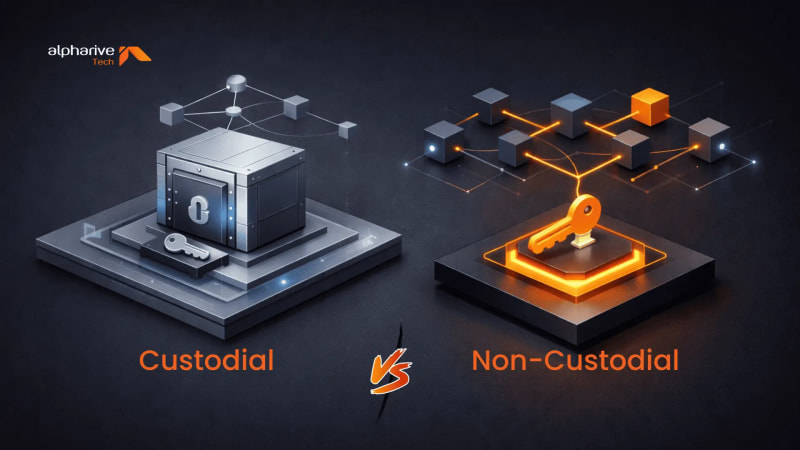
Choosing between a custodial vs non custodial wallet is no longer a basic crypto decision. As digital assets move deeper into enterprise systems, fintech platforms, and regulated financial products, wallet architecture directly impacts security, compliance, and ownership. Whether crypto is held by an exchange, a licensed custodian, or fully controlled by users, the wallet model defines who truly owns the assets and how risks are managed.
When teams evaluate non custodial wallet vs custodial wallet options, the discussion quickly expands beyond convenience. Control over private keys, regulatory obligations, recovery mechanisms, and infrastructure scalability all come into play. For institutions and businesses building crypto-enabled products, wallet choice can shape operational trust and long-term growth.
This guide breaks down both wallet models from a practical and technical perspective. It explains how they work, where each fits best, and how enterprises can make informed decisions without compromising security or compliance.
What Is a Custodial Wallet?
A custodial wallet question often comes up when users first interact with crypto exchanges or hosted platforms. In simple terms, a custodial wallet is a crypto wallet where a third party holds and manages the private keys on behalf of the user. These wallets are commonly offered by exchanges, brokers, and regulated custody providers. From an operational standpoint, custodial wallets simplify access to digital assets. Users log in with standard credentials while the platform handles storage, transaction signing, and security layers. This model aligns well with centralized systems where user experience, liquidity access, and regulatory oversight are priorities.
Understanding how custodial wallets work requires looking at backend custody infrastructure. Assets are usually stored in pooled or segregated wallets, protected by institutional-grade security, internal controls, and monitoring systems. Transactions are executed after internal authorization checks rather than direct key signing by the user. A common concern is custodial wallet safe for long-term storage. Safety largely depends on the custodian's security practices, regulatory status, and internal governance. Licensed custodians typically implement cold storage, audits, and compliance frameworks, making custodial wallets suitable for institutions that value managed risk and recovery options.
What Is a Non-Custodial Wallet?
To answer what is a non custodial wallet, it helps to focus on ownership. In a non-custodial wallet, users fully control their private keys, meaning no third party can access or move funds without explicit authorization. This model reflects the original philosophy of decentralized finance. Non-custodial wallets give users direct control over assets across blockchains. The wallet software only acts as an interface, while private keys remain locally stored or generated through secure key management processes. This approach removes reliance on intermediaries and reduces counterparty risk.
Looking at how non custodial wallets work, transactions are signed directly by the user's wallet using private keys. There is no centralized approval layer, which allows faster execution but also places full responsibility on the wallet owner for security and recovery. When asking is non custodial wallet safe, the answer depends on user practices. Strong security comes from proper key storage, hardware wallets, and secure environments. However, lost keys usually mean irreversible loss, making non-custodial wallets powerful but unforgiving without proper safeguards.
Custodial Wallet vs Non-Custodial Wallet - Core Differences
The custodial wallet vs non custodial wallet comparison becomes clearer when viewed across control, security, and compliance dimensions.
| Aspect | Custodial Wallet | Non-Custodial Wallet |
| Private Key Control | Managed by provider | Owned by user |
| Recovery Options | Platform-assisted | User-managed only |
| Regulatory Alignment | Strong | Limited |
| User Responsibility | Lower | High |
| Institutional Use | Common | Selective |
Real-world custodial vs non custodial wallet examples include exchange-hosted wallets versus self-hosted mobile or hardware wallets. The difference becomes critical for enterprises deciding between managed custody and decentralized ownership.
At a strategic level, this debate mirrors crypto custody vs self custody. Custodial models emphasize protection, compliance, and operational continuity, while non-custodial models prioritize autonomy and decentralization.
Private Key Ownership - Who Controls Your Crypto?
The question of private keys custodial vs non custodial sits at the heart of wallet design. Private keys represent ownership, and whoever controls them controls the assets. In custodial systems, keys are secured and governed by internal policies, while non-custodial wallets shift that responsibility to users.
This difference affects recovery and risk exposure. Custodial wallets can restore access through identity verification and internal controls. Non-custodial wallets eliminate intermediaries but require users to manage backups and recovery phrases independently.
From a technical perspective, enterprises often rely on a structured wallet key management system. This includes key generation, storage, rotation, and access policies. Custodial systems centralize these processes, while non-custodial architectures distribute them across user devices or hardware modules.
Custodial Wallet Security vs Non-Custodial Wallet Security
A crypto wallet security comparison highlights how different risk models apply to each approach.
Custodial Wallet Security
Strong custodial wallet security is built around institutional controls. These include multi-signature authorization, cold storage, transaction monitoring, and internal audits. Providers also implement custodial wallet compliance measures to meet legal and regulatory standards.
For enterprises, regulated crypto custody reduces legal uncertainty. Compliance frameworks such as KYC, AML, and reporting make custodial wallets suitable for financial products, exchanges, and institutional investors.
Non-Custodial Wallet Security
Effective non custodial wallet security relies on cryptography and user discipline. Hardware wallets, secure enclaves, and encrypted backups play a major role. While the absence of intermediaries reduces systemic risk, it increases individual responsibility for safeguarding assets.
Custodial vs Non-Custodial Wallet Architecture
A custodial wallet architecture is typically centralized. Backend systems manage keys, balances, and transaction workflows. Access controls, audit logs, and monitoring tools ensure operational integrity across users and assets.
Non-Custodial Wallet Architecture
A non custodial wallet architecture distributes control across user endpoints. Keys are generated client-side, and transactions interact directly with blockchain networks. This setup relies on robust crypto wallet infrastructure that supports secure signing, network communication, and scalability without centralized custody.
Custodial Wallet Pros and Cons
Understanding custodial wallet pros and cons helps clarify where this model fits best.
Pros
- Simplified user experience
- Asset recovery options
- Regulatory and compliance support
- Institutional-grade security
Cons
- Limited user control
- Dependence on third-party trust
- Potential single points of failure
Non-Custodial Wallet Pros and Cons
Evaluating non custodial wallet pros and cons reveals a different balance.
Pros
- Full ownership and control
- No reliance on intermediaries
- Greater privacy
Cons
- No recovery if keys are lost
- Higher user responsibility
- Limited regulatory alignment
Best Custodial Wallet and Best Non-Custodial Wallet Options
The best custodial wallet options are typically offered by regulated exchanges and licensed custodians that provide insured storage, compliance reporting, and enterprise-grade security frameworks. A best non custodial wallet usually supports multiple blockchains, secure key storage, and seamless user interfaces, often paired with hardware wallet integration for added protection.
Custodial Wallet for Institutions & Enterprises
A custodial wallet for institutions supports large-scale asset management, compliance, and operational efficiency. Enterprises often require role-based access, transaction limits, and audit trails, which are built into modern custody platforms.
For businesses launching crypto products, an enterprise crypto wallet solution enables secure asset handling while meeting regulatory expectations. Many institutional players also rely on specialized institutional crypto custody solutions to manage risk and scalability.
Compliance, Regulation & Enterprise Crypto Custody
Regulated crypto custody plays a critical role in enterprise adoption because businesses cannot afford uncertainty around asset ownership, compliance obligations, or operational accountability. Custodial platforms built for regulated environments rely on structured governance models, detailed reporting frameworks, and continuous oversight to align with financial regulations across jurisdictions. This level of control allows enterprises to operate within clear legal boundaries while maintaining transparency across internal teams and external authorities.
Strong custodial wallet compliance extends far beyond basic KYC and AML requirements. It includes audit trails, role-based access controls, transaction approval workflows, and ongoing risk monitoring that meet the expectations of regulators, auditors, and institutional stakeholders. For organizations managing customer funds, institutional capital, or tokenized assets, compliant custody infrastructure reduces legal exposure while strengthening trust across partners and users, enabling crypto operations to scale without sacrificing control or visibility.
Which Wallet Should You Choose - Custodial or Non-Custodial?
Deciding between custodial vs non custodial wallet depends heavily on how crypto is being used, who manages the assets, and what level of risk an organization is prepared to own. Retail users and early adopters often lean toward custodial wallets because of their ease of access, familiar login experiences, and built-in recovery options. Active traders also prefer custodial environments since direct exchange integration, liquidity access, and faster trade execution take priority over private key control.
Institutions and regulated businesses approach this decision differently, placing greater emphasis on compliance, auditability, governance controls, and operational resilience. For enterprises building crypto products or managing customer funds at scale, the wallet model must align with internal security policies, regulatory requirements, and long-term infrastructure planning. In most real-world cases, the choice is not ideological but practical, shaped by business objectives, risk tolerance, and the need to balance control with accountability.
How Alpharive Supports Secure Crypto Wallet Infrastructure
As a crypto wallet development company, Alpharive approaches wallet development from an infrastructure-first mindset. Our Team designs and implements secure, scalable systems tailored to product goals, compliance needs, and user experience. Whether building an enterprise crypto wallet solution or integrating advanced crypto wallet infrastructure, the focus remains on long-term security, flexibility, and growth. From architecture planning to compliance-ready deployment, Alpharive helps businesses move confidently through complex crypto custody decisions. Talk to experts and build your solution with us.