
A CRM system is software designed to manage customer relationships, sales activities, communication, and data across an organization. While most people think of CRM as a single tool, there are actually four distinct types of CRM systems, each serving a different business purpose.
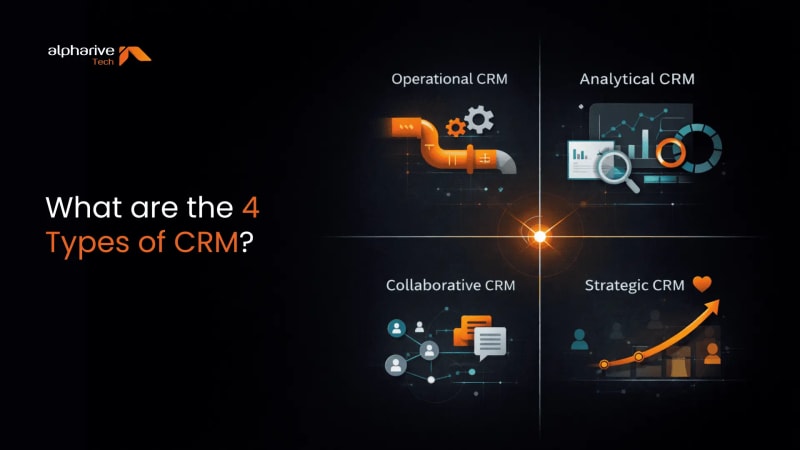
The four types of CRM systems are Operational CRM, Analytical CRM, Collaborative CRM, and Strategic CRM. Understanding these CRM types helps businesses select or build a system that aligns with their goals, team structure, and growth stage instead of adopting software that creates long-term limitations.
What Is a CRM System?
A CRM system is a centralized platform that helps businesses store customer data, manage interactions, automate processes, and gain visibility into sales and engagement activities. It acts as a single source of truth for customer relationships across sales, marketing, and support teams.
Modern CRM systems go beyond contact management. They support automation, analytics, integrations, and customer experience optimization. Businesses evaluating CRM capabilities often start by understanding what a custom CRM is.
4 Types of CRM Systems Explained
CRM systems are generally classified based on how they support business operations and decision-making.
- Operational CRM - focuses on automating sales, marketing, and customer support
- Analytical CRM - focuses on data analysis, reporting, and insights
- Collaborative CRM - focuses on communication and information sharing across teams
- Strategic CRM - focuses on long-term customer relationships and lifetime value
Each type serves a distinct role, and many businesses benefit from using more than one CRM type together.
Operational CRM
Operational CRM focuses on automating day-to-day customer-facing activities. It is the most commonly adopted CRM type, especially for sales-driven organizations.
This CRM type manages lead capture, sales pipelines, customer onboarding, and support workflows. It reduces manual effort by automating repetitive tasks such as follow-ups, status updates, and task assignments.
Operational CRM systems help teams stay organized, improve response times, and ensure no opportunity is lost due to process gaps. Businesses often explore this model when evaluating the benefits of CRM software.
Analytical CRM
Analytical CRM focuses on transforming customer data into actionable insights. Instead of managing interactions, it analyzes them to support better decision-making.
This CRM type tracks customer behavior, purchase patterns, engagement history, and conversion trends. Advanced reporting and forecasting help businesses identify high-value customers, predict demand, and refine strategies.
Analytical CRM is especially valuable for organizations that rely heavily on data-driven decisions. With the integration of AI and predictive models, analytical CRM capabilities often overlap with modern AI CRM solutions.
Collaborative CRM
Collaborative CRM focuses on improving communication and coordination across teams that interact with customers. It ensures customer information is shared consistently rather than siloed within departments.
This CRM type enables sales, marketing, and support teams to auto post, access the same customer data, interaction history, and communication records. It supports multi-channel communication and ensures customers receive consistent responses regardless of touchpoint.
Collaborative CRM is particularly useful in industries where multiple teams manage the same customer relationship, such as insurance, travel, or education-focused businesses.
Strategic CRM
Strategic CRM focuses on building long-term customer relationships rather than managing short-term transactions. It emphasizes customer retention, personalization, and lifetime value optimization.
This CRM type uses insights from operational and analytical systems to shape customer engagement strategies. It helps businesses understand which customers deliver the most value and how to nurture those relationships over time.
Strategic CRM is often adopted by organizations that view customer relationships as a long-term asset rather than a sales funnel. Businesses exploring this approach often seek guidance on how to choose the best CRM.
Comparison of the 4 Types of CRM Systems
| CRM Type | Primary Goal | Best For | Example Use Case |
| Operational CRM | Process automation | Sales and support teams | Managing pipelines and customer tickets |
| Analytical CRM | Data insights | Data-driven organizations | Data-driven organizations |
| Collaborative CRM | Team alignment | Multi-department teams | Unified customer communication |
| Strategic CRM | Long-term value | Growth-focused businesses | Customer retention and personalization |
This comparison highlights how each CRM type addresses a different business priority rather than replacing one another.
CRM Types Based on Business Size
The best CRM type often depends on company size and operational complexity. Small businesses typically benefit from Operational CRM, which helps automate sales and support without adding unnecessary complexity. Mid-sized organizations often combine Analytical and Collaborative CRM to gain insights while improving team coordination.
Enterprises usually require Strategic CRM combined with custom CRM capabilities. At this level, standard tools often fail to support scale, data volume, and governance needs. Businesses evaluating this transition often revisit how to choose the best CRM.
How CRM Types Apply Across Industries
Different industries rely on different CRM types based on how they interact with customers. Healthcare organizations benefit from Analytical and Strategic CRM to manage patient data, compliance, and long-term engagement. Real estate businesses rely heavily on Operational CRM to track leads, properties, and deal pipelines efficiently. Industry-specific requirements often push businesses toward tailored CRM systems rather than generic tools. Relevant examples include healthcare CRM, real-estate CRM and more
Which Type of CRM Is Best for Your Business?
Choosing the right CRM type depends on business goals, team size, data complexity, and growth stage. Businesses focused on execution and efficiency may prioritize operational CRM. Those driven by insights and forecasting lean toward analytical CRM. Organizations with multiple customer-facing teams benefit from collaborative CRM, while growth-focused companies often require strategic CRM capabilities. Many businesses discover that no single CRM type fully meets their needs. This realization often leads them to explore a structured guide to building a CRM.
Can a Custom CRM Combine All 4 Types?
Yes, a custom CRM can combine all four CRM types within a single system. Through modular architecture, businesses can integrate operational automation, analytical insights, collaborative workflows, and strategic engagement features into one unified platform. Custom workflows ensure each team uses only what they need, while unified dashboards provide complete visibility. This approach eliminates the need to manage multiple disconnected tools and ensures CRM capabilities evolve with business growth.
Alpharive Brings the Custom CRM Solution
Businesses rarely fit neatly into a single CRM category. That's why modern CRM systems must combine operational efficiency, analytical intelligence, collaborative workflows, and strategic growth features.
Alpharive provides CRM software development services to build custom CRM solutions that unify all four CRM types into a scalable, flexible system. With thoughtful architecture and business-aligned workflows, CRM platforms are built to support real operations today while remaining adaptable for tomorrow. Build a CRM system that grows with your business, talk to experts and build your solution with us.