
By the end of 2026, nearly 40% of enterprise applications are expected to include task-specific AI agents, yet most teams still start with a single-agent setup and quickly run into limitations. As systems grow more complex, relying on one agent to handle everything often leads to performance issues, lack of scalability, and poor decision outcomes.
This is where multi-agent AI system architecture becomes essential. Instead of forcing one model to do it all, businesses are now designing agentic AI system architecture with multiple specialized agents working together under a shared system. In this guide, we’ll break down how AI agent system architecture works, when it actually makes sense to adopt it, and how to structure it for real-world production without unnecessary complexity.
H2: What Is Multi-Agent AI System Architecture?
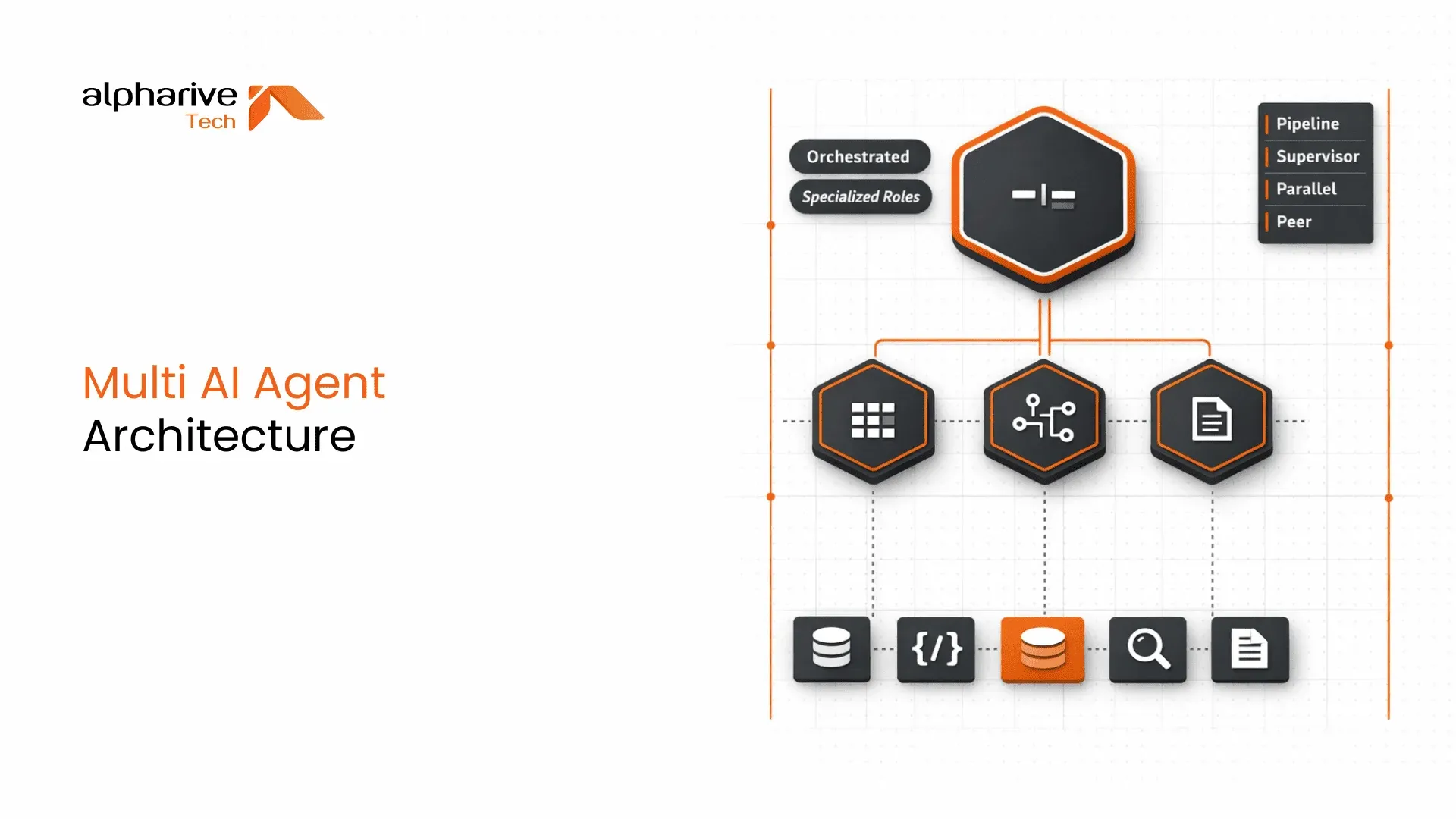
Multi-agent AI system architecture refers to a system design where multiple intelligent agents work together to solve tasks instead of relying on a single model. Each agent is built with a specific role, capability, or domain expertise, allowing the overall system to handle more complex workflows with better accuracy and flexibility. Rather than overloading one agent with every responsibility, this approach distributes tasks across specialized components that collaborate in a structured way.
In practice, this architecture forms the foundation of modern agentic AI system architecture, especially in enterprise environments where workflows are layered and dynamic. It combines coordination, communication, and shared context to ensure that each agent contributes effectively without stepping outside its defined scope. This shift from monolithic AI systems to distributed intelligence is what makes multi-agent setups more adaptable to real-world applications.
H3: How it differs from a single-agent system
A single-agent system operates as one unified model handling all inputs, decisions, and outputs, which works well for simple or linear tasks. However, as complexity increases, it struggles with context limits, task switching, and maintaining accuracy across different domains. Multi-agent systems, on the other hand, break down responsibilities, allowing each agent to focus on a specific task, resulting in better performance and scalability.
This separation also improves system reliability, since individual agents can be optimized, updated, or replaced without affecting the entire architecture. Instead of one point of failure, the system becomes modular and resilient, making it easier to manage in production environments where consistency and control matter.
H3: The core analogy: agents as an expert team
A useful way to understand multi-agent AI system architecture is to think of it as an expert team working toward a shared goal. Each member brings a unique skill set, and a coordinator ensures that tasks are assigned correctly and completed in the right sequence. This mirrors how multi-agent systems operate, with specialized agents collaborating under an orchestrated structure.
By treating agents as team members rather than isolated tools, it becomes easier to design systems that reflect real business workflows. Tasks flow naturally between agents, decisions are distributed, and outcomes improve because each part of the system is focused on what it does best.
H2: When Do You Actually Need Multi-Agent Architecture?
Multi-agent architecture becomes necessary when a system outgrows the capabilities of a single model and starts facing limitations in handling complexity. As workflows expand across multiple steps, domains, or decision layers, relying on one agent often leads to slower performance, reduced accuracy, and difficulty in managing context. This is where multi-agent AI system architecture allows tasks to be distributed intelligently across specialized agents.
At the same time, adopting agentic AI system architecture is not about adding more agents for the sake of it. It’s about recognizing when coordination, specialization, and scalability are required to achieve better outcomes. The shift usually happens when systems need to operate more like structured workflows rather than simple input-output models.
H3: The 4 signals that a single agent has hit its limit
One clear signal is when tasks require handling multiple domains at once, such as combining data analysis, content generation, and decision-making in a single flow. Another sign appears when context windows become a bottleneck, making it difficult for a single agent to retain and process all necessary information effectively. As complexity increases, performance tends to drop, especially in long or multi-step workflows.
In addition, systems that require parallel execution or continuous iteration often struggle with a single-agent setup. When tasks need to run simultaneously or depend on intermediate outputs, a single agent becomes inefficient and harder to manage. These signals indicate that distributing responsibilities across multiple agents can significantly improve both speed and reliability.
H3: When multi-agent is the wrong choice
Despite its advantages, multi-agent architecture is not always the right solution, especially for simple or well-defined tasks. For straightforward workflows with clear inputs and outputs, introducing multiple agents can add unnecessary complexity, increase costs, and make debugging more difficult. In such cases, a single well-designed agent often delivers better results with less overhead.
Another common mistake is adopting multi-agent systems without a clear orchestration strategy. Without proper coordination, agents can overlap in responsibilities, create conflicting outputs, or increase system latency. This is why many implementations fail not because the concept is flawed, but because it is applied without a clear need or structure.
H2: The Core Components of an Agentic AI System Architecture
Agentic AI system architecture is built on a set of core components that work together to coordinate, execute, and manage intelligent tasks across multiple agents. Instead of functioning as isolated units, these components create a structured environment where agents can collaborate efficiently while maintaining clear boundaries. This layered design is what allows multi-agent systems to scale without losing control or consistency.
At its core, the architecture combines orchestration, specialization, shared context, and communication protocols to ensure smooth interaction between agents. Each component plays a distinct role, and when designed correctly, they form a system that behaves more like a coordinated workflow than a collection of independent models. Understanding these building blocks is key to designing systems that perform reliably in production.
H3: The orchestrator: your control plane
The orchestrator acts as the central control layer that manages how agents interact, assigns tasks, and ensures the workflow progresses in the right direction. It does not perform the tasks itself but coordinates which agent should act, when, and with what context. This helps maintain order in systems where multiple agents are operating simultaneously.
In complex environments, the orchestrator also handles decision logic, error handling, and fallback mechanisms. By keeping control centralized, it prevents agents from overlapping responsibilities or creating conflicting outputs, which is critical for maintaining system stability as complexity increases.
H3: Specialized agents: roles, tools, and boundaries
Specialized agents are designed to handle specific tasks or domains, such as data retrieval, analysis, or content generation. Each agent is equipped with its own tools, instructions, and scope, allowing it to perform efficiently without being overloaded with unrelated responsibilities. This separation improves both accuracy and performance.
Defining clear boundaries for each agent is equally important, as it ensures that tasks are handled by the most suitable component. When roles are well-defined, agents can operate independently while still contributing to a larger workflow, making the system more modular and easier to maintain.
H3: Shared memory and state management
Shared memory allows agents to access and update a common context, ensuring continuity across tasks and interactions. Without this, each agent would operate in isolation, leading to fragmented outputs and inconsistent results. A well-managed shared state keeps the system aligned and informed at every step.
State management also plays a crucial role in tracking progress, storing intermediate results, and maintaining context over long workflows. This becomes especially important in enterprise applications where processes are not linear and require coordination over multiple stages.
H3: Communication protocols: MCP, A2A, and ACP explained
Communication protocols define how agents exchange information, invoke tools, and coordinate actions within the system. Standards like Model Context Protocol (MCP), agent-to-agent (A2A), and agent communication protocols (ACP) are emerging to simplify and standardize these interactions. They reduce the need for custom integrations and make systems more interoperable.
By using structured communication methods, multi-agent systems become easier to scale and integrate with external tools or platforms. This not only improves efficiency but also ensures that agents can collaborate seamlessly, even in complex and distributed environments.
H2: 4 Multi-Agent Architecture Patterns and When to Use Each
Multi-agent architecture patterns define how agents are structured, coordinated, and executed within a system. Choosing the right pattern is critical because it directly impacts performance, scalability, and how efficiently tasks are completed. Different use cases require different interaction styles, and applying the wrong pattern can lead to unnecessary complexity or poor outcomes.
In a well-designed multi-agent AI system architecture, these patterns act as blueprints that guide how agents collaborate. Instead of building systems randomly, teams rely on proven structures that align with their workflow needs, whether it's sequential processing, dynamic coordination, or parallel execution across tasks.
H3: Pipeline: Best for document workflows
The pipeline pattern follows a step-by-step flow where each agent processes the output of the previous one in a fixed sequence. This works well for structured workflows like document processing, where tasks such as extraction, validation, and summarization happen in order. Each agent focuses on a single stage, ensuring clarity and consistency.
Because of its linear nature, this pattern is easier to design and debug compared to more dynamic systems. However, it can become slower when handling large-scale operations since tasks must wait for previous steps to complete before moving forward.
H3: Supervisor + workers: Best for dynamic, complex tasks
In this pattern, a central supervisor agent manages multiple worker agents, assigning tasks based on the workflow’s needs. The supervisor decides which agent should act next, making it ideal for scenarios where tasks are unpredictable or require adaptive decision-making. This structure brings flexibility to complex systems.
It also allows the system to adjust in real time, reallocating tasks or introducing new agents as needed. While powerful, this pattern requires strong orchestration logic to prevent inefficiencies or miscommunication between agents.
H3: Parallel execution: Best for independent sub-tasks
Parallel execution enables multiple agents to work simultaneously on separate tasks, significantly improving speed and efficiency. This pattern is useful when tasks are independent and do not rely on each other’s outputs, such as running multiple analyses or processing large datasets.
By distributing workloads across agents, systems can achieve faster results without increasing individual agent complexity. However, it requires careful coordination when combining outputs to ensure consistency and accuracy in the final result.
H3: Peer collaboration: Best for high-stakes decisions
The peer collaboration pattern involves multiple agents working together as equals, often reviewing, challenging, or refining each other’s outputs. This approach is especially useful for decision-making scenarios where accuracy and reliability are critical, such as financial analysis or strategic planning.
Through structured debate or validation, the system can produce more refined and balanced outcomes. While this improves quality, it can increase computation time and requires well-defined rules to manage disagreements and reach final conclusions.
H2: Choosing a Framework: LangGraph, CrewAI, AutoGen, and Google ADK
Choosing a framework for multi-agent AI system architecture plays a major role in how efficiently your system is built, managed, and scaled. Each framework comes with its own strengths, depending on whether you need structured workflows, flexible collaboration, or conversational agent interactions. The right choice depends less on popularity and more on how well it fits your specific use case.
At the same time, agentic AI system architecture continues to evolve, and frameworks are becoming more specialized. Some focus on orchestration and control, while others prioritize ease of development or rapid prototyping. Understanding these differences helps teams avoid costly rework and ensures a smoother path from experimentation to production.
H3: Framework comparison
When comparing frameworks, it’s important to look beyond basic features and evaluate them across dimensions like orchestration control, scalability, flexibility, ease of use, integration capabilities, and production readiness. For example, LangGraph is known for its strong control over deterministic workflows, making it suitable for structured pipelines.
On the other hand, CrewAI focuses on role-based agent collaboration, which works well for dynamic task execution. AutoGen is often preferred for conversational and research-oriented systems, while Google ADK provides strong integration within its ecosystem. Each framework serves a different purpose, and selecting the right one depends on how your agents need to interact and operate.
Framework | Orchestration Control | Flexibility | Scalability | Best For |
|---|---|---|---|---|
LangGraph | High (deterministic workflows) | Medium | High | Structured pipelines and production-grade systems |
CrewAI | Medium (role-based coordination) | High | Medium | Role-driven multi-agent collaboration |
AutoGen | Medium (conversational flows) | High | Medium | Research, chat-based agent systems |
Google ADK | High (ecosystem-driven) | Medium | High | Enterprise apps within Google ecosystem |
H3: The build vs. buy decision for enterprise teams
For enterprise teams, the decision often comes down to whether to build a custom framework or adopt an existing one. Building offers complete control and flexibility, allowing systems to be tailored to specific business needs and compliance requirements. However, it also requires more time, resources, and long-term maintenance.
Using existing frameworks can significantly speed up development and reduce initial complexity, especially for teams new to multi-agent systems. That said, they may come with limitations in customization or scalability. Many organizations choose a hybrid approach, starting with a framework and gradually extending it to meet their unique requirements.
H2: Why 95% of Multi-Agent Systems Fail in Production
Multi-agent AI system architecture often looks promising in controlled environments, but most systems fail when moved into production due to poor design decisions. While building multiple agents may seem like a step toward scalability, the real challenge lies in coordination, control, and maintaining consistency across workflows. Without a strong architectural foundation, systems quickly become unpredictable and difficult to manage.
In many cases, teams focus heavily on model performance but overlook system-level concerns such as governance, monitoring, and structured communication. This gap between experimentation and production is where failures occur, making it essential to design agentic AI system architecture with real-world constraints in mind from the very beginning.
H3: The prompting fallacy: you can't prompt your way out of bad architecture
One of the most common mistakes is relying on better prompts to fix system level issues. While prompt engineering can improve outputs at a micro level, it cannot solve problems related to coordination, task distribution, or workflow design. When architecture is weak, no amount of prompting can compensate for it.
This leads to systems that appear functional in testing but break down under real-world conditions. Instead of refining prompts endlessly, teams need to focus on defining clear agent roles, structured workflows, and reliable orchestration to ensure consistent performance.
H3: Governance, compliance, and bounded autonomy
As multi-agent systems grow, controlling how agents behave becomes increasingly important. Without proper governance, agents may operate beyond their intended scope, leading to incorrect outputs or even compliance risks. This is especially critical in enterprise environments where regulations and data handling standards must be followed.
Bounded autonomy ensures that each agent operates within defined limits, reducing the risk of unintended actions. By setting clear rules, access controls, and validation layers, organizations can maintain trust and reliability while still benefiting from automation.
H3: Observability: how to monitor agents in production
Observability is essential for understanding how agents behave once deployed. Without proper monitoring, it becomes difficult to trace errors, measure performance, or identify bottlenecks within the system. This lack of visibility is a major reason why many multi-agent systems fail after deployment.
By implementing logging, tracking, and performance metrics across agents, teams can gain insights into how workflows are executed in real time. This makes it easier to debug issues, optimize performance, and ensure that the system continues to operate reliably as it scales.
H2: Real-World Multi-Agent AI Use Cases by Industry
Multi-agent AI system architecture is already being applied across industries where workflows are complex, multi-layered, and require coordination between different tasks. Instead of relying on a single system to manage everything, businesses are using specialized agents to handle different parts of their operations, improving both efficiency and accuracy. This shift is especially visible in industries that deal with large volumes of data and dynamic decision-making.
As agentic AI system architecture matures, its real value becomes clear in practical applications rather than theoretical setups. From customer interactions to backend automation, multi-agent systems are helping organizations move faster while maintaining better control over processes that were previously difficult to scale.
H3: Customer service automation
In customer service, multi-agent systems are used to manage different stages of user interaction, from query understanding to resolution and follow-up. One agent may handle intent detection, another retrieves relevant information, while a third generates responses based on company guidelines. This layered approach improves response accuracy and reduces resolution time.
It also allows businesses to handle high volumes of requests without compromising quality. By distributing responsibilities, systems can manage multiple conversations simultaneously while ensuring each interaction remains context-aware and consistent.
H3: Software development pipelines
Multi-agent systems are increasingly being integrated into software development workflows to automate tasks such as code generation, testing, and debugging. Different agents can handle specific stages, allowing development teams to accelerate delivery without sacrificing quality. This creates a more streamlined and efficient pipeline.
At the same time, these systems can continuously improve by learning from previous outputs and errors. By breaking down development tasks into smaller, manageable components, organizations can maintain better control over the entire lifecycle while reducing manual effort.
H3: Enterprise document processing
Handling large volumes of documents is another area where multi-agent architecture proves highly effective. Agents can be assigned to tasks like data extraction, validation, classification, and summarization, working together to process documents quickly and accurately. This is particularly useful in industries like finance, healthcare, and legal services.
With this approach, businesses can reduce processing time and minimize human intervention while maintaining accuracy. Each agent focuses on a specific task, ensuring that the overall workflow remains structured and efficient even at scale.
H3: Supply chain and market research
In supply chain and market research, multi-agent systems help analyze data from multiple sources, identify patterns, and support decision-making. One agent may gather data, another processes it, while others generate insights or forecasts. This collaborative approach enables faster and more informed decisions.
These systems are especially valuable in environments where conditions change rapidly and require continuous monitoring. By distributing tasks across agents, organizations can respond more quickly to market shifts and operational challenges without overloading a single system.
H2: How Alpharive Designs Multi-Agent Systems for Enterprise
Alpharive, a leading AI Agent development company designs multi-agent AI system architecture with a strong focus on real-world performance, scalability, and control. Instead of building experimental setups, the approach centers on creating production-ready systems where orchestration, agent roles, and communication flows are clearly defined from the start. This ensures that every component works together smoothly, even as system complexity grows over time.
At the same time, the process goes beyond just selecting frameworks or models. It involves understanding business workflows, mapping them into structured agent interactions, and implementing governance layers that keep the system reliable and compliant. From architecture design to deployment and optimization, each stage is handled with a focus on long-term stability and measurable outcomes, helping businesses move from ideas to fully operational multi-agent systems.