
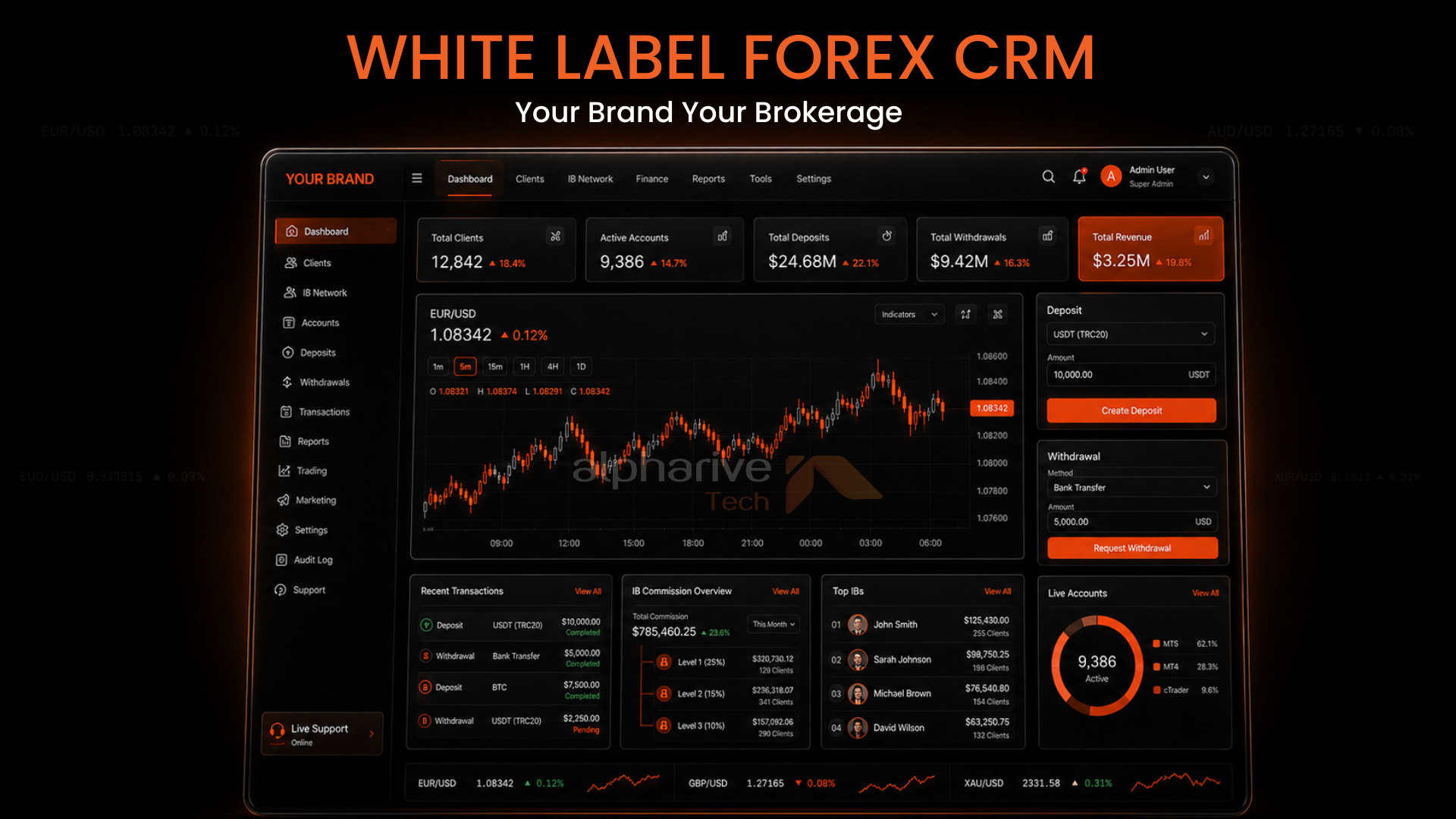
Launching a forex brokerage is easier than managing one.
As client numbers grow, daily operations become harder to control. Onboarding slows down, support requests increase, payments need monitoring, and managing multiple systems starts creating delays and operational inefficiencies.
Building a custom platform can solve some of these challenges, but it also requires more time, cost, and ongoing maintenance.
That’s where White Label Forex CRM comes in.
A White Label Forex CRM gives brokerages a ready to launch system that brings client management, automation, MT4/MT5 connectivity, reporting, and back office operations into one platform while keeping your own branding.
In this guide, you’ll learn what White Label Forex CRM is, how it works, the features that matter most, and how to choose the right solution for long term growth.
What Is a White Label Forex CRM?
White Label Forex CRM is a ready made brokerage management platform that allows businesses to operate under their own brand while using prebuilt infrastructure.
Instead of developing software internally, brokerages customize an existing platform with their own:
- Brand identity
- Domain
- User experience
- Workflow settings
- Payment methods
- Trading integrations
This allows businesses to reduce launch time while still maintaining a professional client experience.
Think of it as launching a branded brokerage ecosystem without building every component yourself.
How White Label Forex CRM Works for Modern Forex Brokerages
A White Label Forex CRM acts as the operational layer between your clients and your trading environment.
Here is a simplified workflow:
→ Visitor Registration
→ Identity Verification
→ Trading Account Creation
→ Deposit Processing
→ Trading Platform Connection
→ Client Dashboard Access
→ Reporting and Support
Once configured, most operational tasks become automated.
Your team spends less time managing administration and more time focusing on acquisition, retention, and growth.
Core Features to Look for in a White Label Forex CRM
Not every CRM is built equally. These are the capabilities worth evaluating before selecting a provider.
MT4 / MT5 Integration
Trading platform integration is one of the most important requirements.
A connected CRM allows brokers to synchronize:
- Trading accounts
- Balances
- Transaction history
- Account activity
This reduces manual work and improves operational accuracy.
Trader Dashboard
Clients expect transparency.
A modern dashboard should allow users to:
- View account information
- Track transactions
- Access documents
- Monitor activity
A better client experience often supports stronger retention.
KYC and Compliance Automation
Manual verification slows onboarding.
Automated compliance workflows help:
- Collect documents
- Verify information
- Track approvals
- Reduce processing delays
This helps teams stay organized while maintaining operational standards.
IB and Affiliate Management
Referral and introducing broker networks remain important growth channels.
Look for systems that support:
- Commission tracking
- Multi level structures
- Automated payouts
- Performance reports
Payment Gateway Integration
Deposits and withdrawals should feel simple.
A good CRM supports:
- Multiple payment methods
- Faster reconciliation
- Transaction tracking
- Financial visibility
Lead and Client Management
Brokerages need visibility across the entire client lifecycle.
The CRM should support:
- Lead assignment
- Client segmentation
- Automated follow ups
- Retention workflows
Multi Currency Support
Operating across international markets requires flexibility.
Multi currency support helps brokers manage regional operations more efficiently.
Real Time Reporting and Analytics
Better decisions come from better visibility.
Track:
- Acquisition performance
- Trading activity
- Conversion metrics
- Client engagement
- Operational efficiency
White Label Forex CRM vs Custom CRM
Feature | White Label Forex CRM | Custom CRM |
|---|---|---|
Setup Time | Fast | Long |
Initial Investment | Lower | Higher |
Maintenance | Managed | Internal |
Launch Speed | Faster | Slower |
Scalability | Flexible | Depends |
Technical Risk | Lower | Higher |
Custom development can make sense for highly specialized requirements.
For most brokerages, White Label CRM provides a faster path to market.
Benefits of White Label Forex CRM for Brokers
A White Label Forex CRM helps brokerages improve operational efficiency and build a stronger foundation for growth. Here are some of the key benefits it offers.
Faster Launch
A White Label Forex CRM reduces the time required to launch brokerage operations by providing ready to use infrastructure. Instead of spending months building internal systems, brokers can focus on onboarding clients and growing the business faster.
Lower Operational Costs
Building and maintaining custom software requires continuous investment. A White Label Forex CRM helps reduce development and maintenance costs while providing access to essential brokerage tools.
Better Client Experience
Managing onboarding, communication, and account access through one system creates a smoother experience for clients. Faster processes and easier access can help improve engagement and retention.
Workflow Automation
Daily operational activities can become time consuming as brokerages grow. Automation helps reduce manual tasks and allows teams to focus on higher value business activities.
Easier Scaling
As client numbers and business operations increase, a White Label Forex CRM supports expansion without requiring major system changes or additional operational complexity.
How to Launch Your Brokerage Using White Label CRM
Launching a brokerage with a White Label Forex CRM allows you to reduce setup time and move into operations faster. Following the right process helps ensure your platform is ready to support clients, daily operations, and future growth.
Step 1: Choose a Brokerage Focused CRM Provider
Start by selecting a Forex CRM provider that understands forex brokerage requirements. Look for features such as MT4/MT5 integration, client management, reporting, payment support, and automation capabilities that match your business goals.
Step 2: Configure Branding
Customize the platform with your company logo, domain, colors, and user experience settings. A branded environment creates a more professional and consistent experience for your clients.
Step 3: Connect Trading Infrastructure
Integrate your trading environment with MT4 or MT5 to enable account creation, balance tracking, and operational management from a single platform. Trading infrastructure plays an important role in brokerage performance, having a reliable MT5 account integration setup can help create smoother operations and improve overall efficiency.
Step 4: Set Up Payment Workflows
Configure payment methods and withdrawal processes to support smooth financial operations. Make sure reporting and transaction tracking are properly connected.
Step 5: Implement Compliance Processes
Set up KYC and verification workflows to simplify onboarding and support operational requirements. Automating these processes can help reduce manual effort.
Step 6: Test Operations
Before launch, review the full client journey including registration, payments, trading access, and support workflows to identify issues early.
Step 7: Go Live and Optimize
Once everything is ready, launch your brokerage and continue monitoring performance. Use operational insights and client feedback to improve processes over time.
Common Mistakes to Avoid
Many brokerages choose the wrong CRM because they focus only on short term pricing.
Avoid these mistakes:
- Choosing based only on cost
- Ignoring platform integrations
- Overlooking reporting capabilities
- Underestimating scalability
- Skipping workflow testing
- Selecting tools without automation support
How to Choose the Right Forex CRM Provider
Before making a decision, evaluate:
- MT4 and MT5 compatibility
- Security standards
- API flexibility
- Reporting capabilities
- Payment integrations
- Support availability
- Product roadmap
- Long term scalability
The right CRM should support your growth, not limit it.
Final Thought
Choosing the right technology foundation can make a major difference in how efficiently a forex brokerage operates and grows. Instead of managing multiple systems and complex workflows, a White Label Forex CRM helps simplify operations and create a better experience for both teams and clients.
As a Forex CRM provider, Alpharive delivers solutions designed to support brokerage operations with automation, MT4/MT5 connectivity, client management, and scalable infrastructure. With the right platform in place, brokerages can launch faster and focus more on long term growth.
Ready to Launch Your Brokerage Faster?
Managing onboarding, payments, reporting, and trading operations through separate systems can slow growth. Alpharive White Label Forex CRM helps bring everything into one platform so your team can operate more efficiently and focus on scaling.
Get a demo to explore how the platform supports brokerage operations.
Frequently Asked Questions
1. Who Should Use White Label Forex CRM?
White Label Forex CRM is best suited for forex brokerages that want to launch faster, automate operations, manage client relationships, and scale efficiently without developing software from scratch.
2. Does Forex CRM support MT5 integration?
Many brokerage CRM platforms support MT5 integration for account synchronization, trading visibility, and operational management.
3. How much does White Label Forex CRM cost?
Pricing depends on customization, integrations, number of users, and infrastructure requirements.
4. Can small brokerages use Forex CRM?
Yes. Many solutions support startups as well as growing brokerages.
5. What compliance tools should a Forex CRM include?
Look for KYC workflows, document management, access controls, reporting tools, and operational tracking.
6. What is included in a White Label Forex CRM?
Most platforms include onboarding tools, client management, trading integration, reporting, payment support, and back office administration.