
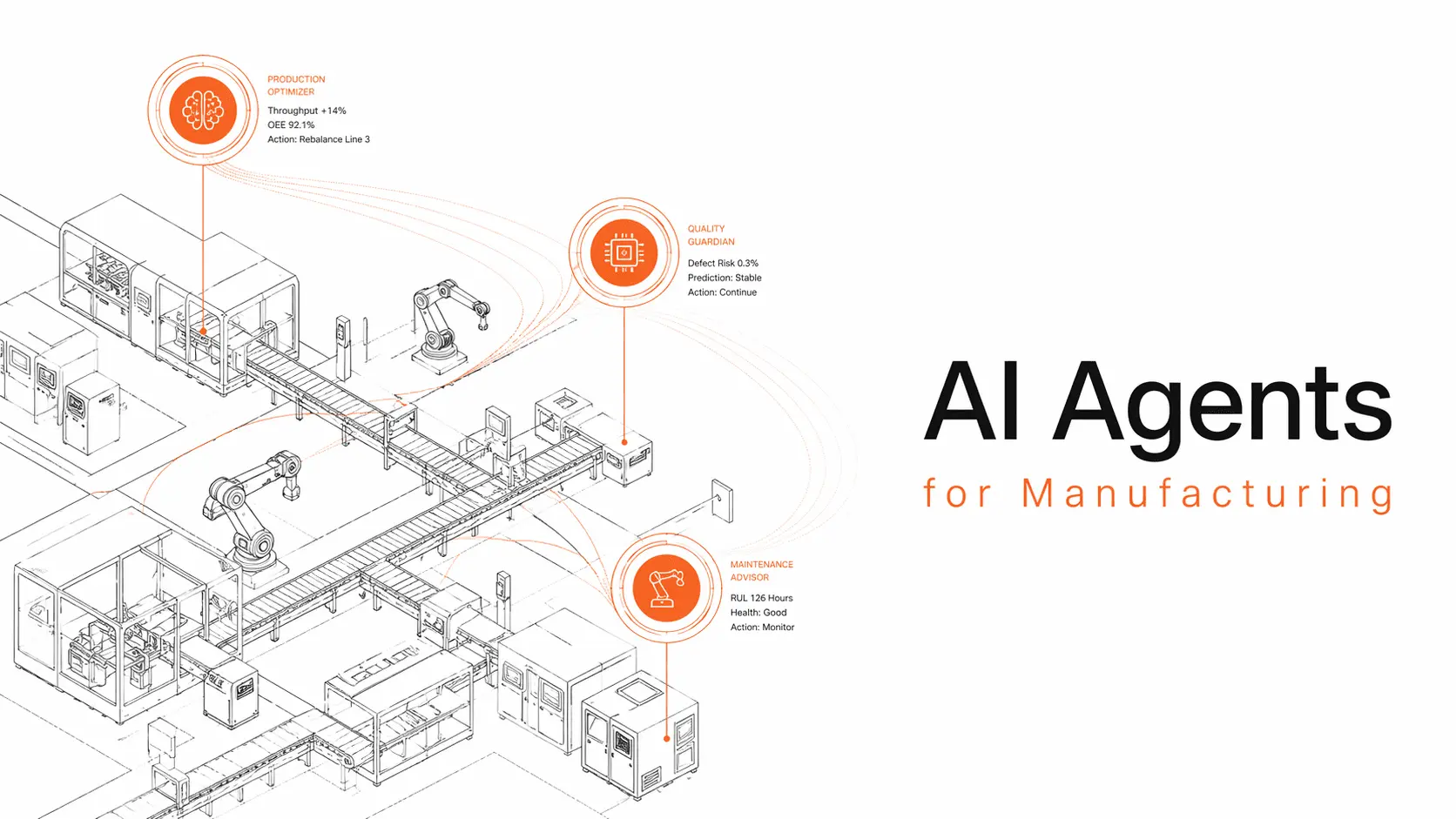
Manufacturing is no longer just about running machines, it’s about making the right decisions at the right time. Factories are evolving into intelligent systems where decisions happen in real time, workflows adapt automatically, and operations continuously improve without constant human intervention. At the center of this shift are AI agent systems designed not just to assist but also to act. To understand how this shift is happening, it’s important to first look at what AI agents actually are in a manufacturing context.
What Are AI Agents in Manufacturing?
AI agents in manufacturing are intelligent systems that can analyze data, make decisions, and take actions without constant human input. Unlike traditional automation, which follows fixed rules, AI agents operate with context. They understand what’s happening across machines, workflows, and systems and respond dynamically. In a manufacturing environment, this means they can:
- Monitor production in real time
- Detect issues before they escalate
- Adjust workflows based on changing conditions
- Trigger actions across connected systems
What makes them different is their ability to combine perception, reasoning, and execution into a continuous loop. They don’t just execute predefined tasks; they evaluate situations and decide what to do next. In simple terms, automation follows instructions. AI agents interpret situations and act on them.
Why Manufacturing Needs AI Agents Now?
According to McKinsey & Company, manufacturers can reduce machine downtime by up to 50% and increase productivity by 20–30% using AI-driven systems. Manufacturing environments have become more complex than ever. Global supply chains, fluctuating demand, and interconnected systems make it difficult to manage operations with manual decision-making alone.
The real challenge isn’t a lack of data, it’s the delay in turning that data into action. Production lines generate constant streams of information, but without real-time decision systems, issues are often identified too late. Small inefficiencies turn into downtime, and disruptions ripple across the entire operation.
AI agents address this gap by continuously analyzing data and acting on it instantly. They help manufacturers:
- Respond to changes in real time
- Reduce unplanned downtime
- Improve coordination across systems
- Maintain consistent production performance
Instead of reacting after problems occur, AI agents enable systems to anticipate, adjust, and optimize as conditions change. What this really means is manufacturing shifts from reactive problem-solving to proactive execution.
How AI Agents Work Across Manufacturing Operations?
Before exploring specific use cases, it’s important to understand how AI agents operate across different parts of a manufacturing environment. AI agents don’t function in isolation; they work as a connected layer across production, supply chain, and customer-facing systems. They continuously collect data, analyze conditions, and trigger actions where needed.
At a high level, AI agents follow a continuous loop: they take in inputs from machines and systems, process that data through decision models, and execute actions using integrated tools and workflows. This allows them to move beyond monitoring and into real-time execution.
1. Smart Production Management
AI agents monitor production lines in real time, identifying inefficiencies and bottlenecks as they happen. They can dynamically adjust production schedules, allocate resources, and optimize workflows to maintain consistent output without manual intervention.
2. Predictive Maintenance and Asset Intelligence
Instead of reacting to equipment failures, AI agents predict them in advance. By analyzing machine data and performance patterns, they can:
- Detect early signs of wear or malfunction
- Trigger maintenance workflows automatically
- Recommend corrective actions before breakdowns occur
This reduces downtime and extends asset lifespan.
3. Supply Chain Coordination
AI agents bring real-time visibility and decision-making into supply chain operations. They can:
- Track inventory levels continuously
- Predict demand fluctuations
- Adjust procurement and logistics plans automatically
This helps manufacturers respond faster to disruptions and avoid delays.
4. Sales, Orders, and Commercial Operations
AI agents extend beyond the factory floor into commercial workflows. They assist by:
- Analyzing order patterns and risks
- Optimizing pricing and quotations
- Automating order-to-cash processes
This ensures smoother coordination between demand and production.
5. Customer Service and Field Operations
AI agents also improve post-sales support and service operations. They can:
- Predict service issues before customers report them
- Schedule maintenance or field visits automatically
- Provide proactive updates and support
This shifts customer service from reactive to proactive.
Key Capabilities That Make AI Agents Powerful
AI agents stand out because they combine intelligence, adaptability, and execution into a single system. These capabilities allow them to operate effectively across complex manufacturing environments.
Autonomous Decision-Making
AI agents can evaluate situations and make decisions without waiting for human input. They analyze real-time data, identify patterns, and choose the best course of action based on predefined goals and learned behavior. This reduces delays and keeps operations moving without constant supervision.
Real-Time Data Processing
Manufacturing systems generate continuous streams of data from machines, sensors, and workflows. AI agents process this data instantly, enabling them to detect issues, identify opportunities, and respond as conditions change. This ensures decisions are based on current, not outdated, information.
Workflow Orchestration
AI agents connect and coordinate multiple systems, processes, and teams. Instead of isolated automation, they enable end-to-end execution by triggering actions across production, supply chain, and service operations. This creates a more unified and efficient manufacturing environment.
Continuous Learning
AI agents improve over time by learning from new data and past outcomes. They refine their decision-making, adapt to changing conditions, and optimize processes without needing constant reprogramming. This allows manufacturing systems to evolve and improve continuously.
Where AI Agents Deliver Measurable Value
AI agents don’t just improve processes; they create measurable impact across manufacturing operations. Their value shows up in how efficiently systems run, how quickly decisions are made, and how reliably operations perform.
Production Efficiency
AI agents continuously monitor production workflows and identify inefficiencies in real time.
They optimize resource allocation, reduce waste, and ensure smoother production cycles, leading to higher output with fewer disruptions.
Decision Velocity
In traditional systems, decisions are often delayed due to manual analysis and approvals.
AI agents eliminate this lag by analyzing data and triggering actions instantly, enabling faster responses across production and supply chain operations.
System Reliability
AI agents improve operational stability by predicting issues and responding before they escalate. They reduce unexpected downtime, maintain consistent performance, and ensure systems run with fewer interruptions.
Challenges to Consider Before Adoption
While AI agents offer clear advantages, implementing them in manufacturing environments requires careful planning. The challenge isn’t just technology, it’s how well systems, data, and teams align.
Data Fragmentation
Manufacturing data is often spread across multiple systems ERP, MES, IoT devices, and legacy platforms. AI agents rely on unified, high-quality data. Without proper integration, their ability to make accurate decisions is limited. Breaking down data silos is a critical first step.
Integration Complexity
Many manufacturing environments still depend on legacy infrastructure. Integrating AI agents with existing systems can be complex and time-consuming, especially when systems were not designed to work together. A structured integration approach is essential to avoid disruptions.
Change Management
Adopting AI agents changes how decisions are made and executed. Teams need to trust automated systems and adapt to new workflows. Without proper training and alignment, adoption can slow down. Technology alone isn’t enough people need to be part of the transition.
Governance and Control
AI agents operate autonomously, which makes governance critical. Manufacturers need clear rules, oversight mechanisms, and accountability frameworks to ensure decisions remain aligned with business objectives. Balancing autonomy with control is key to long-term success. As these challenges are addressed, manufacturing moves closer to a more advanced and adaptive operational model.
The Future: Autonomous Manufacturing Ecosystems
Manufacturing is moving beyond automation toward systems that can operate, adapt, and improve on their own. As an AI development company, Alpharive helps manufacturers integrate AI agents into connected ecosystems where decisions are made continuously across production, supply chain, and service operations.
Instead of isolated processes, everything works as part of a coordinated system. AI agents will act as a digital workforce monitoring conditions, coordinating workflows, and executing decisions in real time. Production lines will adjust automatically, supply chains will respond to disruptions instantly, and service operations will become proactive rather than reactive.
As this shift accelerates, businesses are increasingly investing in AI agent development to build systems tailored to their specific manufacturing environments. What changes is not just efficiency, but how operations are managed.
Manufacturers will move from:
- Fixed workflows >> adaptive systems
- Delayed decisions >> real-time execution
- Reactive responses >> predictive and autonomous operations
This shift creates environments that are more resilient, scalable, and capable of handling increasing complexity without adding operational overhead.
Conclusion: From Efficiency to Intelligence
Manufacturing is no longer defined by how efficiently machines operate, but by how intelligently decisions are made. AI agents introduce a new model where systems don’t just execute tasks, they analyze, decide, and act in real time. This shift enables manufacturers to move beyond static processes and build operations that continuously adapt and improve.
From production and maintenance to supply chain and customer service, AI agents bring a level of coordination and responsiveness that traditional systems can’t match. The future of manufacturing isn’t just automated; it’s autonomous. Organizations that embrace this shift early will be better positioned to handle complexity, reduce disruptions, and scale efficiently in an increasingly dynamic environment.
At Alpharive, we work closely with manufacturers to design and implement AI agent systems tailored to their operations. Through a focused approach to Custom AI agent development, we help integrate data across systems, build intelligent workflows that act in real time, and enable practical, scalable adoption of AI so businesses can move from fragmented processes to truly autonomous operations.