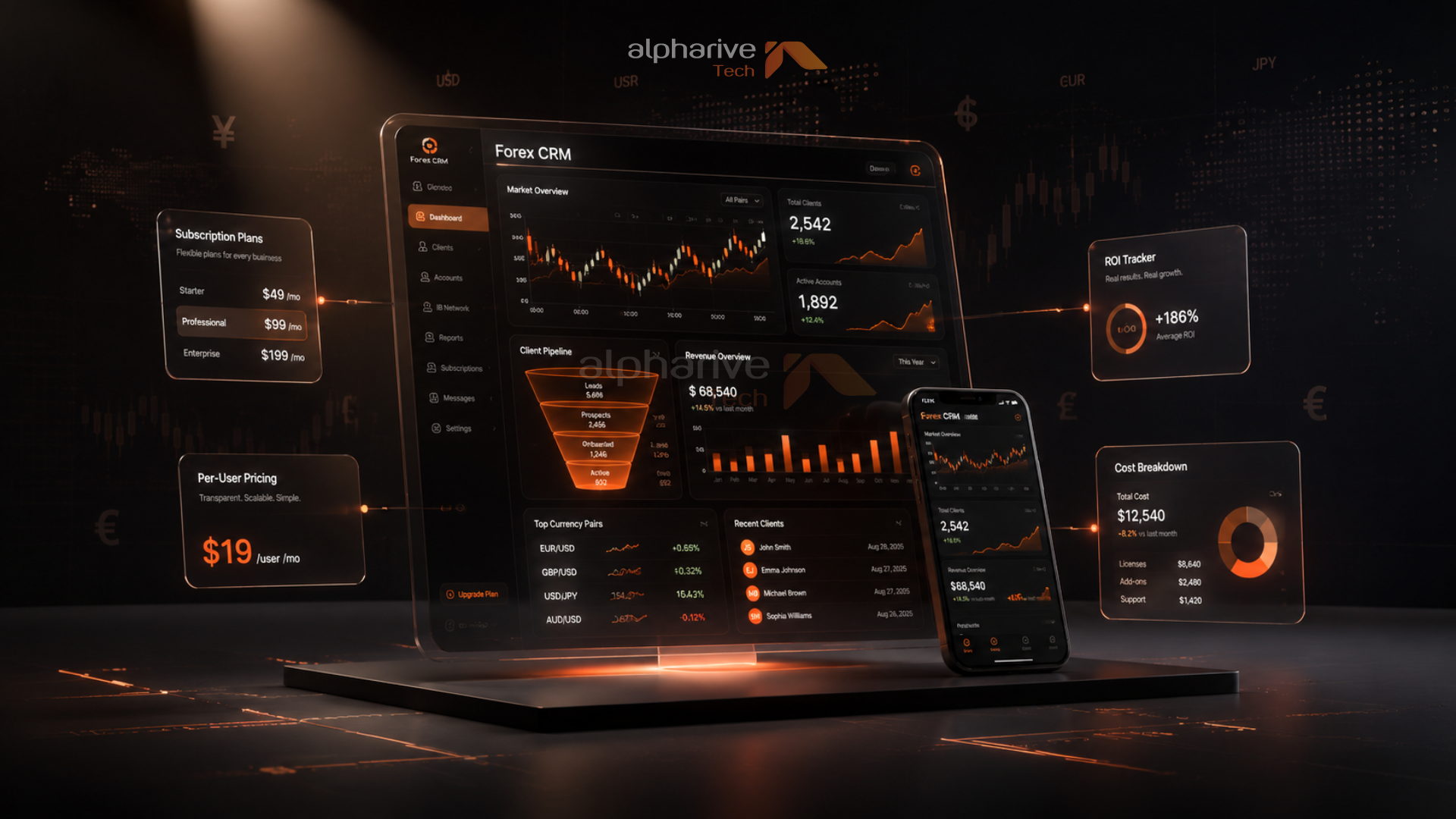
How Much Does It Cost to Build Forex CRM Software in 2026?

How Much Does It Cost to Build Forex CRM Software in 2026?

How Much Does It Cost to Build Forex CRM Software in 2026?

If you're running a forex brokerage — or planning to launch one — your CRM is not optional infrastructure. It's the operational core of your entire business. And like most things in fintech, the cost of building forex CRM software varies enormously depending on what you actually need.

The short answer: a basic forex CRM starts around $10,000, while a fully custom enterprise forex CRM can run $300,000 or more. But the real answer depends on your features, integrations, regulatory compliance requirements, and the scale of your brokerage operations.

The actual forex CRM cost depends on four things: the features you need, the integrations required, your regulatory compliance obligations, and the scale of your brokerage operations. This guide walks through all of it, with real numbers.

What Is a Forex CRM and How Does It Work?

Most people outside the industry assume a forex CRM is just a regular CRM with a trading skin on top. It isn't. Not even close.

A standard CRM tracks contacts, deals, and emails. Forex CRM software does something fundamentally different — it manages the live operational workflows of a brokerage. Trader accounts, compliance checks, fund movements, platform connections, affiliate payouts. It's less like Salesforce and more like the central nervous system of a financial business.

Here's what a properly built forex broker CRM actually handles day to day:

Trader management sits at the core. Every client account — onboarding status, KYC stage, deposit history, communication log — lives here. Good forex trader management software means your operations team always knows exactly where each client stands without digging through emails or spreadsheets.

KYC and AML compliance is non-negotiable, especially for institutional brokerages operating under multiple regulatory licences. Document collection, identity checks, sanctions screening, audit trails — all of it needs to be built in from the start, not bolted on later.

IB and affiliate management is where a lot of brokerages make or lose real money. Tracking introducing brokers, calculating commissions across multiple tiers, giving IBs their own portal — this is complex stuff that manual processes simply can't handle at scale.

MT4/MT5 integration connects your CRM directly to your trading platform. Any MT5 CRM solution worth using gives you real-time account sync, automated account creation, and direct deposit routing — all through the MetaQuotes API. Without this, your ops team is constantly reconciling data between two systems that don't talk to each other.

Trader's room software is the client-facing side of the CRM — a branded portal where traders can deposit funds, manage their accounts, upload documents, and get support. The quality of this interface directly affects first impressions and trader retention.

Payment systems handle deposits, withdrawals, and reconciliation across multiple gateways and currencies. Client onboarding automation starts here — a trader who has to wait three days to fund their account is a trader who might not come back.

Back-office automation is what makes large-scale broker operations actually manageable. Automated commission payouts, compliance alerts, status change workflows — all the manual work that kills productivity in high-volume trading operations gets handled without anyone touching it.

Think of it this way. The trading platform is where the trades happen. The brokerage CRM software is where everything around those trades happens. Remove it, and you're running a financial business on spreadsheets and goodwill.

Why Forex Brokers Need CRM Software in 2026

Five years ago, a lean brokerage could get by with basic tools and a small ops team. That window has closed.

The forex market in 2026 is genuinely more competitive than it's ever been. Regulatory expectations are higher. Traders expect faster onboarding, faster withdrawals, and better support. And the brokers who are actually growing right now are the ones who've invested in technology infrastructure that makes all of that possible at scale.

CRM for forex brokers isn't a nice-to-have anymore. For any brokerage trying to grow seriously, it's foundational.

Automation is probably the single biggest reason brokers make the switch. When you're processing hundreds of KYC applications, dozens of IB commission calculations, and thousands of deposit requests manually, you're burning time and creating risk. Client onboarding automation alone can cut per-client operational cost dramatically — and it removes the human errors that cause compliance headaches down the line.

Lead management is something generic tools don't handle well for brokerages. Forex brokerage management software tracks leads from first inquiry through to funded account, with full visibility into where each prospect is in the pipeline. Your sales team stops working blind.

Regulatory compliance is increasingly non-negotiable. Broker operations under FCA, CySEC, ASIC, and similar authorities need documented, auditable processes. A CRM built with regulatory compliance baked in makes your next audit something you approach calmly rather than in a panic.

Affiliate tracking at any real scale requires dedicated software. Managing an IB network of fifty partners manually is painful. Managing five hundred is impossible. White label forex CRM platforms and custom builds both solve this, but the depth of control differs significantly.

Trader retention is where the economics really play out. Keeping an existing trader active costs a fraction of what acquiring a new one costs. Automated re-engagement workflows, personalised communication, and a seamless experience through trader's room software all contribute to retention numbers that compound over time.

Operational scaling is the long-term argument. Scalable infrastructure designed for high-volume trading operations means your CRM handles 500 traders and 50,000 traders on the same architecture. You don't rebuild. You just grow.

Multi-asset trading adds another layer of complexity. Brokers expanding into commodities, indices, and crypto alongside forex need CRM logic that handles multiple instrument types and margin structures without breaking.

The brokers using integrated forex CRM software for brokerages aren't just more efficient — they're building a durable operational advantage that gets harder to close the longer it compounds.

How Much Does It Cost to Build Forex CRM Software in 2026?

Right. Here are the actual numbers.

Forex CRM software development cost in 2026 broadly falls into three tiers, depending on the complexity of what you're building:

CRM Type

Estimated Cost

Basic Forex CRM

$10,000 – $25,000

Mid-Level Brokerage CRM

$25,000 – $80,000

Enterprise Forex CRM

$80,000 – $300,000+

Basic Forex CRM — $10,000 to $25,000

This gets you core trader management, basic KYC, a single MT4/MT5 integration, and a functional trader's room. It's the right starting point for new brokerages that are still finding their footing — but it's limited. Automation is minimal, customisation is constrained, and you'll hit the ceiling faster than you expect if your trader base grows quickly.

Mid-Level Brokerage CRM — $25,000 to $80,000

This is where most growing brokerages land. Full KYC/AML workflows, proper IB management, multi-gateway payment handling, CRM automation, reporting, and a fully branded trader's room. The forex CRM cost at this tier reflects what you actually need to run a real brokerage operation without constantly working around your own software.

Enterprise Forex CRM — $80,000 to $300,000+

This is the full build. Custom forex CRM development at this level includes PAMM/MAM modules, copy trading, multi-currency wallets, deep liquidity integration, multi-language architecture, advanced regulatory compliance tooling, and scalable infrastructure built specifically for institutional brokerages running high-volume trading operations across multiple regions. It's a significant investment — and for the brokerages it's designed for, it pays for itself.

Other costs you need to plan for

Development timeline — budget 2 to 4 months for a basic CRM, 4 to 8 months for mid-level, and 9 to 18 months for enterprise builds. Rushing the timeline is one of the most reliable ways to end up with a platform that needs a rebuild.

Scalable infrastructure — cloud hosting, database architecture, and security infrastructure add $1,000 to $5,000 per month in running costs depending on trader volume and redundancy requirements.

Maintenance — $1,500 to $8,000 per month for ongoing support, security patches, and incremental feature work. This is a cost most brokers underestimate in their initial forex CRM software cost calculations.

Integrations — each connection to a payment gateway, KYC provider, or liquidity integration layer adds $2,000 to $15,000 depending on API complexity. Build this into your project budget from day one.

Factors That Influence Forex CRM Development Cost

Two brokerages can ask for the same thing and get quotes that are $100,000 apart. Here's why.

Security architecture — trading platforms are targets. Role-based access control, two-factor authentication, encryption at rest and in transit, DDoS protection, penetration testing — these are baseline requirements for any platform handling real money across high-volume trading operations. They add to the overall forex CRM development cost. They're not optional.

Scalable infrastructure — the architecture decisions made at the start define how the platform performs two years from now. Building scalable infrastructure designed for growth costs more upfront. Rebuilding it under load pressure costs a lot more later.

Regulatory compliance modules — broker operations under different regulatory bodies have different requirements. FCA wants certain audit logs. CySEC wants specific reporting formats. If you're operating under multiple jurisdictions, the regulatory compliance layer gets meaningfully more complex and more expensive.

API integrations — every third-party connection requires its own development, testing, and maintenance work. A CRM with five payment gateways and a full liquidity integration layer is a substantially bigger project than one with a single connection of each type.

Liquidity integration — connecting to liquidity providers for real-time pricing, execution routing, and reconciliation is technically demanding. It's one of the items that most frequently gets underscoped in initial project quotes for custom brokerage CRM software builds.

Multi-asset trading support — if your brokerage offers multi-asset trading across forex, commodities, indices, and crypto, the CRM needs to handle different instrument types, margin structures, and reporting requirements within the same system. That's not a minor addition.

Multi-language architecture — serving traders across Asia, Europe, and the Middle East properly requires real localisation work, not just translated strings. Currency handling, time zone logic, and sometimes data residency requirements in specific regions all add to the scope.

Security and Compliance Standards We Follow

Your CRM handles trader funds, personal data, KYC documents, and live account activity. The security architecture underneath it isn't a feature — it's the foundation your entire operation runs on.

Every forex CRM we build meets the compliance expectations of regulated brokerages across the US, EU, UK, and beyond.

SSL Encryption

All data in transit — client logins, API calls, payment requests, document uploads — is protected with SSL/TLS encryption across every connection, end to end.

Role-Based Access Control (RBAC)

Granular permissions scoped precisely to each role across your operation — compliance officers, account managers, IB partners, support agents, and administrators. Access limited to exactly what each role requires.

KYC/AML Workflows

Document collection, identity verification, sanctions screening, risk scoring, and audit trails built natively into the CRM workflow — not bolted on. Examination-ready by default under FCA, CySEC, FinCEN, or ASIC.

GDPR-Ready Data Handling

Consent management, data subject access controls, right-to-erasure workflows, and data minimisation practices architected in from day one — not retrofitted after launch.

Secure API Integrations

Token-based authentication, IP whitelisting, webhook signature validation, and rate limiting across every third-party connection — payment gateways, KYC providers, liquidity integrations, and MetaQuotes API.

Audit Logging Systems

Every user action, account status change, payment event, and administrative operation is logged with a full, tamper-resistant audit trail — built to satisfy regulatory retention requirements.

Cloud Infrastructure Security

Enterprise-grade cloud deployment with firewall controls, DDoS mitigation, intrusion detection, environment isolation, and security review on every release.

Multi-Layer Authentication

2FA enforced across all administrative access by default. Configurable MFA for client portals, with session management, login anomaly detection, and automatic timeout controls throughout.

Data Backup and Disaster Recovery

Automated daily backups, point-in-time recovery, and geographically distributed redundancy — with documented and tested RTO and RPO, not assumed ones.

Built for Regulated Brokerages. Verified by Design.

Security and compliance in a forex CRM are not checkbox features. They are the architecture decisions made at the very beginning of a build — and they define what your operation looks like to regulators, institutional partners, and the traders who trust you with their funds.

Every platform Alpharive delivers is designed to meet that standard from the first line of code to the final deployment.

Forex CRM Features That Affect Development Pricing

This is where a lot of initial budgets go wrong — not because anyone is hiding the cost, but because the real complexity of certain features only becomes clear once you're actually building them.

Trader dashboard — account overview, balance history, transaction records. Moderately complex. Well-designed forex trader management software at this level typically accounts for 8 to 12 percent of total build effort. It sounds simple until you're handling real-time data across thousands of accounts.

Wallet system — multi-currency internal wallets, crypto and fiat support, internal transfers, reconciliation. This is one of the areas where forex CRM software cost tends to grow faster than expected, especially when combined with multiple payment gateways.

Payment gateway integration — each provider needs its own API integration, webhook logic, error handling, and reconciliation. The more gateways you need, the higher the cost. It's straightforward math, but it adds up fast.

CRM automation — the rules engine behind automated emails, triggered status changes, re-engagement workflows, and compliance alerts. Client onboarding automation at enterprise scale is a serious engineering challenge. It often represents 15 to 20 percent of a mid-level build's total cost — and it's consistently underestimated.

MT5 CRM integration — real-time account sync, automated account creation, deposit routing, live balance updates. A proper forex CRM with MT5 integration built through the MetaQuotes API is technically demanding. It's also the feature most commonly responsible for timeline overruns when the development team doesn't have direct prior experience building an MT5 CRM solution.

Reporting and analytics — standard reports are fine for most situations. Custom multi-variable analytics dashboards with real-time data and scheduled exports are a different scope category entirely, particularly in forex back office software built for institutional use.

Copy trading — low-latency trade mirroring across master and follower accounts requires real-time infrastructure and careful risk management logic. It's not a feature you add lightly to a platform serving high-volume trading operations.

PAMM and MAM modules — proportional profit distribution across pooled accounts, investor reporting, performance fee calculations. This is among the most technically complex work in forex back office software development. Budget $20,000 to $60,000 for this feature alone depending on the depth required.

IB and affiliate system — multi-tier structures, real-time referral tracking, automated payouts, dedicated IB portals. A properly built affiliate system is one of the highest-ROI features in brokerage CRM software. It's also one of the most time-consuming to get right.

White Label vs Custom Forex CRM Software

This is the decision most brokers wrestle with before they start building — and it's worth thinking through carefully rather than defaulting to whichever option looks cheaper upfront.

Feature

White Label Forex CRM

Custom Forex CRM

Launch Time

Faster

Longer

Upfront Cost

Lower

Higher

Ownership

Vendor Controlled

Full Ownership

Customization

Limited

Fully Custom

Scalability

Moderate

Enterprise-Level

Branding

Shared Framework

Fully Branded

Compliance Flexibility

Limited

High

Long-Term Cost

Higher Over Time

Lower Over Time

Best For

Startups

Growing & Enterprise Brokers

White label forex CRM makes sense in specific situations. If you need to launch quickly, your initial budget is under $30,000, and you're still validating whether your target market is viable — a white label solution gets you operational in weeks. Core features are already built. You're not starting from scratch. For early-stage brokerages, that speed genuinely matters.

Custom brokerage CRM software makes sense when you're building for the medium and long term. If you have specific regulatory compliance requirements that off-the-shelf platforms can't meet, if you want full ownership of your technology and data, or if you're planning to scale into the kind of high-volume trading operations that white label platforms can't comfortably support — custom is almost always the right call for institutional brokerages.

The trap that catches a lot of brokers is choosing white label to save money upfront, growing past it within 18 months, and then commissioning a custom build anyway. The total cost ends up higher than going custom from the start, and you've lost 18 months of building on the right foundation. If your business plan involves serious growth with high-volume trading operations, forex CRM software development cost is better calculated over a 3–5 year horizon — and going custom from the beginning is usually the more economical path.

Is Building a Custom Forex CRM Software Worth It in 2026?

For growth-focused brokerages, yes. Almost without exception.

Here's the argument:

Long-term ROI — a white label platform charges licence fees every month, forever. Custom forex CRM development costs more upfront, but once that cost is recovered — typically somewhere between 18 and 36 months for an actively growing brokerage — the platform is yours. No recurring fees. No dependency on a vendor's pricing decisions. The cost of ownership drops dramatically and stays there.

Operational control — when your broker operations run on a custom system, the software adapts to how you work. You build the features you actually need, in the order that actually matters to your business. You don't file feature requests with a vendor and wait six months to see if they make the roadmap.

Branding — a fully branded trader's room software implementation, seamless client onboarding automation, and a polished client portal all contribute to how traders perceive your brokerage. On a shared white label platform, that differentiation is fundamentally limited. Institutional brokerages competing for high-value traders can't afford that limitation.

Scalable infrastructure — enterprise-grade architecture designed for high-volume trading operations handles 10,000 traders the same way it handles 100. You're not rebuilding when you scale. That's what scalable brokerage operations actually look like in practice.

Multi-asset trading growth — as brokerages expand into multi-asset trading, white label platforms often become real constraints. Custom forex CRM software for brokerages grows with your product offering instead of limiting it.

For brokers who are still in early-stage validation, white label is a perfectly sensible starting point. But for anyone who has validated their model and is building for the next three to five years — custom forex CRM development is the investment that makes everything else scale properly.

Why Choose Alpharive for Forex CRM Development?

Building forex CRM software with a team that hasn't done it before is an expensive way to learn. The domain knowledge required — KYC workflows, MT5 API specifics, IB commission logic, regulatory compliance requirements across jurisdictions — takes years to develop. You don't want your brokerage to be the project where a development team acquires it.

Alpharive is a forex CRM software development company with 6+ years of experience building custom software for brokerages, fintech firms, and financial operations globally. Here's what that means in practice when you're evaluating a development partner.

Forex-first experience — Native MT4, MT5, and cTrader integrations, full PAMM/MAM modules, IB management, and KYC/AML workflows built across real brokerage environments. Every edge case is already understood before your build starts.

Hands-on MT5 CRM integration — Real-time account sync, automated account creation, deposit routing, and live trading data inside the CRM — delivered across live brokerage deployments. No learning curve billed to your project.

Security built in, not bolted on — SSL encryption, RBAC, 2FA, audit logging, and encrypted API connections are standard across every build. Not optional add-ons.

Scalable from day one — Architecture designed for high-volume trading operations from the first sprint, so you're not rebuilding when your trader base grows.

Full-cycle partnership — Scoping, development, integration, deployment, and 24/7 ongoing support. A dedicated team that stays accountable well past go-live.

Alpharive has delivered forex CRM solutions for brokerages from early-stage to enterprise scale — building systems that work in production, not just in a demo.

Conclusion

A forex CRM isn't back-office software. It's the infrastructure your brokerage runs on — every day, for every trader, across every transaction.

The brokerages winning in 2026 aren't just competing on spreads. They're competing on client experience, scalable brokerage operations, and enterprise-grade technology. The forex CRM software platform sitting underneath those operations is what makes that competition possible.

If you're launching your first brokerage, a white label solution might be the right starting point. If you're scaling something that's already working, or building the kind of institutional brokerage infrastructure that high-volume trading operations actually require — the forex CRM software development cost is an investment that pays for itself when you're working with the right forex CRM development company.

Frequently Asked Questions

How much does forex CRM software cost?

Forex CRM platform pricing ranges from $10,000 to $25,000 for a basic CRM, $25,000 to $80,000 for a mid-level brokerage CRM, and $80,000 to $300,000 or more for an enterprise-grade build. White label forex CRM options start lower — around $5,000 to $20,000 upfront — but carry ongoing licence fees that compound over time. Monthly maintenance typically adds $1,500 to $8,000 to your forex CRM software cost depending on complexity and trader volume.

What is included in forex CRM software?

A complete brokerage CRM software platform covers trader management, KYC and AML regulatory compliance, IB and affiliate management, MT4/MT5 integration, payment gateway connections, trader's room software, back-office automation, reporting and analytics, and role-based access control. Enterprise builds also include PAMM/MAM modules, copy trading, multi-currency wallets, liquidity integration, and multi-asset trading support designed for institutional brokerages.

Can forex CRM integrate with MT5?

Yes, and for most brokerages it's one of the most important requirements in the entire build. A properly built forex CRM with MT5 integration syncs account data in real time, automates account creation, routes deposits directly to the trading platform, and surfaces live trading activity inside the CRM dashboard. It's built through the MetaQuotes API. It requires a forex CRM development company with specific, demonstrable MT5 CRM integration experience — not just general API development capability.

Is white label forex CRM cheaper than custom development?

Cheaper upfront, yes. But the full picture is more complicated. White label forex CRM options come with ongoing licence fees, hard limits on customisation, and vendor dependency that becomes a real constraint as your broker operations grow. For institutional brokerages and brokers planning serious scale with high-volume trading operations, the total forex CRM cost over three to five years often makes custom brokerage CRM software the more economical choice.

How long does forex CRM development take?

A basic forex CRM takes 2 to 4 months. A mid-level platform with full integrations and automation is typically 4 to 8 months. An enterprise forex CRM development project with PAMM/MAM, copy trading, deep liquidity integration, and scalable infrastructure built for institutional brokerages can run 9 to 18 months. White label deployments can go live in 2 to 6 weeks if speed is the priority.

What is the difference between a brokerage CRM and a forex CRM?

A general brokerage CRM handles contact management and basic pipeline tracking. A forex broker CRM solution is purpose-built for the specific operational requirements of a forex brokerage — MT5 CRM integration, multi-tier IB management, KYC/AML regulatory compliance, multi-currency payment processing, PAMM/MAM account management, and full forex back office software functionality. They are genuinely different categories of software. Using a general CRM for serious broker operations creates compliance gaps and operational bottlenecks that compound as your brokerage scales.

Which features increase forex CRM pricing the most?

The biggest cost drivers in any forex CRM development cost analysis are PAMM/MAM modules, copy trading infrastructure, multi-tier IB management, liquidity integration, multi-currency wallet systems, and regulatory compliance modules built for multiple jurisdictions. Each one involves complex backend logic, real-time data handling, and serious testing overhead. Together, they're the primary reason the cost to build forex CRM software varies so dramatically between brokerages with similar surface-level requirements.

Recent Blog

Expert insights from our team

How Much Does It Cost to Build Forex CRM Software in 2026?

How Much Does It Cost to Build Forex CRM Software in 2026?

RAG vs Agentic AI: Understand the Difference

RAG vs Agentic AI: Understand the Difference

RPA vs Agentic AI: What’s the Difference?

RPA vs Agentic AI: What’s the Difference?

cta

Contact Us

Partner with Us for Comprehensive IT Solutions

We’re happy to answer any questions you may have and help you determine which of our services best fit your needs.

Your benefits:

Client-oriented

Independent

Competent

Results-driven

Problem-solving

Transparent

+91