For years, RPA helped businesses automate repetitive tasks through fixed rules and workflows. Now, Agentic AI is changing the conversation by making decisions, adapting to changing inputs, and handling complex workflows. If you're comparing RPA vs Agentic AI, this guide will help you understand where each fits and when using both makes more sense.
What Is RPA?
RPA automation uses software bots to perform repetitive, rule-based tasks by copying human actions across digital systems. These bots can log into applications, move data between platforms, extract information from forms, generate reports, and complete repetitive workflows without manual effort. Businesses often invest in RPA development services to automate high-volume processes without replacing their existing systems. Since RPA works well with structured data and predefined instructions, it remains highly effective for repetitive workflows.
Even with the rise of newer AI technologies, RPA remains highly relevant because many business operations still depend on predictable workflows. Finance teams use it for invoice processing, HR departments automate employee onboarding tasks, and healthcare providers rely on it for claims processing. It is cost-effective, faster to implement than complex AI systems, and continues to deliver strong value where decision-making is not required.
What Is Agentic AI?
Agentic AI refers to AI systems that can make decisions, adapt to changing situations, and complete tasks based on goals rather than fixed instructions. Instead of following a predefined workflow like RPA, these systems analyze data, understand context, choose actions, and adjust when something unexpected happens. They often combine large language models, reasoning capabilities, memory, and tool integrations to handle complex workflows with minimal human intervention.
This makes Agentic AI useful for processes that involve unstructured data such as emails, documents, customer conversations, and dynamic business requests. For example, it can review contracts, route customer support tickets, assess insurance claims, or manage multi-step workflows across departments. As businesses move toward smarter automation, Agentic AI is becoming a strong choice for tasks that require flexibility and decision-making.
RPA vs Agentic AI: A Head-to-Head Comparison
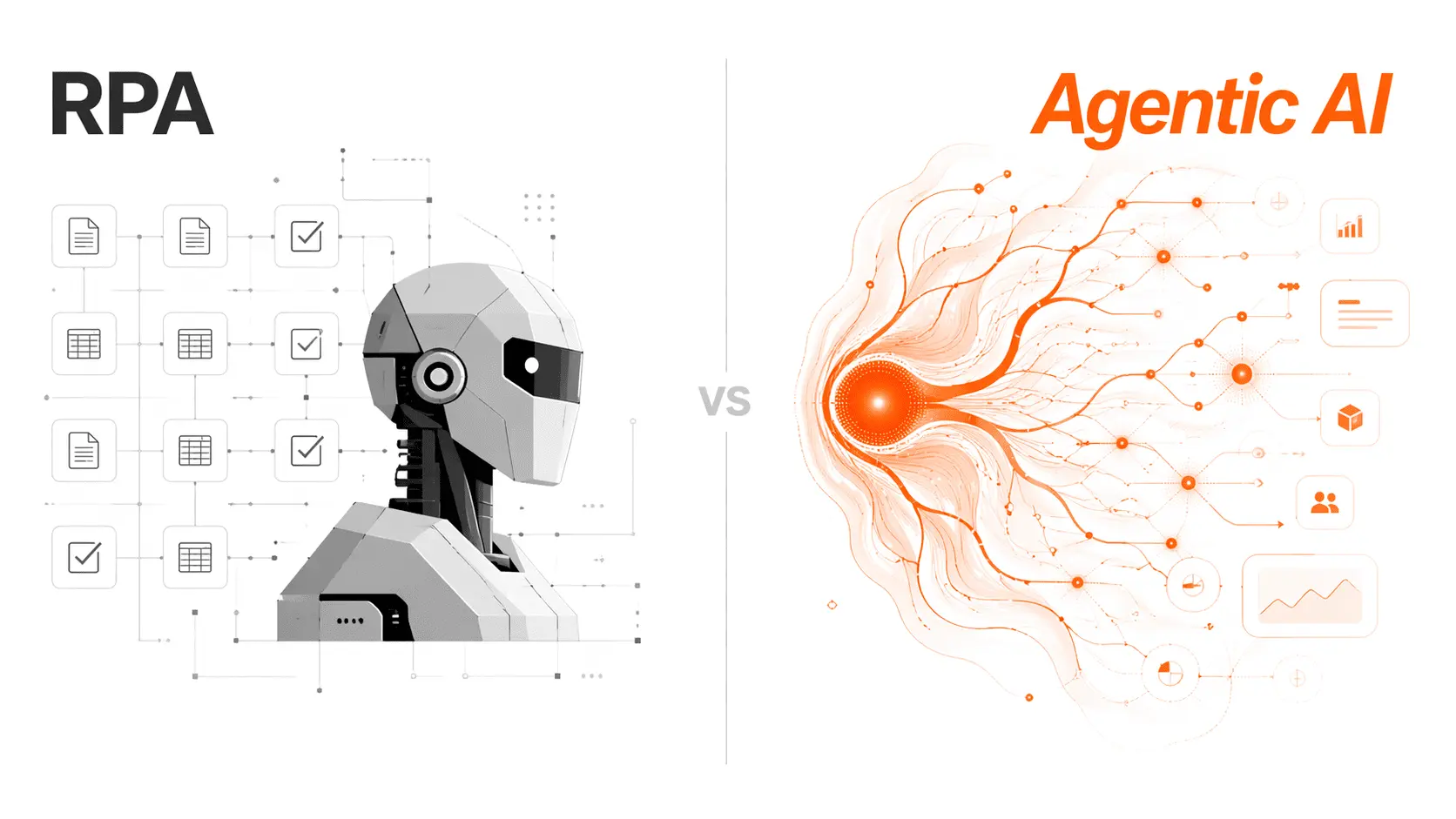
At a high level, RPA vs Agentic AI comes down to how each technology approaches automation. RPA follows predefined rules to complete repetitive tasks, making it ideal for stable workflows with structured data. Agentic AI works differently it focuses on outcomes, analyzes context, and decides the best actions to complete a task. While both improve efficiency, they solve very different business challenges.
Factor | RPA | Agentic AI |
|---|---|---|
Core Logic | Rule-based workflows | Goal-based execution |
Data Handling | Structured data only | Structured + unstructured data |
Decision Making | No independent decision-making | Makes contextual decisions |
Adaptability | Breaks when workflows change | Adjusts to changing inputs |
Learning Capability | No learning ability | Can improve over time |
Implementation Cost | Lower upfront cost | Higher initial investment |
Best For | Repetitive tasks | Complex workflows |
Examples | Payroll processing, invoice entry | Contract review, intelligent support automation |
When businesses compare both, the biggest difference is flexibility. RPA is faster to deploy for repetitive work that rarely changes, while Agentic AI performs better in workflows that involve exceptions, unpredictable inputs, and real-time decisions. The right choice depends on how dynamic your business processes are.
How They Handle Data
RPA works best with structured data that follows fixed formats, such as spreadsheets, databases, invoices, and standard forms. It struggles when data comes in different formats because bots rely on predefined instructions to process information accurately. Agentic AI can handle both structured and unstructured data, including emails, contracts, customer chats, PDFs, and voice transcripts. It understands context and extracts useful insights even when the input is inconsistent.
How They Make Decisions
RPA does not make decisions on its own. It follows rules that are programmed in advance, meaning every action depends on specific instructions created by humans. Agentic AI is designed to evaluate situations, analyze multiple inputs, and make decisions based on goals. It can choose actions dynamically without waiting for manual intervention.
How They Handle Change
RPA workflows can break when systems change, interfaces are updated, or process steps are modified. Even small changes may require developers to reconfigure automation scripts. Agentic AI is far more adaptable because it can adjust to changing workflows, unexpected requests, and new business conditions. This makes it better suited for environments where processes constantly evolve.
Real-World Use Cases: When to Use Each
RPA use cases are best suited for repetitive processes where tasks follow the same steps every time. Finance teams use RPA for invoice processing, payroll entries, and account reconciliation. HR departments automate employee onboarding paperwork, while retail businesses use it to update inventory records across legacy systems. It also works well for compliance reporting, data migration, and other back-office operations that rely on structured information.
Agentic AI use cases are more effective when workflows involve decision-making and unpredictable inputs. Businesses use it to analyze contracts, manage customer support requests, process insurance claims with missing information, and automate IT incident responses. It can understand emails, documents, and conversations, making it valuable for operations that need flexibility. When workflows become too complex for traditional bots, Agentic AI delivers smarter automation.
Can RPA and Agentic AI Work Together?
Many businesses assume they must choose between RPA and Agentic AI, but that’s rarely the smartest approach. In reality, both technologies can work together to create stronger automation systems. RPA handles repetitive execution tasks like moving data, updating records, and completing structured workflows, while Agentic AI manages decision-making, exception handling, and unstructured inputs that traditional bots struggle to process.
Think of RPA as the execution layer and Agentic AI as the intelligence layer. For example, an AI agent can review incoming emails, understand customer requests, and decide the next action, while RPA bots handle tasks like updating CRM systems or processing transactions. This hybrid automation model helps businesses scale faster by combining the speed of RPA with the flexibility of Agentic AI.
How to Choose Between RPA and Agentic AI
Choosing between RPA vs Agentic AI depends on how your workflows operate. If your processes follow fixed steps, rely on structured data, and rarely change, RPA is often the better choice. It offers faster deployment, lower costs, and reliable automation for repetitive tasks like payroll processing, report generation, and invoice management.
Agentic AI makes more sense when workflows involve decision-making, changing inputs, or unstructured data like emails, documents, and customer conversations. If your business needs both operational efficiency and intelligent decision-making, combining both technologies can deliver better long-term results. The right automation strategy starts with understanding your workflow complexity before investing in either solution.
Is RPA Dead? The Short Answer Is No
Despite the growing attention around Agentic AI, RPA is not dead. It continues to be one of the most practical solutions for automating repetitive, rule-based tasks that involve structured data and predictable workflows. Many businesses still rely on RPA for finance operations, compliance reporting, HR processes, and legacy system automation because it is reliable, affordable, and easier to implement.
What’s changing is the role RPA plays in modern automation strategies. Agentic AI is taking over tasks that require reasoning, adaptability, and contextual decision-making areas where traditional bots were never built to perform. Instead of replacing RPA, businesses are increasingly combining both technologies to build smarter and more scalable automation ecosystems.
Alpharive: Your Trusted AI Partner for Business Automation
Choosing between RPA, Agentic AI, or a hybrid automation model becomes easier when you have the right technology partner guiding the process. Alpharive, as a AI Development Company we help businesses identify automation gaps, build intelligent workflows, and implement solutions that align with real operational needs. Whether you need rule-based automation for repetitive tasks or advanced AI agents for complex decision-making, our team builds solutions that are practical, scalable, and future-ready. From strategy to deployment, we help businesses automate smarter and stay ahead in a rapidly evolving digital landscape.