Two AI architectures are shaping enterprise innovation in 2026 RAG and Agentic AI. Yet many businesses still confuse where each fits. While one improves response accuracy through external knowledge retrieval, the other enables autonomous decision-making and execution. This guide breaks down both models, their differences, and when to use each.
The AI Architecture Question Every Tech Team Is Asking
Businesses are moving fast with AI adoption, but choosing the right architecture has become a major challenge. Teams often invest in AI tools without fully understanding whether they need better knowledge retrieval, autonomous task execution, or both. That confusion leads to wasted budgets, weak performance, and systems that fail to scale.
RAG vs Agentic AI has become one of the biggest discussions in enterprise AI because both solve very different problems. According to Gartner, nearly one-third of enterprise software applications are expected to include agentic AI capabilities by 2028. At the same time, RAG continues to power reliable AI assistants across industries. Understanding where each model fits can help businesses build smarter AI systems from the start.
What Is RAG?
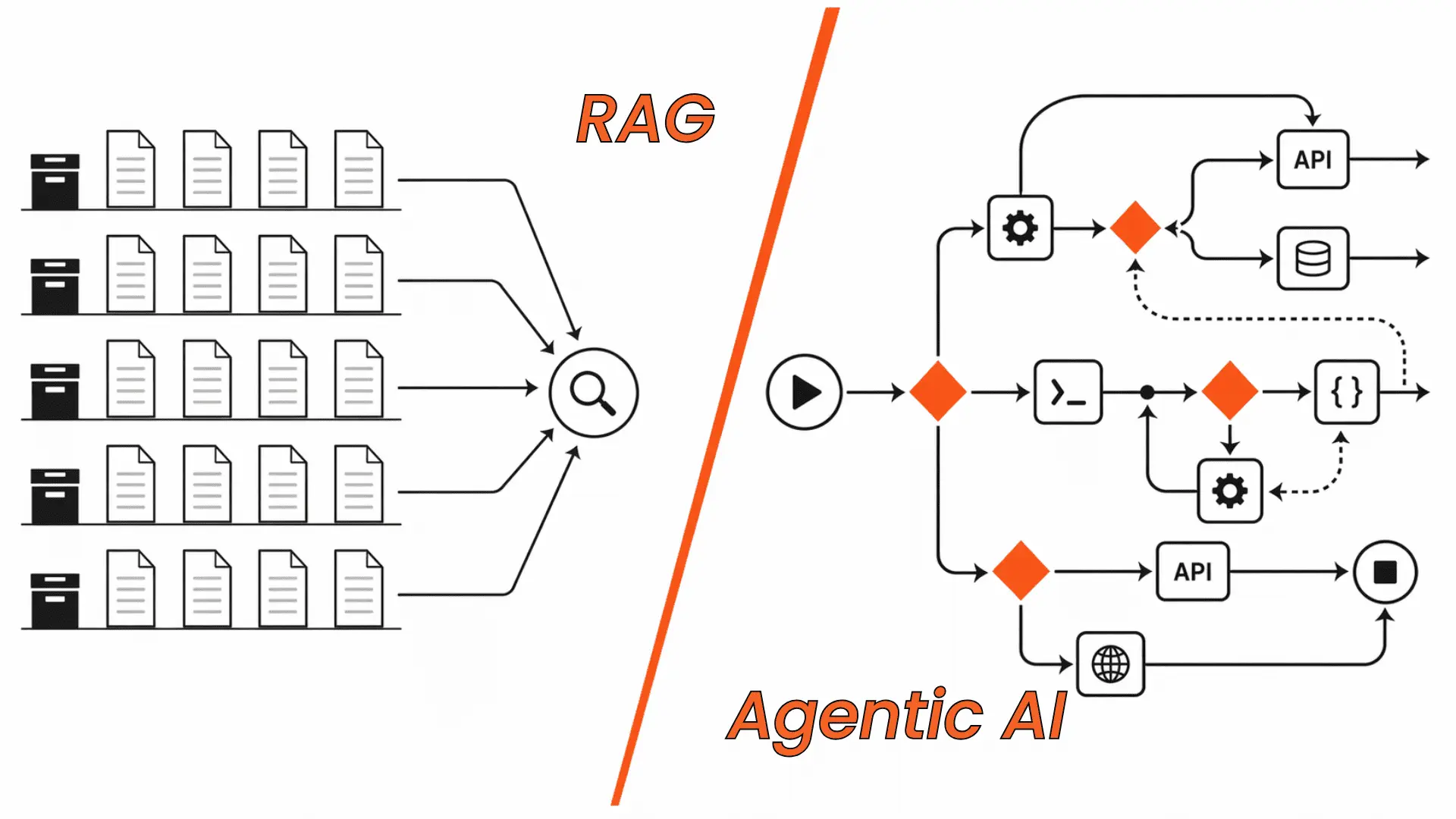
Retrieval-Augmented Generation (RAG) is an AI framework that connects large language models (LLMs) with external knowledge sources to generate more accurate responses. Instead of relying only on pre-trained data, RAG retrieves relevant information from documents, databases, or internal knowledge repositories before generating an answer. This makes it highly effective for businesses that work with constantly changing information.
Many organisations use RAG to improve customer support systems, internal knowledge assistants, compliance tools, and enterprise search platforms. Since the model pulls real-time information from external sources, teams can update knowledge bases without retraining the entire model. This makes RAG a practical and cost-efficient solution for businesses that need accurate answers backed by traceable sources.
How RAG Works: The Three-Step Process
RAG follows a simple but powerful workflow. First, a user submits a query, which is converted into embeddings and matched against a vector database like Pinecone or FAISS using semantic search. The system identifies the most relevant content chunks from the connected knowledge base.
Next, the retrieved information is passed to an LLM as additional context before response generation. Frameworks such as LangChain and LlamaIndex help businesses build these retrieval pipelines efficiently, making responses more accurate and reducing hallucination risks.
Where RAG Excels
RAG works best in environments where factual accuracy matters more than autonomous execution. Businesses use it for customer support chatbots, legal document lookup, financial compliance systems, healthcare documentation retrieval, and internal enterprise search tools.
It also performs well when information changes frequently. Instead of retraining a model every time documents are updated, businesses can simply refresh the external database, making RAG scalable and easier to maintain.
RAG Limitations You Should Know
RAG is powerful, but it has clear limitations. It retrieves information and generates responses, but it cannot independently take actions like scheduling tasks, updating systems, or managing workflows.
It also struggles with complex multi-step reasoning tasks where multiple decisions must happen sequentially. Without memory, planning capabilities, or tool execution, RAG remains a strong retrieval system but not a fully autonomous AI solution.
What Is Agentic AI?
Agentic AI refers to AI systems built to make decisions, complete tasks, and take actions with minimal human intervention. Unlike RAG, which focuses on retrieving information and generating grounded responses, Agentic AI is designed to plan workflows, interact with tools, and execute tasks based on defined goals. It moves AI from simply answering questions to actively completing work.
This model is gaining rapid adoption as businesses look for ways to automate complex operations. From handling customer service workflows to managing internal processes, Agentic AI helps organisations reduce manual effort while improving operational speed. It works particularly well in environments where tasks require reasoning, adaptability, and action execution.
How Agentic AI Works: Perceive, Plan, Act
Agentic AI follows a continuous loop of understanding inputs, creating a strategy, and executing tasks. It first perceives data from users, systems, or environments and then analyses the information to decide the best course of action.
Once the plan is created, the AI interacts with external tools, APIs, software systems, or databases to complete tasks. Frameworks like Microsoft AutoGen, LangChain, LangGraph, and CrewAI are helping businesses build multi-agent systems that can manage complex workflows with greater autonomy.
Where Agentic AI Excels
Agentic AI performs well in multi-step workflows where systems must make decisions and execute tasks independently. Businesses use it for automated customer onboarding, workflow automation, financial reporting, software development support, and intelligent operations management.
It can also connect with multiple enterprise systems to perform tasks such as updating CRMs, sending emails, processing transactions, or coordinating internal workflows. This makes it highly valuable for organisations focused on automation at scale.
Agentic AI Limitations and Risks
Agentic AI offers greater flexibility, but it comes with higher complexity. Since these systems make decisions and interact with external tools, they often require stronger governance, monitoring, and security controls.
They can also become expensive due to higher compute usage, longer processing chains, and potential errors across multi-step tasks. Without proper guardrails and human oversight, autonomous systems can create operational risks that businesses must carefully manage.
RAG vs Agentic AI: Head-to-Head Comparison
RAG vs Agentic AI is not a small technical difference, it’s completely a different way of building AI systems. One is designed to retrieve accurate information from external knowledge sources, while the other is built to reason, plan, and complete tasks independently. Choosing the wrong architecture can lead to unnecessary costs or systems that fail to solve real business problems.
The easiest way to understand the difference is to compare how both models perform across core business and technical requirements.
Factor | RAG | Agentic AI |
|---|---|---|
Core Function | Retrieves external knowledge and generates responses | Makes decisions and executes tasks |
Decision-Making | Limited | High |
Memory | No long-term memory | Can maintain memory/state |
Action Capability | Cannot perform actions | Can interact with tools and systems |
Speed | Faster for direct queries | Slower due to multi-step workflows |
Cost | Lower implementation cost | Higher operational cost |
Complexity | Easier to deploy | More complex architecture |
Best Use Cases | Search, Q&A, documentation | Workflow automation, task execution |
Governance | Easier to monitor | Requires stronger controls |
Failure Risk | Poor retrieval quality | Multi-step execution errors |
RAG works best when businesses need reliable answers backed by structured knowledge bases. Agentic AI becomes valuable when companies need autonomous execution across multiple systems. For many modern enterprises, however, the real opportunity lies in combining both approaches rather than choosing only one.
The Third Path: Agentic RAG (When Both Work Together)
For many businesses, the real debate is no longer RAG vs Agentic AI it is how to combine both for better outcomes. This is where Agentic RAG comes in. Instead of treating retrieval and autonomous execution as separate systems, Agentic RAG combines them to build AI solutions that can access accurate information while also making decisions and taking action.
In a traditional RAG setup, the model retrieves information once and generates a response. In Agentic RAG, the AI agent decides when retrieval is needed, determines what information should be pulled, and evaluates whether the retrieved context is accurate enough before moving forward. This creates a far more flexible and intelligent workflow for complex business tasks.
For example, an AI agent handling insurance claims may first retrieve policy details from a vector database like Pinecone, compare that information with customer records, identify missing documents, request additional information, and then move the claim to the next stage automatically. If the retrieved data is incomplete, the system can refine its search and try again before making a final decision.
This self-correcting approach reduces hallucinations, improves task execution, and creates more reliable enterprise AI solutions. Most businesses building advanced AI products in 2026 are moving toward this hybrid model because real-world workflows rarely need only retrieval or only automation. Many of the intelligent systems built today follow this architecture because it offers both accuracy and operational efficiency.
Which Should You Choose? A Practical Decision Framework
Choosing between RAG, Agentic AI, and Agentic RAG depends on what your business actually needs to solve. The right architecture should align with your operational goals, budget, compliance requirements, and workflow complexity. Instead of chasing trends, businesses should focus on selecting the model that fits their real use case.
Choose RAG if
- You need accurate answers from large knowledge bases
- Your business handles documentation-heavy workflows
- Compliance and source traceability are important
- Your data changes frequently
- You want faster responses at lower operational costs
- Your primary need is search, support, or information retrieval
RAG works well for legal research platforms, internal knowledge assistants, healthcare documentation systems, and customer support chatbots where factual accuracy matters most.
Choose Agentic AI if
- Your workflows require multi-step reasoning
- You need AI systems that can take actions
- Your teams want process automation
- You need AI to interact with APIs, CRMs, or enterprise tools
- Your business handles repetitive operational workflows
Agentic AI is ideal for businesses looking to automate onboarding, financial reporting, workflow approvals, scheduling tasks, and operational execution.
Choose Agentic RAG if
- You need both accuracy and automation
- Your workflows involve complex decision-making
- You operate in regulated industries
- Your AI system must validate information before taking action
- You want more resilient enterprise AI systems
This model works well for enterprise-grade healthcare platforms, fintech systems, legal automation tools, and advanced customer service solutions where both trust and automation matter. Many businesses are moving toward this hybrid approach because it solves more realistic operational challenges.
Real-World Business Use Cases
The difference between RAG vs Agentic AI becomes much clearer when applied to real business scenarios. Most enterprises are not building AI systems for experimentation they want measurable outcomes like faster operations, lower costs, and better customer experiences. In many cases, businesses use RAG, Agentic AI, or a hybrid model depending on the complexity of their workflows.
Customer Support
RAG helps customer support teams deliver faster and more accurate responses by retrieving answers from product documentation, FAQs, and internal knowledge bases. When combined with Agentic AI, the system can also escalate tickets, draft responses, update CRM records, and automate follow-ups without human intervention.
Legal and Compliance
Law firms and compliance teams use RAG to retrieve contracts, regulations, and policy documents quickly. Agentic RAG adds another layer by validating information from multiple sources, identifying missing documents, and creating traceable workflows that reduce compliance risks.
Software Development
Development teams are increasingly using Agentic AI to automate coding workflows such as planning tasks, generating code, testing features, and debugging issues. As a software development company, Alpharive helps teams use RAG and Agentic AI to support coding workflows, technical knowledge, and intelligent software development.
Financial Services
Financial institutions use RAG to pull real-time policy updates, market reports, and compliance documentation. Agentic AI can then automate reporting workflows, process operational tasks, and generate structured outputs that help teams move faster while maintaining accuracy.
Healthcare Operations
Healthcare organisations rely on RAG to retrieve patient guidelines, treatment protocols, and medical documentation. When paired with Agentic AI, hospitals can automate appointment workflows, manage claims processing, and improve operational efficiency while maintaining better access to critical information.
Build the Right AI Solutions with Alpharive
Choosing between RAG vs Agentic AI is about building an AI system that solves real business problems. Some companies need reliable retrieval systems that deliver accurate responses from large knowledge bases, while others need autonomous AI agents that can handle complex workflows and reduce manual effort across operations.
In many enterprise environments, the best outcomes come from combining both through hybrid AI architectures. Alpharive, as an AI Development Company we help businesses with RAG Development, Agentic AI solutions, and advanced Agentic RAG systems built around specific operational goals. Whether you want to improve knowledge retrieval, automate workflows, or build intelligent AI products from scratch, our team can help you create solutions that deliver long-term value.