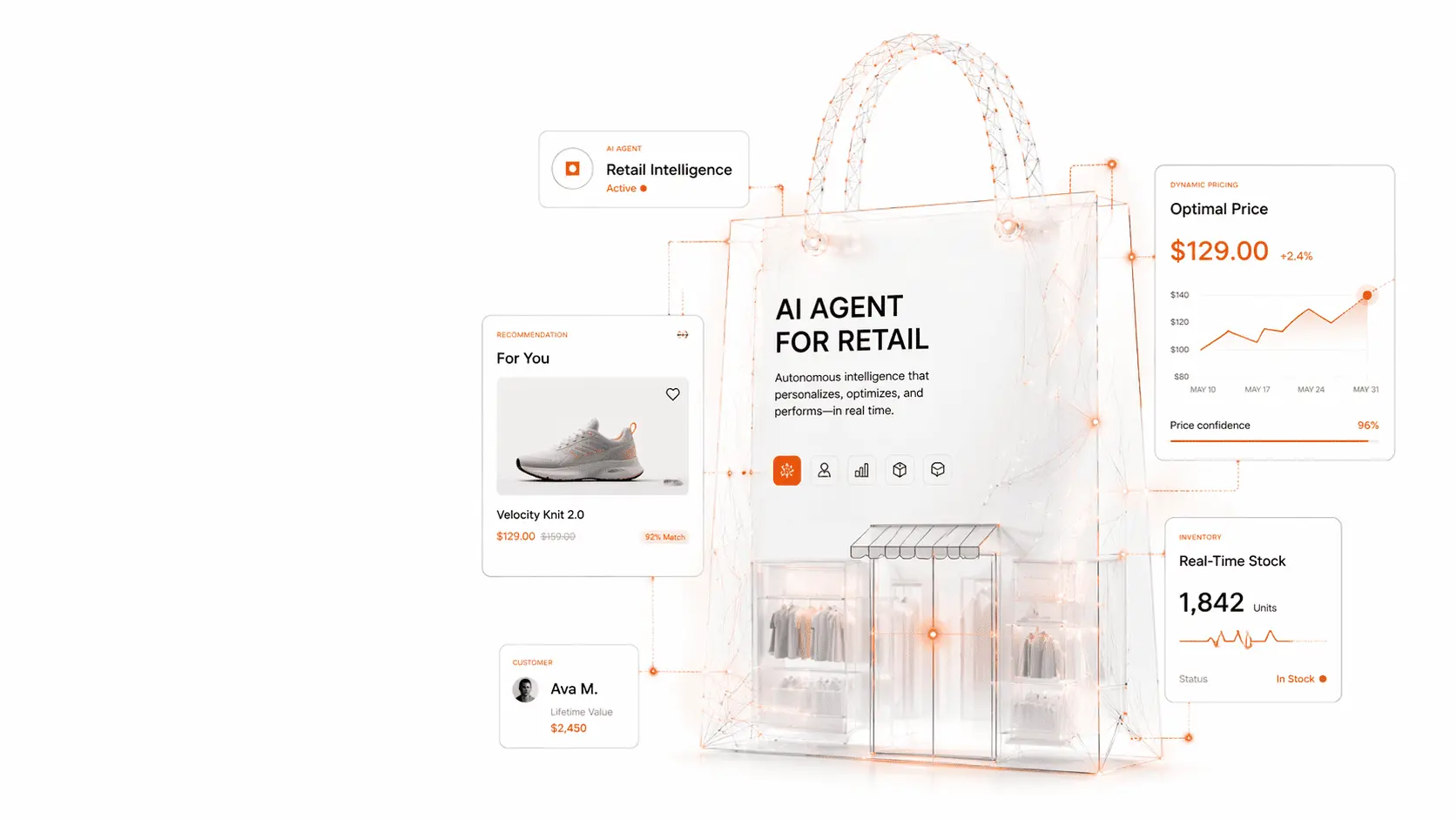
Retail today isn’t just about selling products, it’s about delivering the right experience at the right moment. Customers expect personalized recommendations, instant support, and seamless interactions across every channel. But as data grows, making timely decisions becomes harder, not easier. This is where AI agents are changing the game.
They don’t just analyze customer behavior, they act on it in real time, helping retailers deliver more relevant experiences, optimize operations, and respond instantly to changing demand.
How AI Agents Are Transforming the Retail Industry
AI agents are reshaping retail by turning data into real-time actions across customer journeys and business operations. Instead of static systems, retailers now operate with intelligent layers that continuously adapt to customer behavior and market conditions.
Elevating Customer Experience
AI agents enable hyper-personalized shopping experiences by analyzing browsing patterns, preferences, and purchase history. They ensure every interaction from product discovery to checkout is tailored to the individual customer.
Improving Operational Efficiency
Retail operations involve multiple moving parts, from inventory to order fulfillment.
AI agents streamline these processes by automating workflows, reducing manual effort, and ensuring faster execution across systems.
Driving Data-Backed Decisions
Retailers generate massive amounts of data, but value comes from acting on it.
AI agents process this data in real time, enabling smarter pricing, demand planning, and customer engagement decisions.
Top Use Cases of AI Agents in Retail
AI agents are transforming retail by operating across multiple touchpoints, from customer interactions to backend operations. These use cases show how retailers are applying AI agents to improve customer experience, optimize operations, and drive better business outcomes.
1. Product Recommendations and Personalization
AI agents analyze customer behavior, browsing patterns, and purchase history to deliver highly relevant product recommendations. Instead of generic suggestions, customers receive personalized options that align with their preferences, leading to higher engagement and conversions.
2. Virtual Shopping Assistants
AI-powered assistants guide customers through their shopping journey in real time. They answer queries, suggest products, and help users make decisions, creating a more interactive and seamless experience across websites and mobile apps.
3. Inventory and Demand Forecasting
AI agents predict demand by analyzing historical data, seasonal trends, and real-time signals. This helps retailers maintain optimal stock levels, reduce overstocking or stockouts, and improve supply chain efficiency.
4. Dynamic Pricing Optimization
AI agents continuously monitor market conditions, competitor pricing, and customer demand.
They adjust prices in real time to maximize revenue while remaining competitive, ensuring better pricing strategies without manual intervention.
5. Customer Support Automation
AI agents handle customer queries through chat and voice interfaces. They resolve common issues instantly, provide order updates, and escalate complex cases when needed, reducing response time and improving customer satisfaction.
6. Fraud Detection and Prevention
AI agents monitor transactions and user behavior to detect anomalies and potential fraud. They identify suspicious activities in real time, helping retailers minimize risks and secure payment processes.
Behind these use cases is a structured system that enables AI agents to process data, make decisions, and take action in real time
How AI Agents Work in Retail Systems
AI agents in retail operate through a continuous cycle of understanding data, making decisions, and taking action. They connect customer interactions, business systems, and operational workflows into a unified layer that works in real time.
Data Collection Across Touchpoints
AI agents gather data from multiple sources, including websites, mobile apps, in-store systems, and customer interactions. This includes browsing behavior, purchase history, inventory data, and transaction patterns.
Decision-Making Through AI Models
Once data is collected, AI agents analyze it using machine learning models and predefined business logic. They identify patterns, predict outcomes, and determine the most relevant action, whether it’s recommending a product, adjusting pricing, or flagging a risk.
Action and Execution in Real Time
After making a decision, AI agents execute actions instantly across connected systems.
This could involve:
- Updating product recommendations
- Triggering promotions
- Adjusting prices
- Responding to customer queries
Continuous Learning and Improvement
AI agents improve over time by learning from new data and outcomes.
They refine their recommendations, adapt to changing customer behavior, and continuously optimize retail operations.
Challenges of Implementing AI Agents in Retail
While AI agents bring significant advantages, implementing them in retail environments comes with practical challenges. However, with the right approach, these challenges can be effectively addressed. Success depends not just on technology, but on how well data, systems, and teams are aligned.
Data Privacy and Security
AI agents rely on large volumes of customer data, including personal information and transaction history. Protecting this data is critical to maintaining customer trust and regulatory compliance.
Key challenges include:
- Ensuring compliance with data protection regulations
- Securing sensitive customer and payment data
- Preventing unauthorized access and potential breaches
Integration with Existing Systems
Retail businesses often operate across multiple platforms, including e-commerce systems, POS, and legacy infrastructure.
Common challenges include:
- Lack of seamless communication between systems
- Data silos across platforms
- Complex integration requirements and dependencies
Change Management
AI agents change how retail teams operate and make decisions, which requires organizational alignment.
Key considerations include:
- Training teams to work with AI-driven systems
- Building trust in automated decision-making
- Managing workflow and process transitions
As these challenges are addressed, retailers are moving toward more adaptive, intelligent, and customer-centric systems.
The Future of AI Agents in Retail
For retail business owners and startups, the shift toward AI agents isn’t about future trends; it’s about staying competitive today. Customer expectations are rising fast. Shoppers expect personalized experiences, instant responses, and seamless interactions across every channel.
At the same time, managing inventory, pricing, and operations is becoming more complex. Relying on manual decisions or disconnected systems makes it harder to keep up.
AI agents change this by turning everyday retail operations into intelligent, real-time systems. Instead of reacting to customer behavior after it happens, businesses can anticipate demand, adjust pricing dynamically and deliver personalized experiences instantly. This directly impacts what matters most: conversion rates, customer retention, and operational efficiency.
For startups, this creates an opportunity to build smarter systems from day one without the overhead of traditional retail models. For established businesses, it provides a way to modernize operations, reduce inefficiencies, and scale without increasing complexity.
As adoption grows, AI agents are becoming a core part of how retail businesses operate. Many companies are already investing in custom AI development services to create solutions tailored to their customer journeys and workflows. The result is a shift from managing transactions to running intelligent systems that continuously learn, adapt, and improve.
Conclusion: From Transactions to Intelligent Experiences
Over 77% of consumers prefer brands that offer personalized experiences, making it clear that generic interactions are no longer enough. Businesses that fail to adapt risk losing both relevance and revenue in an increasingly competitive market.
At the same time, managing modern retail operations has become more complex. From inventory and pricing to customer engagement across multiple channels, the need for faster and more accurate decision-making is critical. This is where AI agents make a measurable difference by turning data into real-time actions that improve both customer experience and operational efficiency.
For startups, this creates an opportunity to build intelligent systems from day one, and for established businesses, it provides a path to modernize, reduce inefficiencies, and scale without increasing complexity. AI agents enable retailers to move from reactive processes to systems that continuously learn, adapt, and respond.
At Alpharive, we help retail businesses achieve this shift through tailored Custom AI agent development, building solutions that align with real-world operations and deliver measurable outcomes. The future of retail belongs to businesses that can act faster, think smarter, and deliver more relevant experiences at every touchpoint.