Banks are struggling with making decisions at the right time. Every day, thousands of processes move through underwriting, compliance, and customer operations, yet most of them still depend on fragmented systems and manual intervention. What this really means is speed, accuracy, and scale are still limited by how work is structured, not by how much technology is available.
The shift now isn’t about adding more AI into existing workflows. It’s about redesigning how work happens altogether, moving from systems that assist humans to systems that can act, decide, and continuously optimize outcomes.
What Is Agentic AI in Banking?
"Agentic AI" in banking refers to systems that don’t just analyze data or assist workflows but actively plan, decide, and execute tasks with minimal human intervention. Unlike traditional AI models that depend on predefined rules or prompts, agentic systems operate with goals, adapt to changing inputs, and continuously improve outcomes.
What this really means is that banks move from fragmented, human-dependent processes to intelligent systems that can manage end-to-end workflows from data intake to decision execution. However, adopting agentic AI is not a simple upgrade. A structured approach is necessary. That’s where this roadmap becomes critical.
Before Implementing AI Systems
1. Assess Systems
Before introducing agentic AI, banks need a clear view of where inefficiencies exist. This means auditing existing applications, workflows, and infrastructure to identify where decision-making is delayed, manual effort is high, or processes break down.
The goal here isn’t to replace everything but to pinpoint high-impact areas where agentic systems can deliver immediate value.
2. Upskill Teams
Technology alone won’t drive transformation. Teams need to understand how to work alongside AI agents, manage outcomes, and shift from execution to oversight. This step is about building a workforce that can guide, monitor, and optimize AI-driven processes, not compete with them.
3. Strengthen Data
Agentic AI is only as effective as the data it relies on. Inconsistent, unstructured, or siloed data will limit performance and introduce risk. Banks need to focus on data standardization, quality, and governance to ensure decisions made by AI systems are accurate, compliant, and trustworthy.
4. Pilot, Then Scale
Jumping straight into large-scale implementation increases risk. Instead, banks or finance sectors should start with targeted pilots in specific functions, measure outcomes, and refine systems before expanding. This approach allows organizations to validate impact, reduce uncertainty, and build confidence across stakeholders.
5. Partner with Experts
Agentic AI requires both technical depth and domain expertise. Partnering with experienced AI providers and financial specialists accelerates implementation and reduces costly mistakes.
At Alpharive, as a software development company, we work closely with financial institutions to design and deploy agentic AI systems that align with real-world banking workflows, compliance requirements, and scalability needs.
The right partnerships help banks move faster while maintaining control over quality, compliance, and long-term strategy.
Why Banking Is Moving Beyond Traditional AI
Traditional AI in banking has largely focused on automation and prediction, but it still operates within predefined rules and fragmented systems. As a result, workflows remain slow, reactive, and dependent on human intervention to move from one stage to the next. What’s missing is continuity. Most systems can analyze or assist, but they can’t execute end-to-end processes in real time.
Agentic AI alters the equation in this context. Instead of isolated capabilities, it enables connected, intelligent workflows that operate across systems, process data in real time, reduce errors, and scale without friction.
- Integration with existing systems ensures AI works within the current banking infrastructure, not outside it
- Real-time processing eliminates delays between data input and decision-making
- Error reduction improves accuracy by minimizing manual touchpoints
- Scalability allows banks to handle increasing volumes without proportional resource growth
What this really means is that banks are no longer limited by static automation models. They can move toward systems that continuously act, adapt, and optimize outcomes, which is something traditional AI was never designed to achieve.
How Agentic AI Is Reshaping Financial Work
Agentic AI is not just improving existing processes it is fundamentally changing how financial work is structured and executed. Instead of relying on disconnected systems and manual handoffs, banks can move toward continuous, intelligent workflows that operate with minimal intervention.
At the core of this shift is the ability of AI agents to manage entire processes end-to-end. They don’t just analyze data or generate insights but take action, make decisions within defined boundaries, and adapt based on real-time inputs. This changes how work flows across the organization.
- From sequential to continuous execution: Traditional workflows move step by step, often waiting on approvals or data availability. Agentic AI enables processes to run continuously, reducing idle time and accelerating outcomes.
- From manual coordination to intelligence: Instead of teams managing handoffs between systems, AI agents coordinate tasks across functions, ensuring smoother and faster execution.
- From reactive to real-time decision-making: Decisions are no longer delayed by human bottlenecks. AI systems process inputs instantly and act within predefined rules and goals.
- From static processes to adaptive systems, workflows are no longer fixed. Agentic AI continuously learns from outcomes and adjusts processes to improve efficiency and accuracy.
What this really means is financial institutions are shifting from task-driven operations to outcome-driven systems. Work is no longer defined by individual actions but by how effectively systems can deliver results at scale.
This transformation lays the foundation for more efficient operations, better risk management, and a new level of responsiveness across banking functions.
From Fragmented Workflows to Agent-Driven Banking Operations
Traditional banking workflows are built on fragmentation. Each stage document review, data extraction, underwriting, and approvals operates in isolation, often requiring manual intervention to move forward. The result is slow processing, repeated errors, and multiple handoffs that increase both cost and risk.
Agentic AI changes this by turning disconnected steps into a unified, intelligent workflow. Instead of passing tasks between systems and teams, AI agents manage the process end-to-end, ensuring continuity, speed, and accuracy.
- Fewer handoffs, faster execution:
Processes that once required multiple transitions across teams can now move seamlessly within a single system, significantly reducing delays. - Reduced manual effort and errors
Automated data extraction and validation eliminate repetitive tasks and minimize inconsistencies, improving overall quality. - Accelerated decision cycles
What previously took days can now be completed in hours, with AI systems handling verification, analysis, and initial decision-making. - Improved consistency and compliance
Standardized workflows ensure that every step follows defined rules, reducing variability and strengthening regulatory alignment.
What this really means is banking operations are no longer constrained by how work is divided across teams. Instead, they are driven by how efficiently outcomes can be delivered, with AI agents ensuring processes are faster, cleaner, and more scalable.
The Shift to Human-Agent Collaboration
Agentic AI is about redefining where human value sits. As AI agents take over repetitive processing, data validation, and initial decision workflows, teams are freed from execution-heavy tasks and can focus on oversight, judgment, and strategic direction. This signifies a transition from performing tasks to overseeing and improving their execution.
Employees move into roles where they supervise AI-driven processes, handle exceptions, and ensure outcomes align with risk, compliance, and business objectives. At the same time, decision-making becomes more structured AI delivers speed and consistency, while humans retain ownership in complex or high-stakes scenarios. This also breaks down traditional silos, as AI agents operate across systems, enabling teams to collaborate around outcomes rather than functions. The result is a workforce that is not reduced, but elevated, less focused on operational workload and more aligned with strategy, customer impact, and long-term growth.
Strategic Impact of Agentic AI on Banking Performance and Growth
Fintech startups and modern banks are no longer competing on features they’re competing on execution speed. Agentic AI changes the game by enabling systems that don’t just assist but actively execute decisions, adapt in real time, and operate across workflows. What this really means is faster scaling, smarter operations, and a clear path to measurable business impact.
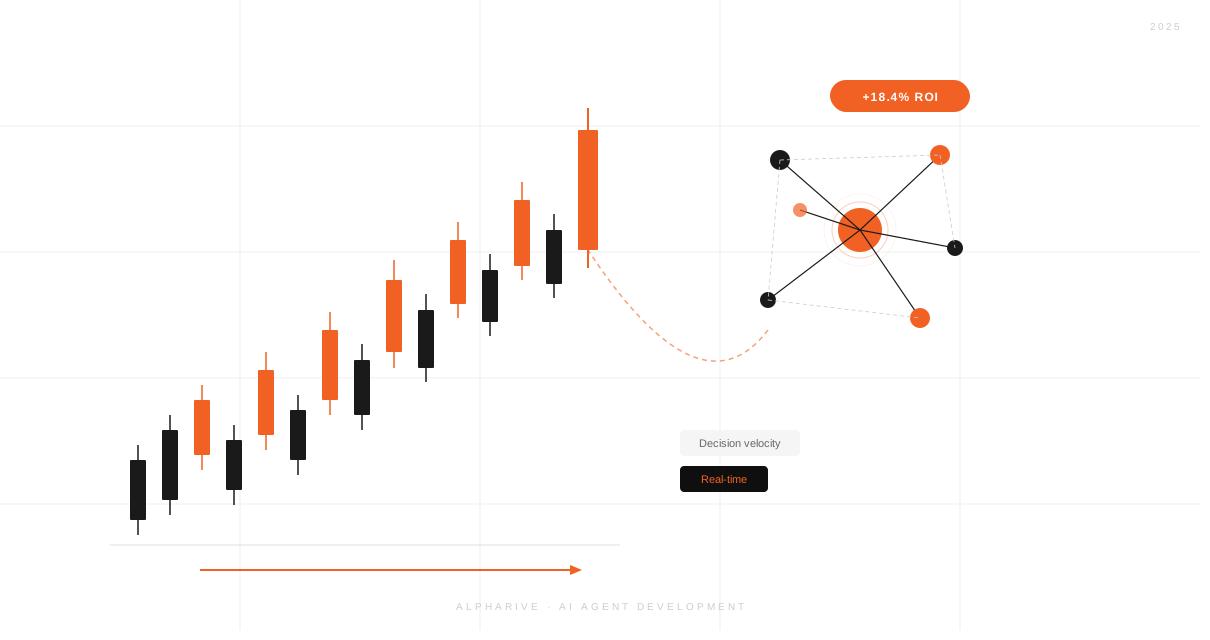
The biggest shift is in productivity and decision velocity. Processes like underwriting, onboarding, and fraud detection that once took hours or days can now happen in near real time, with fewer resources and higher accuracy. With the right approach to AI agent development, fintechs can reduce operational costs, improve customer experience, and scale without increasing headcount.
This is where working with an experienced AI agent development company becomes a strategic advantage. Instead of building isolated solutions, fintechs can deploy end-to-end intelligent systems that drive consistency, reduce risk, and unlock new growth opportunities. The result isn’t just efficiency, it’s the ability to compete, scale, and lead in a rapidly evolving financial landscape.
Conclusion
Banking is moving beyond incremental improvements toward a complete shift in how work is designed and executed. Agentic AI is at the center of this transformation, enabling systems that don’t just assist but actively manage workflows, make decisions, and continuously optimize outcomes. The future of banking is about how smartly systems scale and execute.
The institutions that move early will gain more than efficiency. They will build faster decision cycles, more adaptive operations, and a workforce focused on strategy rather than routine execution. Those delays will find themselves limited by outdated processes in a market that increasingly rewards speed, accuracy, and responsiveness.
Alpharive, as an AI agent development company, we work with financial institutions to design and implement agentic AI systems that align with real-world banking operations, compliance requirements, and long-term growth strategies. The shift is already underway. The question is not whether banks will adopt agentic AI, but how quickly they can turn it into a competitive advantage.