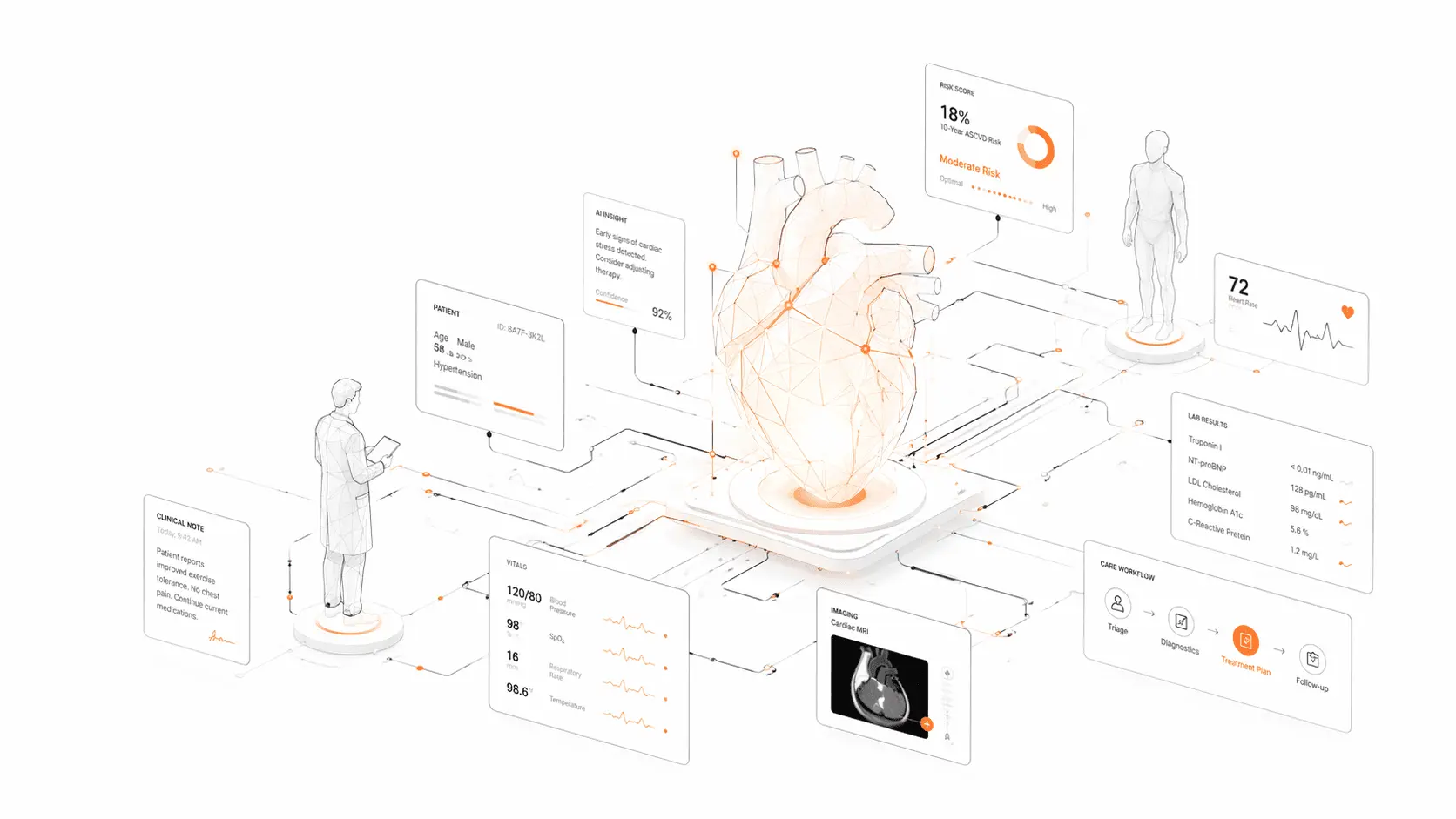
Healthcare doesn’t have a data problem rather, it has a coordination problem. Every day, patient information flows across EHRs, labs, billing systems, and insurance platforms, yet most of these systems operate in isolation. Instead of enabling faster care, this fragmentation creates delays, increases administrative burden, and forces clinicians to spend more time navigating systems than treating patients.
The issue isn’t the lack of technology, it’s how that technology is used. Traditional AI has improved specific tasks like documentation or predictions, but it hasn’t fixed the underlying workflow gaps. Processes still rely on manual handoffs, decisions are often delayed, and critical information doesn’t move seamlessly across the care journey.
Agentic AI introduces a different approach. Instead of assisting in isolated steps, it enables systems that can coordinate workflows, make decisions, and execute tasks across multiple touchpoints. For healthcare providers and healthtech startups, this opens the door to faster operations, reduced friction, and a more scalable model of care delivery in an increasingly complex environment.
What Is Agentic AI in Healthcare?
AI agents in healthcare are intelligent systems that can analyze data, make decisions, and execute tasks across clinical and administrative workflows. Unlike traditional AI, they don’t just assist; they actively manage processes such as patient intake, documentation, decision support, and care coordination in real time.
For healthcare providers and healthtech startups, this shifts AI from a supporting tool to an operational layer that drives execution. It enables faster decisions, reduces manual coordination, and creates a more connected system where care delivery and operations can scale without added complexity.
Why Healthcare Systems Are Failing to Keep Up
Today, 30–40% of healthcare spending is tied to administrative tasks, much of which is still handled manually. Clinicians spend nearly 2× more time on documentation than with patients, increasing burnout and reducing care quality.
Fragmentation makes it worse. Most healthcare organizations operate across multiple disconnected systems: EHRs, labs, billing, and insurance platforms leading to delays and inefficiencies. Studies show that up to 80% of patient data remains unstructured, making it difficult to access, analyze, and act on in real time. As a result, critical decisions are often delayed, impacting both outcomes and operational performance.
At the same time, demand is rising while capacity remains constrained. The global healthcare workforce is projected to face a shortage of 10+ million professionals by 2030, yet patient volumes continue to grow. Without a shift in how workflows are managed, healthcare organizations will continue to scale costs instead of care, making it harder to deliver fast, efficient, and high-quality services.
How Agentic AI Fixes Fragmented Care Workflows
Agentic AI addresses one of healthcare’s biggest challenges fragmentation by enabling systems that can operate across multiple touchpoints instead of within isolated functions. Rather than relying on manual coordination between EHRs, labs, billing, and insurance platforms, AI agents can connect these systems and manage workflows as a continuous process.
Instead of moving step by step with delays and handoffs, workflows become integrated and real-time. AI agents can collect patient data, validate inputs, trigger actions, and update systems simultaneously, reducing the need for repetitive manual intervention. This eliminates bottlenecks and ensures that critical information flows seamlessly across the care journey.
The impact is immediate at an operational level. Administrative tasks are reduced, decision-making becomes faster, and errors caused by manual data handling are minimized. At the same time, care teams gain better visibility across processes, allowing them to focus on patient outcomes rather than system coordination.
By shifting from disconnected systems to intelligent, end-to-end workflows, agentic AI enables healthcare organizations to operate with greater speed, accuracy, and scalability without adding complexity to existing infrastructure.
The Shift to Human Agent Collaboration in Healthcare
Agentic AI doesn’t replace healthcare professionals it changes how they work. As AI agents take over administrative tasks, data processing, and routine coordination, clinicians and care teams are no longer tied to repetitive workflows. Instead, their focus shifts toward clinical judgment, patient interaction, and decision oversight.
This shift improves both efficiency and the quality of care. Doctors and nurses spend less time on documentation and system navigation and more time on patient care. At the same time, AI agents handle data validation, workflow coordination, and real-time insights, ensuring that processes move faster without compromising accuracy or compliance.
For healthcare organizations, this creates a more balanced operating model. AI drives execution and consistency, while humans retain control over complex, high-risk decisions. The result is not a reduced workforce, but an augmented one, more productive, less burdened, and better aligned with patient outcomes.
Strategic Impact of Agentic AI on Care, Cost, and Scale
Agentic AI is not just improving healthcare workflows it is redefining how organizations deliver care, manage costs, and scale operations. Organizations that adopt enterprise AI solutions early and implement multi-agent systems can move beyond incremental improvements toward measurable business impact. For healthcare providers investing in AI agent development, this shift is becoming a key driver of operational efficiency and long-term growth.
The value becomes clear when comparing adoption maturity and system design. Healthcare providers using integrated, multi-agent architectures achieve faster operations, higher cost savings, and more consistent outcomes, while those relying on isolated tools struggle to scale impact. This shift is creating a growing gap between early adopters and late movers, making execution strategy as important as adoption itself.
Conclusion
Healthcare is entering a phase where efficiency is no longer enough execution is what defines success. Agentic AI is enabling systems that don’t just support decisions but actively manage workflows, coordinate across systems, and deliver outcomes in real time. This shift allows healthcare organizations to move faster, reduce operational burden, and improve care delivery without increasing complexity.
The real advantage lies in how AI is implemented. Organizations adopting integrated, multi-agent systems are already outperforming those relying on isolated tools, creating a clear gap in cost efficiency, scalability, and performance. As adoption accelerates, the difference between early movers and late adopters will continue to grow.
Alpharive, as an AI agent development company, we work with healthcare providers and healthtech startups to design and deploy agentic AI systems that align with real-world workflows, compliance requirements, and long-term growth strategies. The opportunity is clear: those who act now won’t just improve operations, they’ll define the future of healthcare delivery.