
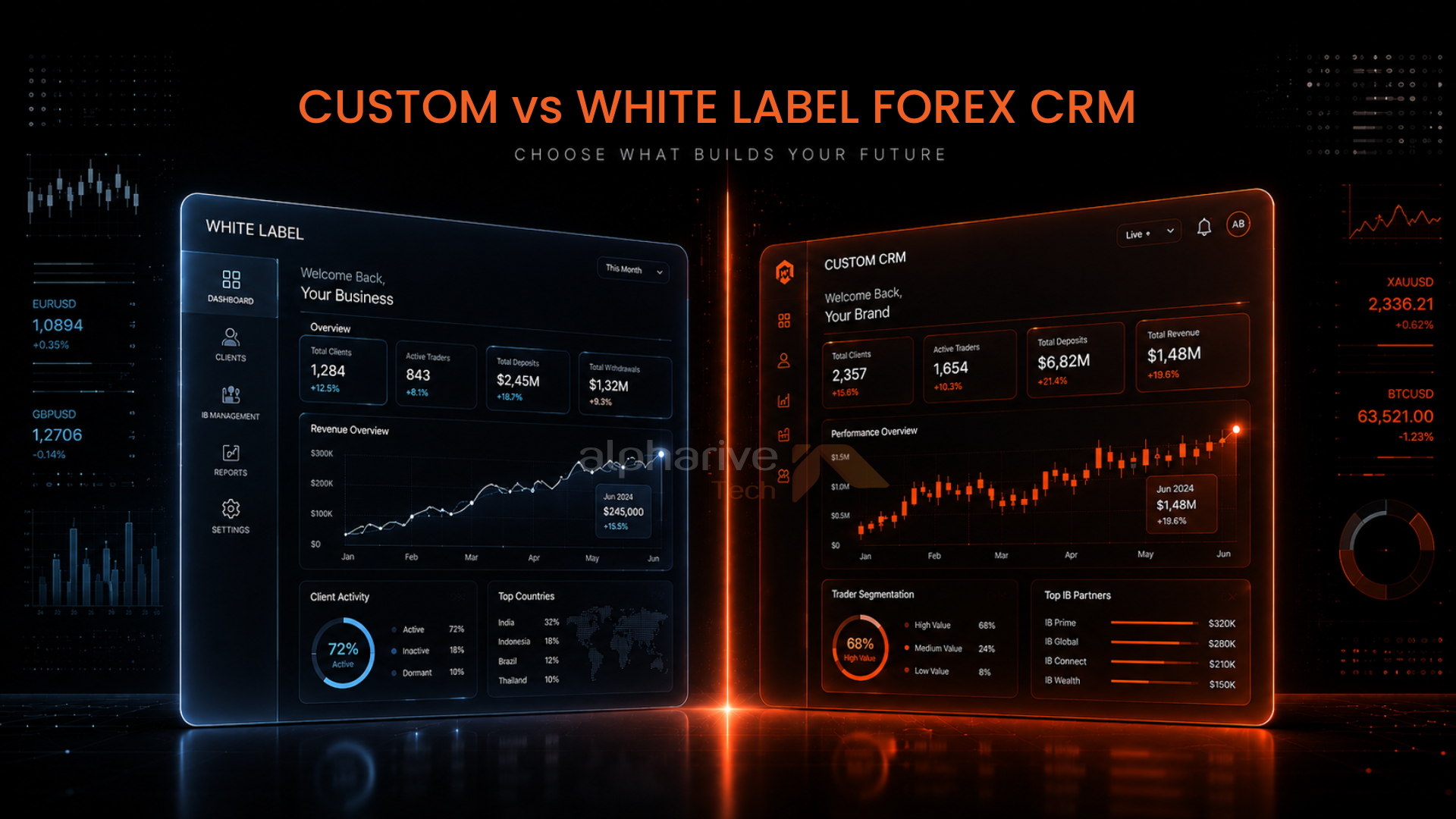
Launching a brokerage has become easier. Scaling one has not.
Over the last few years, forex competition has shifted away from simply offering trading access. Brokers now compete on onboarding speed, trader retention, operational efficiency, reporting visibility, and customer experience. Behind all of that sits one critical layer that often gets underestimated early: CRM infrastructure.
For many brokerages, choosing between a custom and white label Forex CRM becomes one of the first major technology decisions.
At first, the answer appears obvious.
White label solutions promise faster launch timelines and lower upfront costs. Custom development offers flexibility and ownership but demands more investment.
But once brokers begin scaling operations, onboarding more traders, managing partner programs, and connecting multiple systems, the decision becomes less about software and more about operational strategy.
This guide breaks down custom vs white label Forex CRM from the perspective of US brokers evaluating long term growth.
Why Forex Brokers Are Reconsidering CRM Infrastructure in 2026
A modern forex broker CRM is no longer a contact management tool.
Today’s brokers rely on CRM infrastructure to coordinate multiple business functions including:
- Lead capture and conversion
- Trader onboarding
- KYC verification
- Deposits and withdrawals
- Partner and IB management
- Client segmentation
- Customer retention
- Reporting and analytics
- Back office operations
As brokerages grow, manual workflows become difficult to maintain. A modern forex back office software helps centralize operations and improve visibility
That creates a common challenge: continue using an existing platform with limitations or move toward infrastructure designed for scale.
This is where the conversation around custom vs white label forex CRM becomes increasingly relevant.
What Is a White Label Forex CRM?
White label Forex CRM software is a ready-to-launch solution licensed from a provider and deployed under the broker’s brand.
Instead of building infrastructure from scratch, brokers gain access to predefined workflows, dashboards, and operational tools.
This model is popular among new brokerages because it reduces technical complexity.
Advantages of White Label Forex CRM
Faster launch timelines
Deployment often moves significantly faster than building internally.
Lower upfront investment
Initial development costs are typically reduced compared with custom platforms.
Reduced technical responsibility
The provider handles infrastructure maintenance and updates.
Established workflows
Many solutions already include onboarding, account management, and reporting features.
White label CRM can create a practical entry point for brokers entering competitive markets.
Limitations Brokers Should Consider
Speed comes with tradeoffs.
Common challenges include:
- Limited customization
- Restricted third party integrations
- Dependency on provider roadmap
- Licensing costs over time
- Difficulty supporting unique workflows
These limitations may not appear early but often become visible during growth stages.
What Is a Custom Forex CRM?
Custom Forex CRM is designed around the brokerage rather than adapting the brokerage to software limitations.
Every module, integration, dashboard, and workflow can be developed according to operational requirements.
For brokers expecting long term expansion, custom infrastructure creates greater control.
Advantages of Custom Forex CRM
Workflow flexibility
Build onboarding and operational processes around business goals.
Integration freedom
Connect liquidity providers, payment systems, analytics tools, and internal applications.
Better scalability
Expand architecture as trading volume and operational requirements increase.
Stronger competitive differentiation
Deliver unique experiences that competitors using shared platforms cannot easily replicate.
Ownership and visibility
Greater control over reporting, data, and future platform decisions.
Tradeoffs to Consider
Custom development also introduces challenges:
- Longer implementation cycles
- Higher initial investment
- Planning and architecture requirements
- Ongoing technical ownership
For some brokers, these tradeoffs become worthwhile only after reaching growth milestones.
Custom vs White Label Forex CRM: Full Comparison
Choosing the right forex CRM software requires evaluating long term business outcomes rather than launch speed alone.
Deployment Speed
White Label:
Fast implementation with predefined workflows.
Custom:
Longer development but aligned with exact operational needs.
Winner:
White Label
Upfront Investment
White Label:
Lower initial spending.
Custom:
Higher entry investment.
Winner:
White Label
Long Term Cost
White Label:
Recurring licensing and upgrade expenses may increase over time.
Custom:
Higher initial cost but stronger ownership potential.
Winner:
Depends on growth horizon.
Ownership and Control
White Label:
Platform decisions remain partially controlled by the vendor.
Custom:
Full business ownership.
Winner:
Custom
Integrations
White Label:
Often limited by provider ecosystem.
Custom:
Built to support operational flexibility.
Winner:
Custom
Automation
White Label:
Standard automation options.
Custom:
Advanced workflow optimization opportunities.
Winner:
Custom
Scalability
White Label:
Suitable for early growth.
Custom:
Supports long term operational expansion.
Winner:
Custom
Maintenance
White Label:
Lower internal responsibility.
Custom:
Requires technical ownership.
Winner:
White Label
Which Forex CRM Is Better for Different Broker Stages?
There is no universal answer.
The right choice depends on where the brokerage stands today and where it plans to go.
Startup Brokers
A white label Forex CRM often makes more sense.
Primary priorities usually include:
- Faster launch
- Lower capital requirements
- Faster validation
Recommended direction:
White Label
Growth Stage Brokers
Operational complexity starts increasing.
New priorities appear:
- Retention
- Automation
- Multi team workflows
- Better analytics
Recommended direction:
Hybrid evaluation
Enterprise Brokerages
At scale, flexibility becomes essential.
Common requirements include:
- Advanced reporting
- Multiple business units
- Deep integrations
- Custom operational logic
Recommended direction:
Custom CRM
Hidden Costs Brokers Often Miss When Choosing CRM
Initial pricing rarely tells the full story. Several costs tend to emerge later.
Vendor lock in
Changing providers becomes expensive.
Integration restrictions
Adding new services may require provider approval.
Licensing expansion
Additional users and modules increase recurring costs.
Migration expenses
Moving data and rebuilding workflows requires time and budget.
Operational inefficiencies
Manual work creates hidden overhead.
When comparing forex broker CRM solutions, evaluate total ownership cost rather than launch cost.
How US Forex Brokers Should Evaluate CRM Vendors
Before choosing a Forex CRM Provider, brokers should evaluate operational fit.
Use this checklist.
Technical Evaluation
✔ API flexibility
✔ Integration capabilities
✔ Security architecture
✔ Performance under scale
Operational Evaluation
✔ Trader onboarding
✔ Back office workflows
✔ Reporting depth
✔ Automation support
Growth Evaluation
✔ Vendor roadmap
✔ Long term scalability
✔ Customization flexibility
✔ Support responsiveness
This framework creates better decisions than comparing features alone.
Final Verdict: Should You Choose Custom or White Label Forex CRM?
The wrong CRM decision rarely causes immediate failure.
Instead, limitations appear gradually through slower operations, fragmented reporting, rising costs, and reduced flexibility.
White label Forex CRM remains an effective option for brokers prioritizing speed and market entry.
Custom Forex CRM becomes increasingly valuable for brokers focused on ownership, scalability, automation, and long term growth.
The question is not which option is universally better.
The better question is:
Will your CRM still support your business two years after launch?
If the answer is uncertain, that decision deserves deeper evaluation before scaling further.
Frequently Asked Questions
Is white label Forex CRM cheaper than custom CRM?
Usually upfront, yes. Long term costs depend on licensing, upgrades, and operational requirements.
Can brokers migrate from white label to custom CRM?
Yes, although migration complexity increases with business size and integration depth.
What should a forex broker CRM include?
Core capabilities include onboarding, KYC workflows, reporting, automation, analytics, and back office management. Brokers evaluating platforms should also review the most important Forex CRM features that directly influence trader acquisition, retention, and operational performance.
How long does custom forex CRM development take?
Timelines vary depending on requirements, integrations, and platform complexity.
Is custom Forex CRM worth it for growing brokerages?
For brokers expecting operational expansion and advanced requirements, custom infrastructure may create stronger long term value.