
Launching a forex brokerage has never been more accessible.
Modern platforms, infrastructure providers, and deployment models allow businesses to enter the market faster than ever before. But faster launch does not automatically create a scalable brokerage.
That distinction matters.
Many brokerages reach a point where growth becomes harder despite increasing marketing spend. Acquisition improves but activation slows. Client volume increases but operations become inefficient. Reporting becomes fragmented. Support teams expand while productivity stays flat.
At that point, the issue is rarely marketing.
It is infrastructure.
Forex brokerage infrastructure has become one of the biggest growth differentiators for brokers entering or expanding in the market in 2026. The strongest brokerage businesses are not simply attracting more traders. They are building systems that reduce operational friction, improve execution quality, increase retention, and create long term efficiency.
If you are evaluating a new forex brokerage setup or improving existing operations, this guide explains the infrastructure layers that matter and how to build them for sustainable growth.
What Is Forex Brokerage Infrastructure?
Forex brokerage infrastructure is the complete operational and technology foundation behind a brokerage business.
Most traders only interact with the visible layer of the business. They see account registration, deposits, charts, and order execution.
Behind those actions sits an interconnected environment responsible for acquiring users, onboarding accounts, processing activity, managing operations, supporting execution, monitoring performance, and retaining customers.
A modern forex brokerage infrastructure environment usually combines:
- Trading platforms
- Forex CRM software
- Liquidity systems
- Client portals
- Risk controls
- Analytics
- Automation tools
- Back office operations
Infrastructure determines how efficiently every department works.
When systems operate together, growth becomes easier.
When systems operate independently, complexity increases faster than revenue.
How Infrastructure Supports the Forex Brokerage Business Model
A brokerage business model defines how revenue flows through the operation, but infrastructure determines how efficiently that model performs.
Whether a brokerage operates with spread based revenue, commission structures, or hybrid monetization approaches, infrastructure directly affects execution quality, operational efficiency, reporting visibility, and long term scalability.
This is why infrastructure decisions should not be treated as isolated technology purchases.
The trading platform influences execution. CRM infrastructure supports onboarding and retention. Liquidity systems affect pricing consistency. Back office operations improve visibility and operational control.
As broker operations grow, infrastructure becomes one of the main factors that determines whether the business model scales efficiently.
Why Infrastructure Has Become a Competitive Advantage
For years, broker competition was driven mainly by product availability and marketing reach. Launching faster, adding features, and increasing acquisition budgets were often enough to create momentum.
That approach is becoming easier to replicate.
Today, operational efficiency is increasingly becoming the real differentiator.
Consider two brokerages operating with similar acquisition budgets.
- Broker A relies on manual account approvals, disconnected reporting, and internal teams to manage operational workload.
- Broker B automates onboarding, centralizes reporting, and builds workflows that reduce repetitive tasks.
Both businesses continue attracting traders.
But over time, one scales more efficiently.
That difference is infrastructure.
Strong infrastructure creates advantages that build over time. Faster onboarding improves conversion. Better reporting leads to faster decisions. Automation reduces operational overhead. More consistent execution improves trader experience and retention.
Most customers never notice infrastructure directly. They notice the outcomes it creates.
That is why infrastructure has shifted from being a technical requirement to becoming a business advantage.
Infrastructure Considerations for Modern Forex Brokers
While the core principles of brokerage infrastructure remain consistent, operational expectations continue to evolve. Modern brokers are expected to move faster, operate more efficiently, and scale without creating unnecessary complexity.
That makes infrastructure decisions more important than ever.
Many businesses focus heavily on launch requirements and underestimate what happens after growth begins. As operations expand, pressure increases across onboarding, reporting, internal coordination, and day to day execution.
Infrastructure should not only support where the business is today. It should support where the business expects to be in the next few years.
Multi Layer Operational Complexity
Growth introduces more moving parts.
Teams become larger, workflows become more connected, and decisions rely on information flowing across multiple systems.
Without strong infrastructure, operational overhead increases quickly.
Scalable environments create visibility across teams and help maintain consistency as operations become more complex.
Higher Onboarding Expectations
User expectations continue to shift.
Customers increasingly expect smooth onboarding, fast activation, and transparent account progression.
Every unnecessary step creates drop off.
Strong infrastructure removes friction without creating operational risk.
Building Better Reporting Visibility
Reporting increasingly drives business decisions.
Leadership teams depend on infrastructure to understand:
- Acquisition performance
- Conversion trends
- Operational efficiency
- Retention performance
Disconnected systems reduce business speed.
Designing for Scalability and Adaptability
Infrastructure should support business evolution.
The strongest environments allow businesses to introduce new integrations, automate workflows, and expand operational capacity without rebuilding core systems.
The Core Infrastructure Components Every Modern Broker Needs
Strong brokerage infrastructure is not built around a single platform.
Growth usually depends on how well multiple operational layers work together. Each component influences a different stage of the customer journey and operational workflow, but the real value comes from integration and consistency across the entire environment.
Trading Platform Infrastructure
The trading platform remains the most visible part of a brokerage operation because it directly shapes the trading experience.
But platform selection is no longer only about interface quality or feature lists.
Modern brokers increasingly evaluate platforms based on integration capability, scalability, and long term flexibility. A platform that works well during launch may become restrictive once operational requirements expand.
Many brokers begin with a white label forex platform to accelerate deployment and reduce early complexity. Others invest in more customized environments to gain greater control over user experience and business operations.
The right decision depends less on industry trends and more on business goals.
Forex CRM Software
Modern Forex CRM Software has evolved far beyond lead management.
For many brokerages, CRM becomes the operating center that connects acquisition, onboarding, retention, reporting, and day to day operations.
Strong CRM infrastructure helps teams reduce repetitive work while creating better visibility across the customer lifecycle.
As broker operations grow, automation becomes increasingly important. Well designed CRM environments support operational efficiency without reducing internal control.
Forex Liquidity Solutions
Liquidity infrastructure influences trader experience more than many businesses initially expect.
Execution consistency, pricing quality, and operational flexibility all depend on how liquidity is structured behind the platform.
Modern forex liquidity solutions are designed to improve execution quality through stronger aggregation, smarter routing, and more consistent pricing environments.
When liquidity performs well, traders rarely notice.
When it performs poorly, they notice immediately.
That is why execution quality increasingly becomes a retention advantage.
Forex Broker Back Office Operations
Growth creates operational pressure.
Without strong internal systems, increasing trader activity often results in more administrative work rather than better efficiency.
A modern forex broker back office helps centralize reporting, improve workflow management, increase operational visibility, and support internal coordination across teams.
The goal is not simply managing activity.
It is managing growth without multiplying complexity.
Risk Management Infrastructure
Risk management often receives less attention during launch than it deserves.
As operations expand, this layer becomes increasingly important for maintaining visibility and operational stability.
Modern infrastructure environments automate monitoring, reporting, alerts, and operational controls to reduce manual dependency.
Well designed risk systems should not slow growth.
They should create confidence that growth can continue sustainably.
Traditional Brokerage Infrastructure vs Modern Brokerage Infrastructure
Area | Traditional | Modern |
|---|---|---|
Onboarding | Manual | Automated |
Reporting | Fragmented | Centralized |
Scaling | Resource Heavy | System Driven |
Support | Reactive | Automated |
Modern infrastructure shifts growth away from operational dependency.
Infrastructure selection affects more than operational performance. It also changes how investment priorities evolve as brokerages move from launch to growth and eventually to scale.
Forex Brokerage Infrastructure Cost Breakdown in 2026
Infrastructure investment changes as brokerages move through different stages of growth.
The right budget is not determined by how many systems a brokerage can afford. It is determined by which systems create the greatest operational impact at each stage of the business.
Some infrastructure layers influence growth immediately, while others become more important as operational complexity increases.
Component | Typical Budget Impact | Priority |
|---|---|---|
Trading Platform | High | Critical |
CRM | Medium | Critical |
Liquidity Layer | High | Critical |
Back Office | Medium | High |
Risk Systems | Medium | High |
Analytics | Low | Medium |
During the launch stage, infrastructure investment usually focuses on operational readiness. The priority is creating a stable environment that supports onboarding, trading activity, and core business workflows without unnecessary complexity.
As brokerages move into the growth stage, investment priorities begin to shift. Teams typically focus more on automation, centralized reporting, and improving operational efficiency. At this stage, reducing manual work often delivers greater value than adding new tools.
Once operations begin scaling, infrastructure decisions become more strategic. The focus moves toward integration flexibility, system performance, reporting visibility, and creating operational leverage across departments.
One common mistake is trying to minimize infrastructure cost too early.
Lower upfront investment can sometimes lead to higher operational costs later through fragmented systems, process inefficiencies, and expensive upgrades.
The goal should not be building the cheapest infrastructure.
The goal should be building infrastructure that reduces operational friction as the business grows.
A scalable brokerage is built as a connected operational system rather than a collection of independent tools. Each layer supports the next and helps create a smoother path from acquisition to long term retention.
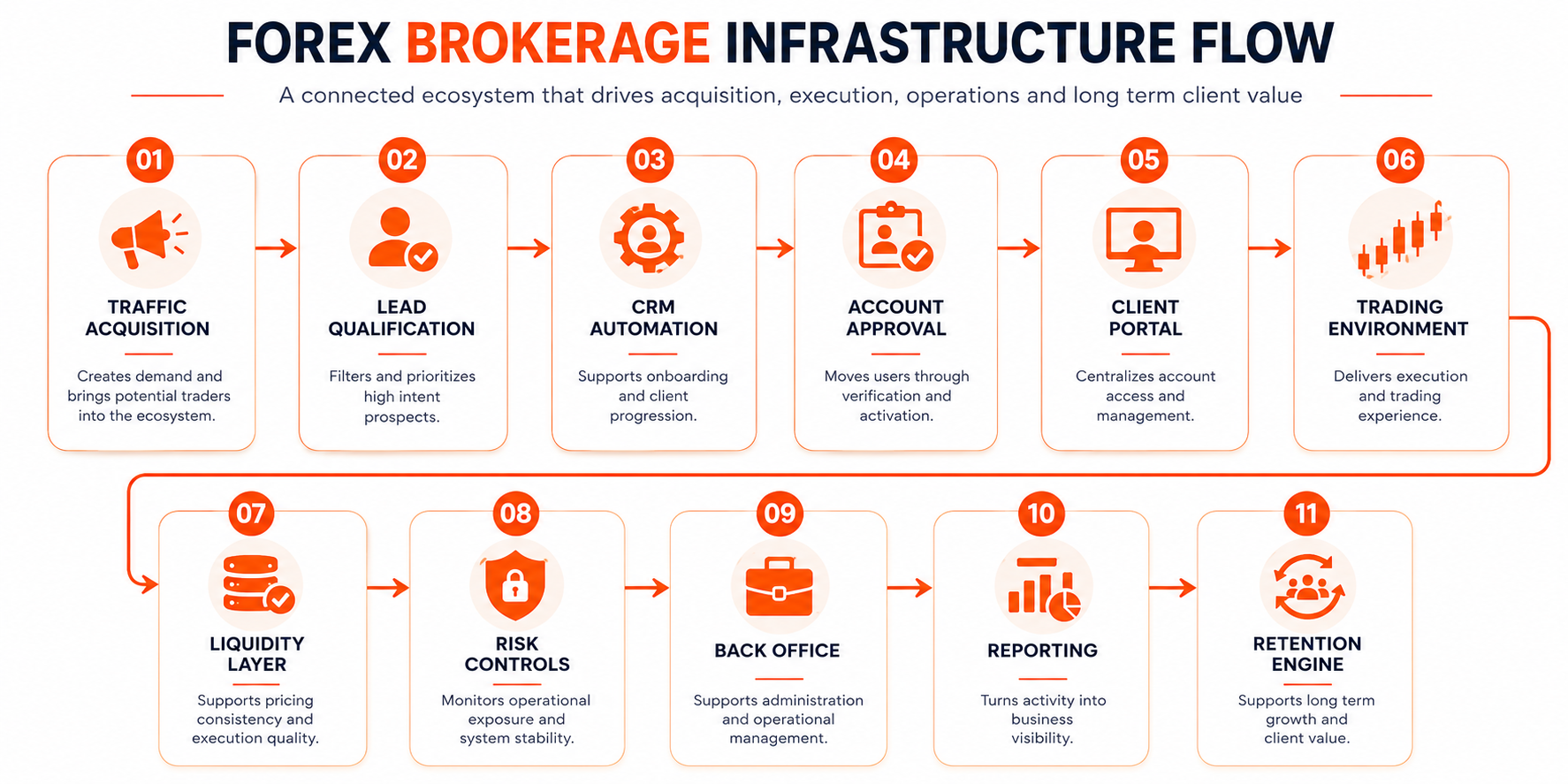
Every stage contributes to operational performance. When infrastructure is aligned, growth becomes easier to manage and internal teams operate more efficiently.
Acquisition and Onboarding Layer
The first stages of infrastructure focus on bringing users into the business and moving them through onboarding efficiently.
Traffic acquisition generates demand. Lead qualification improves resource allocation. CRM automation supports onboarding and client progression, while account approval and the client portal shape the first operational experience.
Small inefficiencies at this stage often create larger conversion losses later.
Trading and Execution Layer
Once users enter the trading environment, infrastructure shifts toward execution quality and operational consistency.
Trading systems and the liquidity layer influence pricing, execution performance, and overall trader experience.
This layer has a direct impact on long term satisfaction and retention.
Operations and Visibility Layer
Risk controls, back office operations, and reporting create visibility across the business.
These systems support monitoring, internal coordination, reporting quality, and operational decision making.
Without strong operational visibility, growth becomes harder to control.
Retention and Growth Layer
Retention infrastructure helps extend customer value after acquisition.
The goal is not simply attracting traders but creating systems that improve engagement and reduce dependency on continuous acquisition.
What Happens When One Layer Fails?
Infrastructure failures rarely remain contained to one stage. Because each layer supports the next, inefficiencies often spread across acquisition, operations, execution, and retention.
Lead Qualification Issues
Increase acquisition waste and reduce conversion efficiency.
CRM Workflow Issues
Slow onboarding and reduce activation rates.
Liquidity Issues
Create execution friction and affect trader experience.
Risk Control Issues
Reduce operational visibility and increase internal pressure.
Reporting Issues
Delay business decisions and limit growth planning.
Retention Issues
Increase dependence on acquiring new users.
Strong brokerage infrastructure prevents isolated operational issues from affecting the entire business.
Common Infrastructure Mistakes That Slow Broker Growth
Building Too Much Too Early
Complex architecture can increase cost before operational demand exists. Infrastructure should evolve with business growth.
Ignoring Automation
Manual workflows may work initially but eventually become a scaling constraint.
Choosing Disconnected Systems
When infrastructure layers operate independently, reporting and operational efficiency decline.
Delaying Reporting Investments
Without centralized reporting, teams react slower and miss opportunities to improve performance.
Treating Infrastructure as a Technical Purchase
Infrastructure decisions influence acquisition efficiency, execution quality, operational performance, and long term profitability.
How to Choose the Right Infrastructure Strategy
Technology decisions affect business performance long after deployment.
Evaluate infrastructure using questions such as:
- Will this support future growth?
- Can workflows evolve?
- Will reporting remain centralized?
- Does the architecture support integrations?
- Will operations become simpler as volume increases?
Choosing the right provider is also essential to building scalable brokerage infrastructure. A Forex CRM Provider like Alpharive can help brokerages connect client management, sales, compliance, reporting, and operational workflows within a centralized CRM platform.
Infrastructure should create leverage, not maintenance.
Modern brokerages do not scale because they add more tools. They scale because infrastructure allows every operational layer to work together more efficiently.
Final Thoughts
Infrastructure is no longer an operational layer sitting behind brokerage growth.
It directly affects acquisition efficiency, trader retention, execution quality, and profitability.
Brokers that invest in scalable systems early create operational leverage that becomes difficult for competitors to replicate.
The strongest brokerage businesses in 2026 will not necessarily be the first to launch.
They will be the ones operating infrastructure designed to support growth at scale.
Frequently Asked Questions
What is forex brokerage infrastructure?
It is the complete technology and operational environment used to manage acquisition, onboarding, trading, reporting, and retention.
How much infrastructure does a forex broker need?
The answer depends on business model, operational scale, and growth goals.
What software does a forex broker typically require?
Core systems usually include trading platforms, CRM, liquidity management, back office tools, analytics, and automation.
Is white label or custom infrastructure better?
White label supports faster launch. Custom infrastructure supports deeper scalability and flexibility.