Building a healthcare mobile app that meets strict security expectations and compliance demands advanced capabilities without slowing innovation. Healthcare businesses planning to launch a mobile solution face one unavoidable reality: healthcare app security and compliance cannot be added later. They must be part of the product strategy before development even begins. From patient data protection to regulatory readiness, every decision impacts how secure and compliant the app will be once it reaches real users.
This guide works as a healthcare app security checklist for organizations evaluating development partners or preparing internal teams for secure healthcare mobile app development. It focuses on what must be implemented, validated, and reviewed before a single line of production code is written. If you are planning a healthcare platform, this checklist aligns well with the planning phase of a full-scale Healthcare App Development initiative.
Healthcare App Security and Compliance
Healthcare app security and compliance must be treated as non-negotiable technical requirements, not optional features added near launch. Healthcare mobile app compliance expectations influence architecture decisions, cloud selection, data flows, and third-party integrations from day one. Ignoring these requirements early often results in costly redesigns or delayed product launches.
Healthcare app security requirements also determine how development teams handle authentication, storage, logging, and system access across environments. With compliance audits becoming stricter, implementation readiness matters more than policy documents. Teams must be able to demonstrate how controls are enforced technically, not just how they are described on paper.
Beyond development, security and compliance directly affect app scalability. As user volume increases, systems must maintain the same level of protection without performance degradation. Apps designed with compliance-first thinking are better positioned to scale safely while supporting future features and integrations.
Why Security Plays a Major Role in Medical Apps
Secure healthcare mobile app development is no longer just a technical concern; it is a business risk management strategy. A single vulnerability can expose sensitive health records, trigger regulatory penalties, and permanently damage brand credibility. Healthcare organizations are now expected to prove that security has been built into their mobile platforms, not patched afterward.
Healthcare app security solutions also influence vendor accountability. Development partners are increasingly responsible for implementing secure coding practices, protecting APIs, and ensuring cloud environments meet healthcare-grade security standards. Any weakness introduced during development reflects directly on the business operating the app.
Beyond legal and financial consequences, trust plays a decisive role. Patients and providers expect medical apps to protect their information at all times. Losing that trust impacts adoption rates, retention, and long-term revenue. Security, therefore, becomes a competitive advantage rather than just a compliance requirement.
Importance of Healthcare App Security
Healthcare app data security protects the most sensitive form of personal information, including diagnoses, treatment plans, and medical histories. When users trust an app with this data, they expect it to remain confidential, accurate, and accessible only to authorized parties.
Mobile app security in healthcare also ensures data integrity across workflows. From patient input to clinician review, information must remain untampered throughout its lifecycle. Even small gaps in validation or storage can compromise clinical decisions and patient outcomes.
Long-term scalability depends heavily on security maturity. Apps designed with strong security foundations adapt more easily to new regulations, integrations, and markets. This approach prevents technical debt and supports sustainable growth as healthcare platforms evolve.
Threats of Health App Security
Healthcare app security risks continue to grow as mobile platforms integrate with wearables, cloud services, and third-party systems. Threat actors increasingly target healthcare apps due to the high value of medical data and often outdated security practices.
Healthcare app security testing acts as a critical mitigation layer against these threats. Regular assessments help identify weaknesses before attackers do, ensuring vulnerabilities are addressed proactively rather than reactively.
Common Security Risks in Healthcare Mobile Apps
- Data breaches caused by improper storage or weak encryption
- Weak authentication mechanisms that allow unauthorized access
- Insecure APIs exposing sensitive backend services
- Cloud misconfigurations leading to unintended data exposure
Addressing these risks requires more than tools, it demands a structured security-first development approach backed by experienced implementation teams.
Key Security Features of a Secure Healthcare App
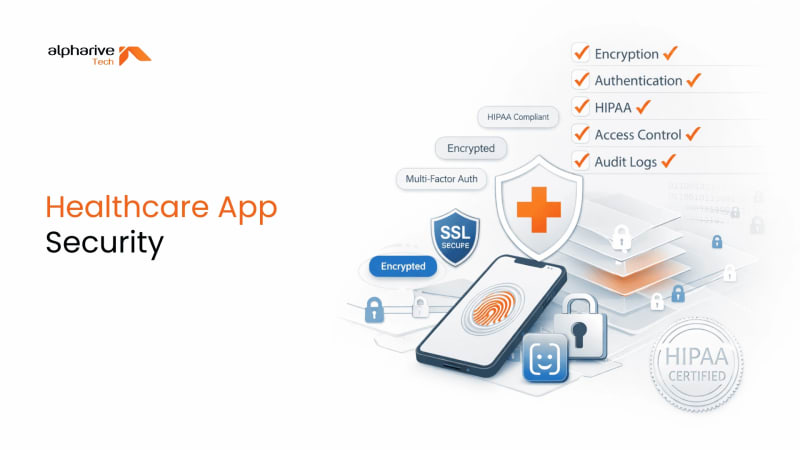
Healthcare app encryption standards and authentication controls form the backbone of secure healthcare platforms. Without these features implemented correctly, compliance remains superficial and easily compromised.
Healthcare app authentication methods must align with real-world clinical workflows while maintaining strict access controls. Role-based access control healthcare apps use ensures that users only see what they are authorized to access, reducing internal misuse and accidental exposure.
Must-Have Security Features for Compliance-Ready Apps
- End-to-end encryption for sensitive healthcare data
- Multi-factor authentication for critical user roles
- Role-based access control aligned with user responsibilities
- Secure API gateways with request validation
- Session management with automatic timeouts
- Audit trails for user activity tracking
These features must be validated during development and maintained throughout the app's lifecycle to ensure continuous compliance.
5 Best Practices for Healthcare App Security
Healthcare app security best practices reflect the maturity of a development process rather than individual tools. Consistent implementation across environments prevents gaps that attackers often exploit.
- Adopt secure coding standards: Development teams should follow healthcare-specific coding guidelines to minimize vulnerabilities during implementation.
- Use secure API integration healthcare apps rely on: APIs should be protected with authentication, rate limiting, and encryption.
- Implement cloud security for healthcare apps: Cloud infrastructure must be configured with least-privilege access and continuous monitoring.
- Perform continuous security testing: Automated and manual testing help detect issues early in the release cycle.
- Maintain secure deployment pipelines: CI/CD processes should include security checks before production releases.
These practices signal operational maturity and help healthcare businesses evaluate development partners more effectively.
Things to Consider to Build Secure Mobile Apps for Healthcare
Secure healthcare mobile app development services begin with choosing the right technology stack. Frameworks, databases, and cloud platforms must support encryption, compliance controls, and audit logging without heavy customization.
Healthcare app compliance services should also be embedded into architectural planning. Secure data flows, backend isolation, and environment segmentation prevent cross-system exposure and simplify compliance audits later.
Partner expertise matters significantly. Teams experienced in healthcare development understand regulatory expectations, security testing requirements, and risk management. This knowledge reduces rework and ensures security decisions align with both technical and business goals.
Regulatory Compliance and Data Privacy
HIPAA compliant healthcare app development requires more than policy acknowledgment. HIPAA compliance for healthcare apps must be technically enforced through access controls, encryption, and monitoring mechanisms that meet HIPAA security requirements for mobile apps.
Compliance efforts should focus on implementation proof. Businesses must demonstrate how protected health information is secured across storage, transmission, and access layers without exceptions.
Healthcare Regulations Impacting Mobile App Security
- Enforcing access controls for authorized users only
- Encrypting protected health information at all times
- Maintaining detailed audit logs for compliance reviews
- Ensuring secure data transmission across networks
Failure to meet these obligations exposes organizations to penalties and operational disruptions that are difficult to recover from.
5 Best Methods for Healthcare Data Protection
Healthcare app data protection relies on layered safeguards rather than single-point solutions. Each method reinforces the others, creating a resilient security posture.
- Data encryption in healthcare apps: Encrypt data at rest and in transit using healthcare-approved algorithms.
- Secure backups: Maintain encrypted backups with restricted access and regular integrity checks.
- Audit logs: Track all system and user activities to support investigations and compliance reviews.
- Access monitoring: Continuously monitor access patterns to detect suspicious behavior.
- Data minimization: Store only necessary data to reduce exposure risk.
These methods help healthcare platforms maintain confidentiality, availability, and integrity of patient data over time.
Build Your Secured Healthcare App with Alpharive
Secure healthcare mobile app development requires teams that understand compliance, risk, and real-world healthcare workflows. Alpharive approaches healthcare projects with a security-first mindset, embedding HIPAA compliant healthcare app development practices into architecture, development, and deployment phases. From secure backend systems to compliance-ready mobile interfaces, the focus remains on building scalable, audit-ready healthcare platforms. If you are planning a secure healthcare solution, explore our Healthcare App Development expertise and build your solution with us.