RWA Tokenization Platform Development Company
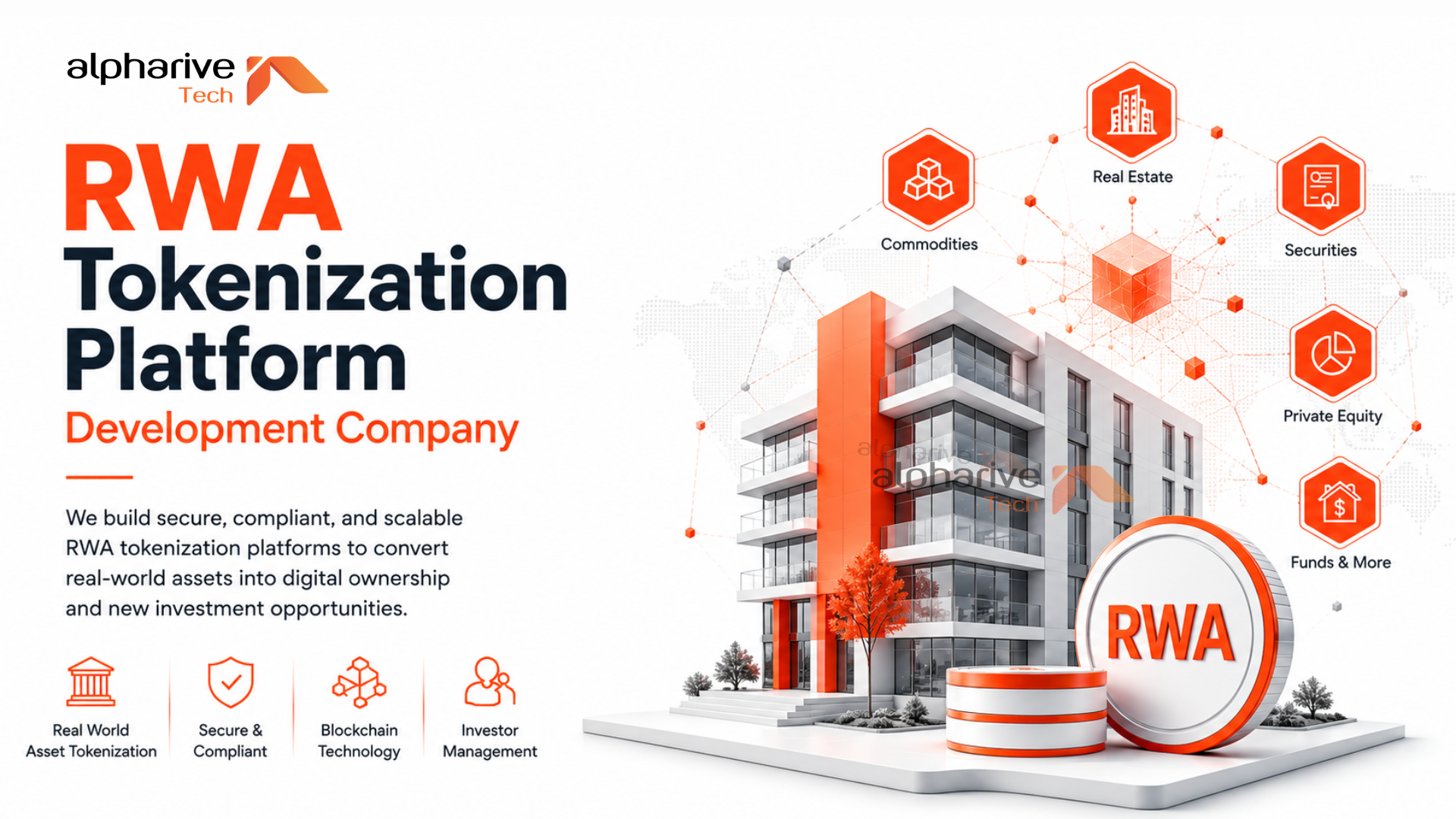
Transform real-world assets into secure, compliant, and digitally manageable assets with Alpharive's RWA tokenization development services. We build customized platforms that help businesses tokenize real estate, commodities, securities, private equity, funds, collectibles, and other eligible assets through blockchain technology.
Our RWA tokenization platform development solutions combine blockchain infrastructure, smart contracts, compliance mechanisms, investor management, asset tracking, and trading capabilities to create scalable digital asset ecosystems.
Get a Quote
Real World Asset Tokenization Platform Development
Real World Asset Tokenization Platform Development involves building blockchain-based infrastructure that enables businesses to represent real-world assets through digital tokens and manage their complete lifecycle.
An RWA platform can connect asset owners, investors, administrators, compliance systems, wallets, marketplaces, and blockchain networks within one ecosystem.
Alpharive develops RWA platforms based on the asset type, ownership structure, regulatory requirements, target market, and business model. The platform can support asset onboarding, token issuance, investor verification, ownership management, transfers, trading, reporting, and redemption.
Whether you want to tokenize real estate, private credit, commodities, investment funds, or other eligible assets, our team can design the underlying technology around your specific requirements.
What Is RWA Tokenization?
RWA tokenization is the process of representing ownership or economic rights associated with a real-world asset through blockchain-based digital tokens.
Real-world assets can include:
- Real estate
- Government securities
- Commodities
- Private equity
- Private credit
- Investment funds
- Art and collectibles
- Infrastructure
- Equipment and machinery
Tokenization can divide ownership or economic interests into smaller digital units, making it possible to create new investment and asset management models.
For example, a high-value property can be represented through a tokenized ownership structure. Instead of requiring one investor to acquire the entire property, a suitable legal and regulatory structure can allow multiple eligible investors to participate in smaller interests.
The token itself does not automatically change the legal ownership of an asset. The legal, regulatory, and contractual structure behind the token determines what rights the token represents.
Why Businesses Are Investing in RWA Tokenization Platform?
Businesses are exploring RWA tokenization to improve how assets are issued, managed, distributed, and transferred.
Unlocking Liquidity
Tokenization can create new pathways for transferring or trading interests in traditionally illiquid assets, subject to applicable regulations and market structures.
Expanding Investor Access
Fractional ownership models can allow eligible investors to participate in assets that may otherwise require substantial capital.
Improving Asset Management
Blockchain-based records can help businesses maintain transparent ownership and transaction histories.
Automating Operations
Smart contracts can automate predefined processes such as transfers, distributions, and compliance rules.
Creating New Investment Models
Tokenization enables businesses to experiment with digital ownership structures, asset-backed investment products, and blockchain-based marketplaces.
Supporting Global Markets
Digital platforms can connect eligible investors and asset providers across markets while applying jurisdiction-specific compliance requirements.
Build Your RWA Tokenization Platform
Turn real-world assets into secure, compliant digital assets with Alpharive's RWA tokenization solutions.
Talk to Our RWA ExpertsHow RWA Tokenization Platforms Work?
An RWA tokenization platform connects the underlying asset with blockchain infrastructure, compliance systems, and investor applications.
The typical process includes:
Asset Identification → Due Diligence → Legal Structuring → Token Design → Smart Contract Development → Token Issuance → Investor Onboarding → Asset Management → Trading or Redemption
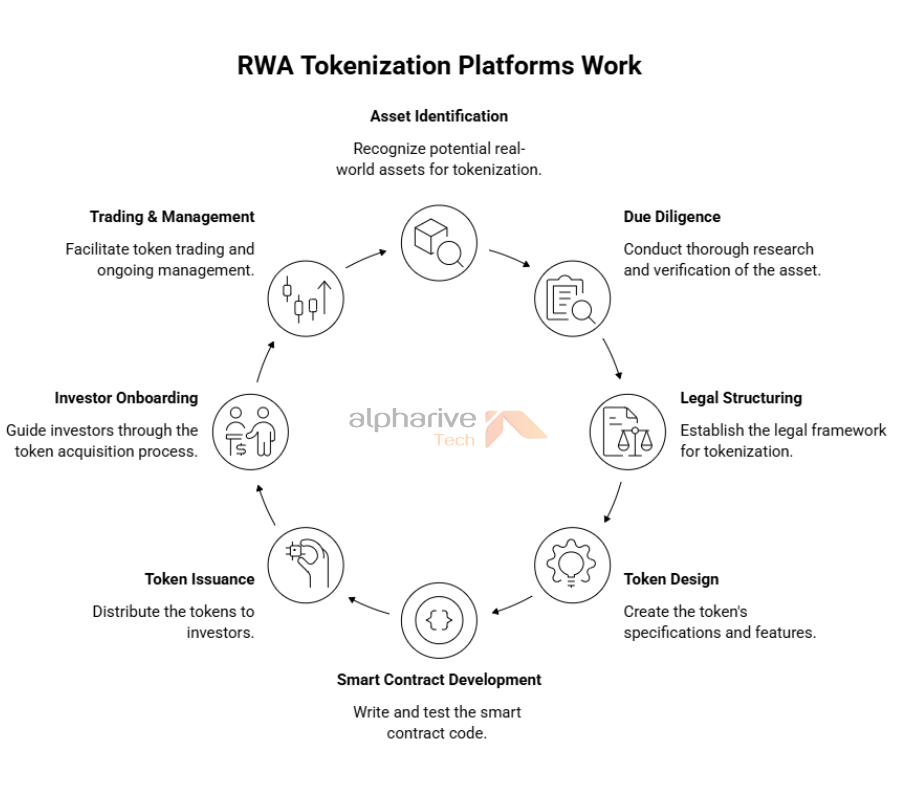
Asset Identification
The business identifies the asset to be tokenized and defines the intended ownership or investment model.
Asset Verification
Ownership documents, valuation information, asset records, and other relevant data are reviewed before the asset enters the tokenization process.
Legal and Regulatory Structuring
The token structure is aligned with applicable laws and regulations. This stage can include securities considerations, investor eligibility, KYC, AML, transfer restrictions, and reporting requirements.
Token Design
The token model defines supply, ownership rights, transfer rules, distribution mechanisms, and other business-specific parameters.
Smart Contract Development
Smart contracts automate token issuance, transfers, ownership rules, distributions, and other predefined functions.
Token Issuance
Tokens are created and issued on the selected blockchain according to the approved token model.
Investor Onboarding
Eligible investors can register, complete applicable verification procedures, connect wallets, and access available tokenized assets.
Management and Trading
The platform can support ownership tracking, portfolio management, permitted transfers, marketplace functionality, secondary trading, and redemption.
Our RWA Tokenization Services
Alpharive provides end-to-end RWA tokenization services covering the technology and infrastructure required to launch and manage tokenized asset ecosystems.
Custom RWA Tokenization Platform Development
We build customized platforms for asset onboarding, token issuance, investor management, compliance, trading, and asset administration.
Token Development
We develop tokens according to the asset structure, blockchain network, ownership model, and regulatory requirements.
Smart Contract Development
Our smart contract development services support secure smart contracts for RWA token issuance, asset transfers, ownership management, automated distributions, compliance rules, and other platform-specific functions.
Asset Tokenization Platform Development
Our asset tokenization platform development solutions help businesses structure eligible real-world assets for blockchain-based representation, digital ownership, and efficient asset management.
RWA Marketplace Development
We develop marketplaces where eligible users can discover, purchase, manage, and trade tokenized assets according to the platform's regulatory framework.
Investor Management Platform
Investor-facing systems can provide portfolio tracking, transaction history, asset information, distributions, and account management.
Compliance Integration
We integrate KYC, AML, identity verification, investor eligibility, transfer restrictions, and reporting workflows where required.
Multi-Chain RWA Development
For businesses requiring broader blockchain interoperability, we can design multi-chain infrastructure around the project's asset and operational requirements.
RWA Platform Maintenance and Support
Post-launch support can include monitoring, upgrades, security improvements, technical maintenance, and feature enhancements.
Have an RWA Tokenization Project in Mind?
Share your requirements with our team and explore the right technology, blockchain, and platform approach for your project.
Start Your Project
RWA Tokenization Platform Features
Have an RWA Tokenization Project in Mind?
Share your requirements with our team and explore the right technology, blockchain, and platform approach for your project.
Start Your ProjectA complete RWA tokenization platform needs more than token creation. It requires infrastructure for managing assets, investors, compliance, transactions, and the token lifecycle.
Asset Onboarding
Add and manage asset information, ownership records, valuation data, documentation, and supporting details.
Asset Verification and Due Diligence
Review asset ownership, authenticity, documentation, and other required information before token issuance.
Token Creation and Issuance
Create, mint, distribute, and manage tokens representing eligible assets.
Investor Dashboard
Allow investors to view holdings, asset information, transactions, distributions, and portfolio activity.
KYC and AML Integration
Connect identity verification and compliance workflows with investor onboarding and transaction processes.
Smart Contract Management
Manage token contracts and automate predefined ownership, transfer, and distribution rules.
Wallet Integration
Allow users to connect supported wallets and manage tokenized assets securely.
Ownership Tracking
Maintain transparent records of token ownership and transfers.
Marketplace
Provide an interface for eligible investors to discover and participate in tokenized asset opportunities.
Secondary Market
Support permitted secondary transfers or trading through a compliant marketplace infrastructure.
Asset Valuation and Analytics
Display relevant valuation, performance, transaction, and portfolio data.
Admin Dashboard
Give administrators control over users, assets, tokens, transactions, compliance workflows, reports, and platform settings.
Custom RWA Tokenization Solutions
Every RWA project has different assets, investors, legal structures, and operational requirements. A custom platform allows businesses to build the technology around their specific model instead of adapting their operations to a generic system.
Alpharive develops customized RWA tokenization solutions based on:
- Asset type
- Ownership structure
- Target investors
- Geographic market
- Regulatory requirements
- Token model
- Blockchain network
- Trading requirements
- Custody requirements
- Third-party integrations
Custom development can support specialized ownership structures, asset management workflows, compliance rules, investor experiences, and marketplace functionality.
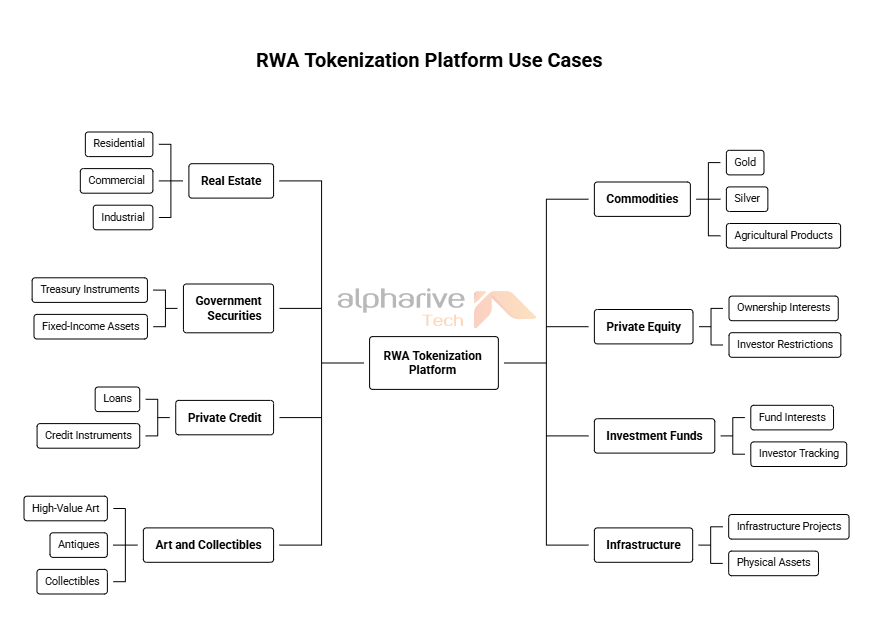
RWA Tokenization Platform Use Cases
RWA tokenization can be applied across physical and financial asset categories.
Real Estate
Tokenize eligible residential, commercial, industrial, and other property interests to support fractional ownership and digital asset management.
Commodities
Gold, silver, agricultural products, energy-related assets, and other commodities can be represented through blockchain-based token structures.
Government Securities
Treasury instruments and other eligible fixed-income assets can be represented digitally to support more efficient issuance, ownership tracking, and settlement.
Private Equity
Tokenized private equity structures can provide digital representations of ownership or investment interests while incorporating applicable investor and transfer restrictions.
Private Credit
Loans and credit instruments can be structured into tokenized representations with automated ownership and payment workflows.
Investment Funds
Fund interests can be represented through digital tokens to support investor management, ownership tracking, and distributions.
Art and Collectibles
High-value art, antiques, collectibles, and other unique assets can be represented digitally with transparent ownership records.
Infrastructure
Infrastructure projects and physical assets can potentially be structured into tokenized investment models to support capital formation and asset participation.
Have an Asset Ready for Tokenization?
Get the latest updates directly to your inbox.
Discuss Your ProjectRWA Token Standards
Token standards determine how digital assets are created, transferred, and managed on blockchain networks.
Common standards relevant to RWA tokenization include:
ERC-20
ERC-20 is commonly used for fungible tokens where each token represents an equivalent unit within the defined token model.
ERC-721
ERC-721 supports unique tokens and can be used when individual assets or asset representations require distinct digital identities.
ERC-1155
ERC-1155 supports multiple token types within a single smart contract and can be useful for platforms managing different asset representations.
ERC-1400
ERC-1400 is designed for security token structures and supports features relevant to regulated digital securities.
ERC-1404
ERC-1404 supports transfer restrictions and can be used where token transfers need to follow predefined compliance conditions.
ERC-3643
ERC-3643 is designed for permissioned tokenization and incorporates identity and compliance mechanisms suitable for regulated asset structures.
The appropriate standard depends on the asset, token model, regulatory requirements, blockchain infrastructure, and intended investor experience.
Blockchain Networks for RWA Tokenization
The blockchain network plays an important role in the performance, interoperability, security, and cost structure of an RWA platform.
Depending on the project requirements, businesses may consider networks such as:
- Ethereum
- Polygon
- BNB Chain
- Avalanche
- Arbitrum
- Optimism
- Other compatible blockchain networks
The right network depends on transaction volume, token standards, smart contract requirements, ecosystem integrations, investor accessibility, interoperability, and regulatory considerations.
Regulatory Compliance for RWA Tokenization
Regulatory compliance is a fundamental part of RWA tokenization.
Because RWA tokens can represent rights connected to physical or financial assets, the platform may need to address securities regulations, property laws, financial regulations, investor protection requirements, data privacy, and other jurisdiction-specific rules.
A compliance-focused platform can include:
- KYC verification
- AML checks
- Investor eligibility
- Accreditation verification where applicable
- Transfer restrictions
- Identity management
- Transaction monitoring
- Regulatory reporting
- Audit trails
- Data protection
- Compliance documentation
The exact requirements depend on the asset, token structure, jurisdiction, and target investors. Businesses should obtain appropriate legal and regulatory advice before launching an RWA tokenization platform.
Benefits of Real World Asset Tokenization development
Fractional Ownership
Tokenized structures can divide interests in high-value assets into smaller units, potentially enabling broader participation among eligible investors.
Increased Liquidity
Tokenization can create additional mechanisms for transferring or trading traditionally illiquid asset interests where permitted.
Greater Transparency
Blockchain records can provide a verifiable history of ownership and transactions.
Faster Settlement
Digital transactions and smart contract automation can reduce manual steps involved in asset transfers and settlement.
Automated Compliance
Compliance conditions can be incorporated into platform workflows and smart contracts where technically and legally appropriate.
Global Accessibility
Digital platforms can connect eligible investors with tokenized assets across markets while enforcing applicable jurisdictional restrictions.
Improved Operational Efficiency
Automated workflows can reduce repetitive administrative tasks involved in asset issuance, ownership management, and investor servicing.
White Label RWA Tokenization Platform Development
A white-label RWA tokenization platform can provide businesses with pre-built infrastructure that can be customized with their branding, business workflows, and platform requirements.
A white-label solution may include:
- Custom branding
- Asset management
- Token issuance
- Investor onboarding
- KYC/AML integration
- Wallet connectivity
- Marketplace functionality
- Admin dashboard
- Compliance workflows
This model can help businesses enter the tokenization market faster than developing every component from the ground up.
RWA Tokenization Development Cost
The RWA tokenization development cost typically ranges from $10K to $80K+, depending on the platform's complexity, asset type, blockchain network, compliance requirements, integrations, and required features.
Platform type | Estimated cost |
|---|---|
Basic | $10K–$20K |
Mid-level | $20K–$60K |
Advanced | $60K–$80K+ |
Key factors include:
- Asset type and complexity
- Blockchain network
- Token standard
- Smart contract requirements
- Compliance infrastructure
- KYC/AML integrations
- Wallet integrations
- Custody requirements
- Marketplace functionality
- Secondary trading
- Investor dashboard
- Admin infrastructure
- Security audits
- Third-party integrations
- Multi-chain requirements
A basic RWA platform focused on asset onboarding and token issuance will have very different development requirements from an institutional platform with compliance infrastructure, custody, marketplace, secondary trading, and multi-chain capabilities.
For an accurate estimate, the platform scope, asset model, regulatory requirements, and target market should be evaluated before development begins.
Get a Cost Estimate for Your RWA Tokenization Platform
Share your requirements with our experts and get a development estimate based on your platform scope and business model.
Get an EstimateRWA Tokenization Development Process
Alpharive follows a structured development approach for building RWA tokenization platforms.
01. Requirement Analysis
We understand the asset class, business model, target users, geographic market, tokenization objectives, and required platform capabilities.
02. Asset and Business Assessment
The underlying asset and proposed ownership model are evaluated to determine the technical and operational requirements.
03. Compliance Planning
KYC, AML, investor eligibility, transfer restrictions, reporting, and other applicable requirements are incorporated into the platform architecture.
04. Token Model Design
We define token supply, ownership rights, transfer rules, distributions, redemption mechanisms, and other token parameters.
05. Blockchain Selection
The blockchain is selected based on scalability, transaction costs, security, token standards, interoperability, and project requirements.
06. Smart Contract Development
Smart contracts are developed for token issuance, ownership management, transfers, distributions, and applicable compliance logic.
07. Platform Development
The investor interface, asset management system, marketplace, admin panel, backend infrastructure, and required integrations are developed.
08. Testing and Security
The platform and smart contracts undergo functional, performance, integration, and security testing.
09. Deployment
The completed platform is deployed to the selected blockchain and production environment.
10. Maintenance and Support
Ongoing support includes monitoring, upgrades, maintenance, security improvements, and feature enhancements.
AI in RWA Tokenization Platform Development
AI can enhance RWA tokenization platforms by supporting data analysis, asset intelligence, compliance workflows, and investor services.
Potential applications include:
Asset Valuation Analysis
AI models can process relevant asset and market data to support valuation analysis.
Risk Assessment
AI can help analyze asset-related data and identify potential risk indicators.
Compliance Monitoring
AI-powered systems can assist with transaction monitoring, anomaly detection, and compliance workflows.
Investor Analytics
AI can analyze portfolio and market information to generate useful insights for investors and administrators.
Fraud Detection
Machine learning models can identify unusual activity and potential transaction anomalies.
Automated Reporting
AI can help organize platform data and generate reports for administrators and stakeholders.
AI should complement, rather than replace, appropriate legal, compliance, financial, and investment expertise.
Why Choose Alpharive for RWA Tokenization Platform Development
Building an RWA platform requires expertise across blockchain development, smart contracts, asset management, compliance infrastructure, investor applications, and security.
As a Real World Asset Tokenization Development Company, Alpharive brings these capabilities together to help businesses develop customized RWA tokenization ecosystems.
Custom Development
We build platform architecture around your asset class, business model, target users, and technical requirements.
Blockchain Expertise
As a blockchain development company , Alpharive supports tokenization, smart contracts, wallet integration, and blockchain infrastructure.
Compliance-Focused Architecture
We design platform workflows to support applicable KYC, AML, investor verification, transfer restrictions, and reporting requirements.
Scalable Infrastructure
Platforms can be designed to support growing asset inventories, users, transactions, and integrations.
AI Integration
AI capabilities can be incorporated into analytics, monitoring, asset intelligence, and other platform workflows where appropriate.
End-to-End Development
From planning and architecture to development, testing, deployment, and post-launch support, Alpharive can support the complete technology lifecycle.
RWA Tokenization Market Trends
The RWA tokenization market is moving from early experimentation toward broader institutional adoption. Financial institutions, asset managers, fintech companies, and blockchain platforms are exploring tokenized versions of real estate, government securities, private credit, funds, and other real-world assets.
Institutional Adoption of Tokenized Assets
Banks, asset managers, and financial institutions are increasingly exploring blockchain-based representations of traditional financial assets. Tokenized funds, government securities, and private-market assets are becoming important areas of institutional experimentation.
Tokenized U.S. Treasuries and Fixed-Income Assets
Government securities and other fixed-income products are among the more established RWA applications. Tokenized Treasury products demonstrate how blockchain can support digital issuance, ownership tracking, transfer, and settlement of traditional financial instruments.
Real Estate Tokenization
Real estate remains one of the most prominent RWA use cases because properties are traditionally expensive and relatively illiquid. Tokenization can create fractional ownership structures and digital management models for eligible residential, commercial, and other property assets.
Growth of Tokenized Private Credit
Private credit is emerging as another important area for RWA tokenization. Blockchain-based representations can support digital ownership, automated payment workflows, transaction tracking, and broader distribution of eligible private credit products.
Expansion of Tokenized Funds
Asset managers are exploring tokenized fund structures that can provide digital representations of investor interests. Tokenization can help automate parts of fund administration, ownership tracking, and distribution processes.
Cross-Chain RWA Infrastructure
As tokenized assets are issued across different blockchain networks, interoperability is becoming increasingly important. Cross-chain infrastructure can help tokenized assets interact with multiple ecosystems, wallets, applications, and liquidity venues.
Increasing Focus on Regulatory Infrastructure
RWA adoption is closely connected to regulatory development. Businesses building tokenization platforms are placing greater emphasis on KYC, AML, investor eligibility, transfer restrictions, reporting, identity verification, and jurisdiction-specific compliance.
The Shift Toward Institutional-Grade RWA Platforms
The market is moving beyond simply creating asset-backed tokens. Businesses increasingly need complete infrastructure covering asset onboarding, token issuance, compliance, custody, investor management, marketplaces, settlement, reporting, and secondary trading.
This is where Real World Asset Tokenization Platform Development becomes important. The opportunity is no longer just to put assets on a blockchain, but to build the infrastructure required to manage their complete digital lifecycle.
FAQs
What is an RWA tokenization platform?
An RWA tokenization platform is a blockchain-based system that enables businesses to represent eligible real-world assets through digital tokens and manage issuance, ownership, compliance, investment, transfers, and other asset lifecycle activities.
How does RWA tokenization work?
RWA tokenization typically involves asset assessment, due diligence, legal structuring, token design, smart contract development, token issuance, investor onboarding, and ongoing asset management.
What assets can be tokenized?
Potential RWA use cases include real estate, commodities, securities, private equity, private credit, investment funds, art, collectibles, infrastructure, and other eligible physical or financial assets.
How much does RWA tokenization platform development cost?
The RWA tokenization platform development cost typically ranges from $10K to $250K+, depending on the asset type, blockchain, token model, compliance requirements, platform features, integrations, security requirements, and marketplace functionality. A detailed project assessment is required to determine the exact development cost.
Which blockchain is best for RWA tokenization?
There is no single blockchain that is best for every RWA project. The choice depends on scalability, security, transaction costs, token standards, interoperability, ecosystem support, and business requirements.
What token standards are used for RWA tokenization?
Common standards include ERC-20, ERC-721, ERC-1155, ERC-1400, ERC-1404, and ERC-3643. The appropriate standard depends on the asset and tokenization model.
Is RWA tokenization regulated?
RWA tokenization can be subject to securities, financial, property, data protection, and other regulations depending on the asset, token structure, jurisdiction, and target investors.
Can Alpharive build a custom RWA tokenization platform?
Yes. Alpharive can develop customized RWA tokenization platforms with asset onboarding, token issuance, smart contracts, investor management, compliance integrations, marketplaces, wallets, analytics, and other required functionality.
Build Your RWA Tokenization Platform with Alpharive
Ready to transform eligible real-world assets into a secure digital ecosystem?
Alpharive can help you design and develop an RWA tokenization platform aligned with your asset class, business model, regulatory requirements, and target market.
Talk to our RWA tokenization experts and discuss your project today.