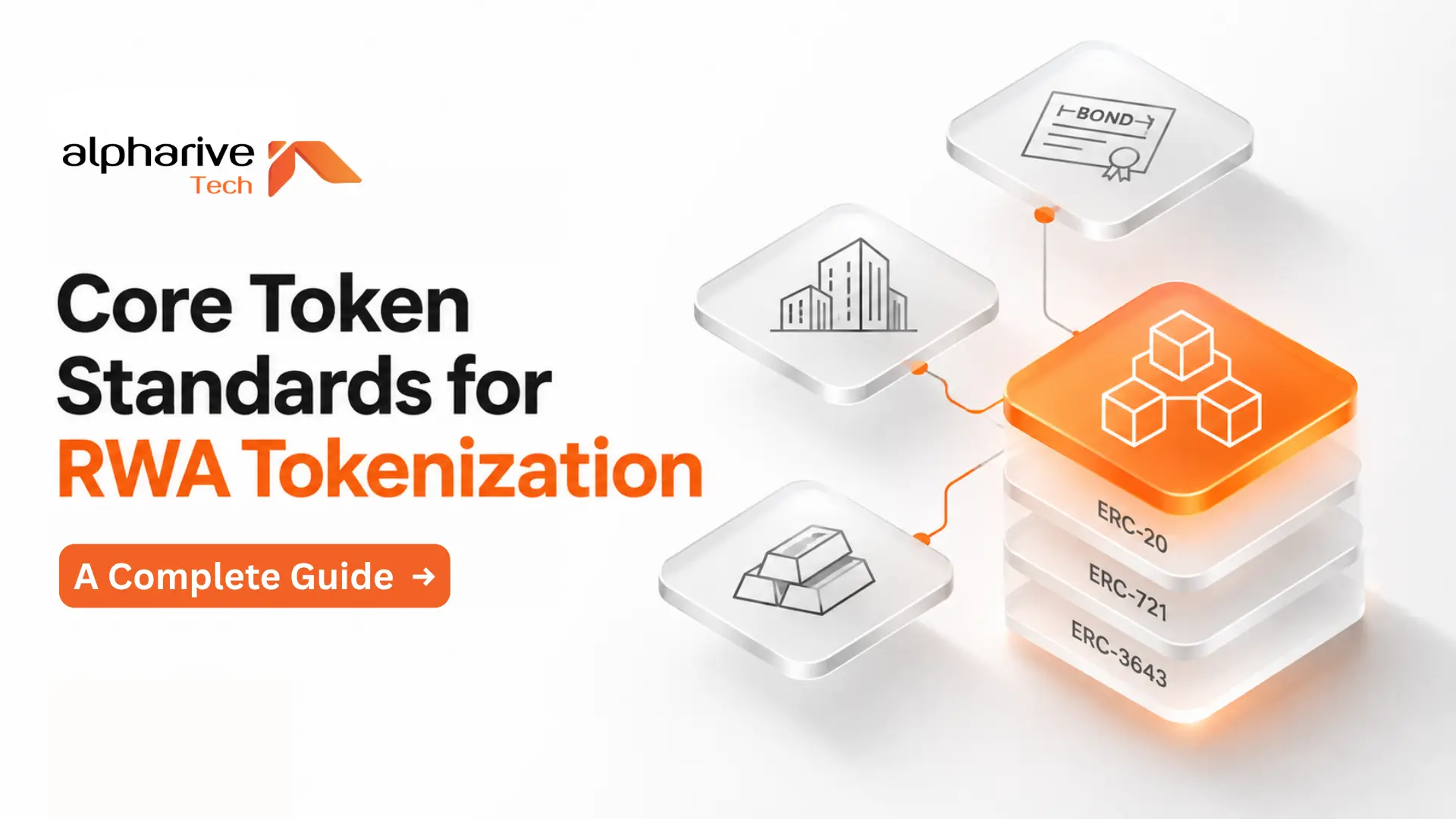
Choosing the right token standard is an important part of building a real-world asset (RWA) tokenization platform. The standard determines how tokens represent ownership interests, how they can be transferred, and how they interact with wallets, smart contracts, and other blockchain applications.
A token representing fractional real estate investment may need different functionality from a token representing a bond, commodity, or private credit fund. Some projects require basic token transfers, while others need investor eligibility checks, transfer restrictions, and asset-specific controls.
At Alpharive, we approach RWA tokenization by considering the asset structure, ownership model, and business requirements before selecting a token standard. These decisions influence the smart contract architecture, investor workflows, and blockchain integrations required for the platform.
This guide explores the main token standards used in RWA tokenization, their technical capabilities, practical applications, and how businesses can choose the right standard for their projects.
What Are RWA Token Standards?
RWA token standards are technical specifications that define how blockchain tokens behave. They provide common interfaces that allow smart contracts, wallets, exchanges, and other applications to interact with tokens.
For example, ERC-20 defines a common interface for fungible tokens, while ERC-721 identifies individual non-fungible tokens. Other standards introduce functionality for permissioned transfers, tokenized vaults, and asset-specific controls.
How Token Standards Work
A token standard defines functions such as creating tokens, checking balances, transferring assets, and identifying individual tokens. Some standards also introduce specialized interfaces for vault deposits, identity verification, or transfer eligibility.
The standard provides the technical framework, but the implementation determines how the token operates.
For example, an RWA platform may issue interchangeable investment units using ERC-20. If those units can only be transferred between eligible investors, the platform may require additional identity and compliance mechanisms.
Why Token Standards Matter for Asset Ownership, Transfers, and Compliance
The right token standard helps align a token's technical behavior with the rights it represents.
Consider a private investment offering. Investors may need to complete identity verification before receiving tokens. Transfers may also be restricted based on investor eligibility or jurisdiction.
A basic token interface does not provide a complete solution for these requirements. The platform may need identity registries, compliance rules, transfer validation, and administrative controls.
Tokenization also does not automatically establish legal ownership of an underlying asset. Legal agreements, custody arrangements, asset records, and enforceable ownership rights must support the token's intended purpose.
Why RWA Tokenization Requires Different Token Standards
Real-world assets differ in how ownership is divided, recorded, transferred, and redeemed. A token standard suitable for one asset may not fit another.
Fungible vs. Non-Fungible Assets
Fungible assets can be divided into interchangeable units that carry equivalent rights. ERC-20 may suit fractional investment units or certain tokenized financial products.
Non-fungible assets have distinct identities. ERC-721 can identify individual assets or separately defined ownership interests.
Semi-fungible assets combine unique token identities with divisible values or units within defined categories. ERC-3525 supports this type of structure.
The right model depends on what the token represents, not simply on the physical asset involved.
For example, a property could be represented by a unique token identifying an asset, or by fungible investment units representing interests in a legally structured entity that owns the property.
Investor Eligibility and Transfer Restrictions
Some tokenized assets can move freely between wallets. Others require identity checks, jurisdiction restrictions, investor eligibility checks, or additional transfer conditions.
ERC-3643 supports permissioned token transfers using identity and compliance infrastructure. ERC-7943 defines common interfaces for RWA-specific controls, including transfer eligibility checks and token freezing.
These standards provide technical capabilities, but the platform must still implement the required rules and establish its legal and regulatory obligations.
Key Token Standards Used in RWA Tokenization
ERC-20 for Fungible Assets
ERC-20 defines a standard interface for fungible tokens, including balances, transfers, and spending approvals.
In RWA tokenization, it may suit fractional investment units, fund interests, or commodity-backed tokens where each unit carries equivalent rights.
For example, a real estate investment platform could issue interchangeable investment units representing interests in a legally structured property-owning entity.
Where it fits: Interchangeable investment units and tokenized financial interests.
Limitation: ERC-20 does not provide investor verification, legal ownership records, or regulatory compliance by itself.
ERC-721 for Unique Assets
ERC-721 defines a standard for non-fungible tokens, each identified by a unique token ID.
An RWA platform can use ERC-721 to identify individual assets, property records, or distinct ownership interests.
For example, a platform managing multiple properties could assign individual token IDs to represent their respective asset records.
Where it fits: Individually identified assets and unique asset records.
Limitation: ERC-721 does not natively divide one token into fractional units. Fractional investment may require a different token model or additional contracts.
ERC-1155 for Multiple Asset Types
ERC-1155 allows a single smart contract to manage multiple token types, including fungible and non-fungible tokens. It also supports batch transfers.
An RWA platform managing different asset categories could use separate token IDs within a shared contract, depending on its implementation requirements.
For example, a platform managing tokenized commodities and other asset categories may benefit from a multi-token contract structure.
Where it fits: Multi-asset platforms that need to manage different token types.
Limitation: Investor eligibility and asset-specific compliance require additional logic.
ERC-3643 for Permissioned Security Tokens
ERC-3643, also known as T-REX, builds on the fungible token model with identity registries and compliance mechanisms for permissioned transfers.
A private investment platform could use this approach to check whether an investor meets configured eligibility requirements before allowing a token transfer.
For example, if an investment offering is limited to verified investors, the token implementation can check the recipient's eligibility before processing a transfer.
Where it fits: Permissioned securities, private investment offerings, and regulated token transfers.
Limitation: Identity management, compliance configuration, and administrative controls add implementation complexity. The standard does not independently establish legal compliance.
ERC-4626 for Tokenized Vaults
ERC-4626 standardizes vaults built around an underlying ERC-20 token. Investors deposit the underlying token and receive vault shares according to the vault's accounting rules.
It may suit investment products that pool eligible tokenized assets and issue shares against the holdings, provided the product structure supports this model.
For example, a compatible investment vault could accept eligible ERC-20 assets and issue shares that represent an investor's position in the vault.
Where it fits: Tokenized vaults and compatible pooled investment structures.
Limitation: ERC-4626 does not tokenize a physical asset directly or establish the legal rights of investors.
ERC-3525 for Semi-Fungible Assets
ERC-3525 combines unique token IDs with slots and divisible values. Tokens can retain individual identities while representing values within a defined category.
This model may suit financial positions where both individual identification and divisible quantities matter.
For example, certain structured financial instruments may need to represent individual positions while allowing their associated values to be divided.
Where it fits: Certain structured financial positions, debt instruments, and investment products.
Limitation: The slot and value model must match the asset's actual economic rights and business rules.
ERC-1400 and Related Security-Token Approaches
ERC-1400 describes a family of security-token approaches that includes features such as token partitions and document references.
These approaches may help represent securities with different classes, tranches, or transfer conditions.
For example, a security-token implementation may need to distinguish between different investment classes or holding conditions.
Where it fits: Security-token implementations that require partitions or security-specific interfaces.
Limitation: ERC-1400 should not be treated as a universally adopted, single implementation. Evaluate the specific implementation, ecosystem support, and required compliance functionality before selecting an approach.
ERC-7943 for Universal RWA Interfaces
ERC-7943, also called the Universal Real World Asset Interface (uRWA), defines common interfaces for RWA-specific controls. It can complement base token standards such as ERC-20, ERC-721, or ERC-1155.
Depending on the implementation, these interfaces can support transfer eligibility checks, transfer authorization, frozen-token information, and authorized enforcement operations.
For an RWA platform, this can help establish a consistent way to handle asset-related controls across different token models.
Where it fits: RWA platforms that need consistent interfaces for asset controls across different token models.
Limitation: ERC-7943 does not automatically provide KYC, AML monitoring, or a complete compliance system. These capabilities depend on the wider platform architecture and implementation.
RWA Token Standards Comparison Table
Standard | Main Purpose | Potential Use Case | Key Limitation |
|---|---|---|---|
ERC-20 | Fungible tokens | Fractional investment units | No built-in investor verification |
ERC-721 | Unique tokens | Individual asset records | No native fractional ownership |
ERC-1155 | Multiple token types | Multi-asset platforms | Additional compliance logic may be needed |
ERC-3643 | Permissioned token transfers | Security tokens | Requires identity and compliance configuration |
ERC-4626 | Tokenized vaults | Pooled investment products | Requires a compatible vault structure |
ERC-3525 | Semi-fungible tokens | Financial positions with divisible values | Requires a suitable slot and value model |
ERC-1400 approaches | Security-token functionality | Partitioned securities | Implementation and ecosystem support vary |
ERC-7943 | Common RWA control interfaces | Standardized asset controls | Does not provide a complete compliance system |
These standards are not all direct alternatives. Some define token ownership models, while others focus on vaults, security-token functionality, or RWA control interfaces.
A platform can combine compatible standards where the asset structure and implementation require it.
How to Choose the Right Token Standard for Your Asset
Start with the asset's ownership structure, the rights attached to the token, and the rules governing transfers.
Use the following as an initial selection guide:
- Interchangeable investment units: Evaluate ERC-20.
- Individually identified assets: Evaluate ERC-721.
- Multiple token types within a shared contract: Evaluate ERC-1155.
- Permissioned security tokens: Investigate ERC-3643.
- Vault-based investment products: Evaluate ERC-4626.
- Divisible values linked to unique token identities: Investigate ERC-3525.
- Securities requiring partitions: Review relevant ERC-1400 implementations.
- Standardized RWA control interfaces: Investigate ERC-7943.
Before selecting a standard, businesses should evaluate several technical and operational requirements.
Ownership structure: Does the token represent a direct asset interest, a share in a legal entity, or a contractual investment right?
Investor eligibility: Must investors complete identity verification or meet specific eligibility criteria?
Transfer restrictions: Are transfers limited by jurisdiction, investor status, holding periods, or other conditions?
Custody and asset records: How will the underlying asset be held, verified, and recorded?
Redemption and distributions: How will investors redeem their interests or receive payments?
Integrations: Which wallets, custody providers, investor dashboards, and other systems must support the token?
Security and administration: Who can issue, freeze, recover, or upgrade tokens, and under what conditions?
The simplest standard that meets the requirements is often the best starting point. Additional interfaces and contracts should be introduced only when they serve a clear business or technical purpose.
How Token Standards Influence RWA Platform Development
Selecting a token standard is one part of building an RWA tokenization platform. The chosen standard also influences how the platform handles token issuance, investor records, asset management, and transfers.
Consider a platform designed for fractional real estate investments. Its development may involve several connected components.
Token issuance: Creating investment units based on the defined ownership structure and selected token standard.
Investor onboarding: Collecting and verifying investor information through the required onboarding process.
Transfer management: Applying eligibility checks and transfer restrictions where required.
Asset management: Maintaining records associated with the underlying asset and its ownership structure.
Investor dashboard: Allowing investors to view their token holdings and relevant investment information.
Administrative controls: Managing token issuance, permissions, and platform activities.
At Alpharive, these requirements help shape the technical architecture of an RWA tokenization solution. Our development approach considers the selected blockchain, token standard, smart contract functionality, and platform integrations together rather than treating token creation as an isolated task.
The final implementation depends on the asset type, business model, and applicable regulatory requirements.
Token Standards for Real Estate, Bonds, Commodities, and Private Credit
Different asset classes can use different token models depending on their legal and economic structure.
Asset Type | Standards to Investigate | Key Consideration |
|---|---|---|
Real estate | ERC-20, ERC-721, ERC-3643 | Whether tokens represent property records or fractional investment interests |
Bonds | ERC-20, ERC-3643, ERC-1400 approaches | Investor eligibility, payment terms, and transfer restrictions |
Commodities | ERC-20, ERC-721, ERC-1155 | Reserve verification, custody, and redemption rights |
Private credit | ERC-20, ERC-3643, ERC-3525, ERC-4626 | Investor restrictions, loan servicing, and whether the product uses a vault |
These are starting points, not fixed mappings. The appropriate standard depends on the rights represented by the token, the asset's legal structure, and the platform's required functionality.
What Compliance Features Should an RWA Platform Consider?
The token standard is only one part of the platform. Depending on the asset and applicable rules, an RWA solution may also need additional compliance-related functionality.
KYC and identity verification: Establishing investor identities through an appropriate verification process.
AML controls: Supporting risk-based monitoring and review of suspicious activity where required.
Investor eligibility checks: Restricting access to investors who meet applicable criteria.
Transfer validation: Checking whether a proposed transfer satisfies configured restrictions.
Audit records and reporting: Maintaining appropriate records of issuance, transfers, and administrative actions.
Asset verification and custody: Documenting how the underlying asset is held, managed, and verified.
For example, a permissioned investment platform may combine ERC-3643 token functionality with an identity registry and external verification workflows. Transfer checks can then evaluate whether an investor meets the configured requirements.
Not every project requires the same set of features. Requirements must be assessed according to the asset, offering structure, and relevant jurisdiction. Technical controls support compliance processes but do not guarantee regulatory approval.
Common Mistakes to Avoid When Choosing an RWA Token Standard
Choosing based on popularity: Select the standard according to the asset model and required functionality, not simply its popularity.
Assuming tokens prove legal ownership: Establish the legal relationship between the token and the underlying asset through appropriate documentation and enforceable rights.
Ignoring transfer restrictions: Identify whether investor eligibility checks, jurisdiction restrictions, or holding-period rules are required.
Using unnecessary complexity: Additional standards and contracts can increase development, testing, and maintenance requirements.
Overlooking security controls: Review administrative permissions, freezing, recovery, and contract upgrade mechanisms.
Skipping integration planning: Check compatibility with wallets, custody systems, investor dashboards, and required third-party services.
Treating a token standard as a complete compliance solution: Identity verification, AML processes, legal documentation, custody, and reporting may require separate systems and procedures.
How Alpharive Supports RWA Tokenization Platform Development?
Building an RWA tokenization platform requires the right combination of token standards, smart contracts, asset records, transfer controls, and supporting applications.
Alpharive helps businesses plan and develop custom RWA tokenization solutions around their asset models and operational requirements.
Depending on the project scope, development can include:
RWA token development: Implementing token contracts based on suitable standards such as ERC-20, ERC-721, and ERC-3643.
Smart contract development: Building contract functionality for token issuance, transfers, and asset-related operations.
Investor management: Developing investor registration, onboarding, and dashboard functionality.
Wallet integration: Connecting supported blockchain wallets for token management and transactions.
Compliance-related functionality: Implementing project-specific KYC workflows, eligibility checks, and transfer controls where required.
Admin dashboard: Providing tools to manage token issuance, investor records, permissions, and platform activities.
Every RWA project has different technical and business requirements. Alpharive evaluates these requirements to help determine the appropriate blockchain, token standards, and platform architecture.
Looking to develop an RWA tokenization platform? Explore Alpharive's RWA Tokenization Platform Development Services to discuss your project requirements.
Conclusion
The right token standard depends on what an RWA token represents and how it needs to operate. ERC-20 and ERC-721 address different token models, while ERC-3643, ERC-4626, ERC-3525, ERC-1400 approaches, and ERC-7943 address more specialized requirements.
For businesses planning an RWA tokenization platform, selecting a standard should begin with the asset's ownership structure, investor requirements, and intended transfer functionality.
At Alpharive, we consider these technical and business requirements when planning custom RWA tokenization solutions. Choosing the right token architecture from the beginning helps establish a platform foundation that can support its intended operations and future development needs.
Define the asset structure first, identify the necessary controls, and then choose the standards that fit.
Frequently Asked Questions
Which token standard is best for RWA tokenization?
ERC-20 may suit interchangeable investment units, ERC-721 may suit unique asset identifiers, and ERC-3643 may suit permissioned securities. The right choice depends on the asset's ownership model, transfer requirements, and intended functionality.
What is the difference between ERC-20 and ERC-3643?
ERC-20 defines a general interface for fungible tokens. ERC-3643 builds on the fungible token model with identity and compliance infrastructure designed for permissioned token transfers.
Can ERC-721 be used for real estate tokenization?
Yes. ERC-721 can identify individual assets or distinct ownership interests. Fractional investment may require an additional token model or separate contracts. Legal ownership rights must be established independently.
What does ERC-4626 do in RWA tokenization?
ERC-4626 standardizes tokenized vaults that accept an underlying ERC-20 asset and issue shares. It may suit pooled investment products when their structure supports a vault model.
What is the purpose of ERC-7943?
ERC-7943 defines common interfaces for RWA-related controls, including transfer eligibility checks and token freezing functionality. It does not provide a complete KYC, AML, or regulatory compliance system.
Can an RWA platform use multiple token standards?
Yes. A platform can use different standards for different asset classes or combine compatible interfaces. The design must maintain consistent ownership records and enforce the required transfer rules.
Does a token standard guarantee regulatory compliance?
No. A token standard provides technical functionality, not automatic legal or regulatory compliance. Ownership rights, investor eligibility, custody, disclosures, and applicable regulatory obligations require separate consideration.
How do I choose a token standard for fractional ownership?
Start by identifying what investors legally own and how their interests can be transferred. ERC-20 may suit interchangeable investment units, while ERC-3643 may be relevant when permissioned transfers are required. The legal and economic structure should guide the final choice.