The global forex market processes over $7.5 trillion in daily trading volume, creating strong demand for advanced platforms. If you plan to launch a forex trading platform, this guide walks you through essential steps, technology components, licensing requirements, and cost considerations to help you build, launch, and scale your brokerage with clarity.
What You Actually Need to Launch a Forex Trading Platform
A forex trading platform requires more than just a trading interface it is a combination of multiple systems working together to support execution, compliance, and user management. At its core, you need a front-end trading terminal where users can place orders, track charts, and manage positions in real time. Alongside this, a strong order management system ensures trades are executed accurately and without delay.
Beyond the interface, the backend plays an equally important role. A reliable liquidity connection links your platform to a liquidity provider, allowing real-time trade execution at market prices. You also need a back-office system or forex CRM to handle onboarding, KYC/AML compliance, reporting, and client management. Add to this a valid regulatory license, payment integrations, and a defined risk model such as A-Book, B-Book, or hybrid, and you have the full foundation required to operate a successful brokerage.
Choose Your Launch Path: 3 Models Compared
Choosing how to launch a forex trading platform is one of the most important decisions, as it directly impacts your cost, timeline, flexibility, and long-term growth. Broadly, there are three approaches to consider, each suited to different business goals and budgets. Understanding these models clearly helps you avoid costly mistakes early on.
At the same time, there is no one-size-fits-all solution. Some businesses prioritise speed and lower investment, while others focus on control and scalability. The right choice depends on your vision, technical expectations, and how much ownership you want over your platform.
Option 1: Custom Development
This approach involves building your forex platform entirely from the ground up, including the trading engine, frontend, backend systems, and integrations. It typically takes 12–18 months and requires a significant investment, often ranging from $300K to $1M or more depending on complexity.
Custom development gives you full ownership, complete control over features, and the ability to create a unique product. However, it comes with higher risk, longer timelines, and the need for a strong technical team to manage development and maintenance.
Option 2: White Label Platform
A white label forex platform allows you to launch quickly by using an existing, pre-built system provided by a vendor. Setup usually takes 4–8 weeks, with initial costs between $15K and $100K, along with ongoing monthly fees.
This option is ideal for entrepreneurs entering the market for the first time. It offers proven technology and faster deployment, but limits customisation and creates dependency on the vendor’s ecosystem. Popular solutions include MT5, cTrader, and Match-Trader.
Option 3: Hybrid Approach
The hybrid model combines the speed of white label solutions with the flexibility of custom development. It involves using a base platform while building custom frontends, features, and back-office systems tailored to your business.
With timelines ranging from 2–6 months and costs between $50K and $250K, this approach offers a balanced path for growing brokers. It allows greater branding control and scalability without the heavy investment of full custom builds, making it a practical choice for many modern forex startups.
Launch Path | Timeline | Cost Range | Control Level | Best For |
|---|---|---|---|---|
Custom Development | 12 - 18 months | $300K - $1M+ | Full Control | Established fintech companies |
White Label | 4 - 8 weeks | $15K - $100K | Limited Control | First-time brokers, startups |
Hybrid / Semi-Custom | 2 - 6 months | $50K - $250K | Moderate to High | Scaling startups, growing brokers |
The Core Technology Stack Explained
The forex trading platform tech stack is the backbone that powers execution speed, data flow, and overall user experience. It is not a single system but a layered architecture where each component plays a specific role in ensuring trades are processed accurately and without delay. A well-structured stack directly impacts performance, scalability, and reliability.
Beyond performance, each layer also supports business operations such as client management, liquidity access, and compliance. When these components are properly integrated, the platform runs smoothly under high trading volumes and delivers a consistent experience to traders across devices.
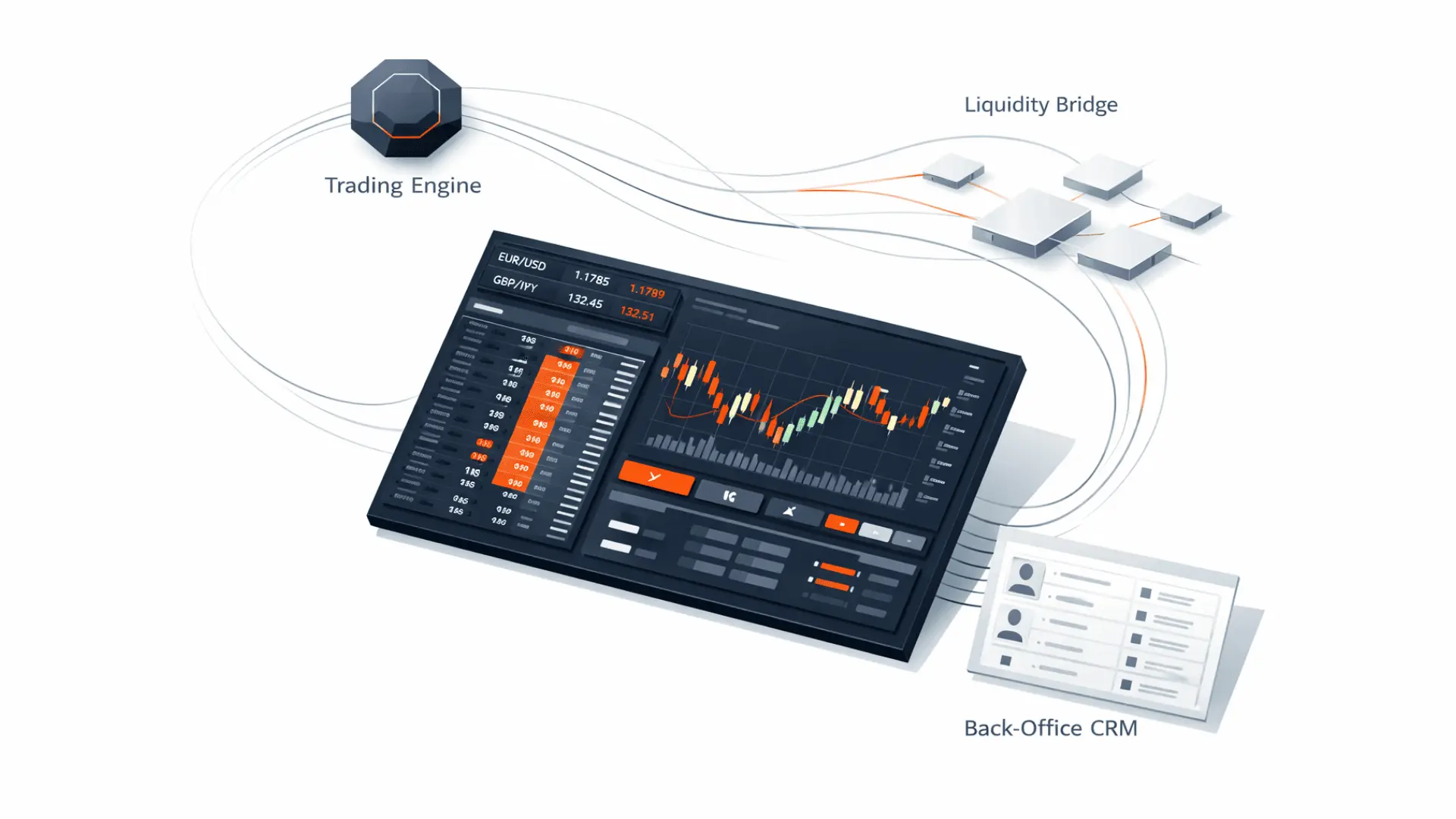
Layer 1: Trading Engine (Matching Engine)
At the core of every platform is the trading engine, responsible for processing orders and matching buy and sell requests in real time. Speed and low latency are critical here, which is why many platforms use co-location in data centers like LD4 or NY4.
Layer 2: Liquidity Bridge
The liquidity bridge connects your platform to a forex liquidity provider using FIX API protocols. It ensures that client orders are executed with real market prices and supports different execution models such as A-Book, B-Book, or hybrid routing.
Layer 3: Front-End Trading Terminal
This is the user-facing interface where traders interact with the platform. It includes web and mobile applications, advanced charting tools, multiple order types, and integrations like TradingView for real-time market analysis.
Layer 4: Back-Office & CRM
The back-office system, often referred to as forex CRM software, manages user accounts, KYC/AML processes, deposits, withdrawals, and reporting. It also supports IB management, making it essential for scaling broker operations efficiently.
Regulatory Licensing: Where to Register Your Forex Broker
Forex broker license requirements vary by jurisdiction, and choosing the right one directly affects your credibility, cost, and time to market. Each country has its own regulatory framework, capital requirements, and approval timelines, which means your decision should align with your business goals and target audience. Regulated markets offer stronger trust but require higher investment and longer setup.
At the same time, offshore jurisdictions provide faster entry and lower costs, making them appealing for startups. However, they often come with limitations in banking, payment processing, and client trust. Balancing speed with long-term reputation is key when selecting where to establish your forex brokerage.
Jurisdiction | Regulator | Capital Requirement | Timeline |
|---|---|---|---|
United Kingdom | FCA | £730K+ | 6 - 12 months |
Cyprus / EU | CySEC | €125K - €730K | 3 - 6 months |
Australia | ASIC | AUD $1M+ | 6 - 12 months |
UAE (DIFC) | DFSA | $500K+ | 4 - 8 months |
Singapore | MAS | SGD $1M+ | 6 - 12 months |
Saint Lucia | FSA | $50K+ | 4 - 8 weeks |
Choosing a well-regulated jurisdiction like the UK, Australia, or Singapore strengthens your brand and improves access to global clients and banking partners. On the other hand, offshore options can help you launch faster, but may require transitioning to a stronger license as your brokerage grows.
How Much Does It Cost to Launch a Forex Trading Platform?
Forex trading platform cost depends on your chosen approach, licensing jurisdiction, and the level of customization you require. There is no fixed number, as costs can vary widely based on whether you choose a white label solution, a semi-custom build, or a fully custom platform. Understanding these cost layers helps you plan your investment more realistically.
In addition to development, you also need to consider ongoing operational expenses such as liquidity, infrastructure, and compliance. Many first-time founders underestimate these recurring costs, which can significantly impact long-term sustainability and growth.
Cost Component | White Label | Full Custom |
|---|---|---|
Platform Setup | $15K-$50K | $200K-$500K |
Licensing | $10K-$100K | $10K-$200K |
Liquidity Connection | $5K + $50K margin | $5K + $50K+ margin |
CRM / Back-Office | Included | $80K-$200K |
Payment Integration | $2K-$10K | $30K-$80K |
Monthly Operating Costs | $10K-$30K/month | $25K-$60K+/month |
Total Year-1 Estimate | $100K-$250K | $500K-$1.5M+ |
Choosing the right model is not just about budget but also about how quickly you want to enter the market and how much control you need. A clear cost structure gives you a better foundation to plan your launch and scale with confidence.
Key Features Your Forex Platform Must Have
A successful forex trading platform must include essential features that support smooth trading, risk control, and user engagement. These features are not just add-ons but core elements that define how traders interact with your platform and how efficiently they can execute strategies in real time.
At the same time, modern traders expect more than just basic functionality. Advanced tools like real-time charting with multiple indicators, various order types, and one-click execution are now standard. Adding features such as copy trading, mobile accessibility, multi-asset support, and built-in KYC/AML workflows creates a more complete ecosystem that attracts and retains users while supporting long-term platform growth.
Launch Timeline: From Idea to Live Brokerage
A forex trading platform launch timeline outlines the key stages required to move from concept to a fully operational brokerage. While timelines can vary based on your chosen approach, having a clear step-by-step process helps you stay on track and avoid delays during execution.
In most cases, white label solutions move faster, while custom builds take longer due to development and compliance requirements. Regardless of the path, following a structured timeline ensures smoother coordination between technology, licensing, and operational setup.
Step 1 - Define Strategy
Define your target market, asset classes, and brokerage model early to align business goals with technical and regulatory requirements clearly.
Step 2 - Choose Model
Choose between custom development, white label, or hybrid approach based on your budget, timeline, scalability needs, and long-term platform ownership goals.
Step 3 - Select Jurisdiction
Select the right licensing jurisdiction by evaluating regulatory requirements, capital needs, approval timelines, and how it impacts your target market reach.
Step 4 - Partner Setup
Engage a reliable technology partner or white label provider to begin platform setup, ensuring alignment with your business vision and technical requirements.
Step 5 - Connect Liquidity
Connect your platform to a forex liquidity provider using FIX API bridges to enable real-time pricing, trade execution, and efficient order routing systems.
Step 6 - Integrate Payments
Integrate secure payment gateways and KYC systems to support deposits, withdrawals, and user verification while meeting compliance and anti-money laundering requirements.
Step 7 - Test Platform
Conduct QA testing, user acceptance testing, and performance checks to ensure the platform handles trading volume, execution speed, and system stability effectively.
Step 8 - Review Compliance
Perform final compliance checks, audit workflows, and ensure all regulatory requirements are met before proceeding with platform launch and client onboarding processes.
Step 9 - Soft Launch
Launch a demo or limited environment to onboard early users, test real-world performance, and identify any operational gaps before full-scale deployment begins.
Step 10 - Go Live
Go live with your forex platform, launch marketing campaigns, and begin acquiring users while continuously monitoring system performance and user experience.
Alpharive Your Forex Trading App Development Partner
Alpharive as your forex trading app development partner brings the right balance of technical expertise, industry understanding, and practical execution needed to build scalable trading platforms. With experience across fintech and trading ecosystems, the focus remains on creating platforms that are secure, high-performing, and aligned with real business goals rather than generic solutions.
From selecting the right architecture to integrating liquidity, CRM systems, and compliance workflows, every stage is handled with clarity and precision. Whether you are building a custom platform or a hybrid solution, the approach adapts to your vision, ensuring long-term flexibility and growth.