
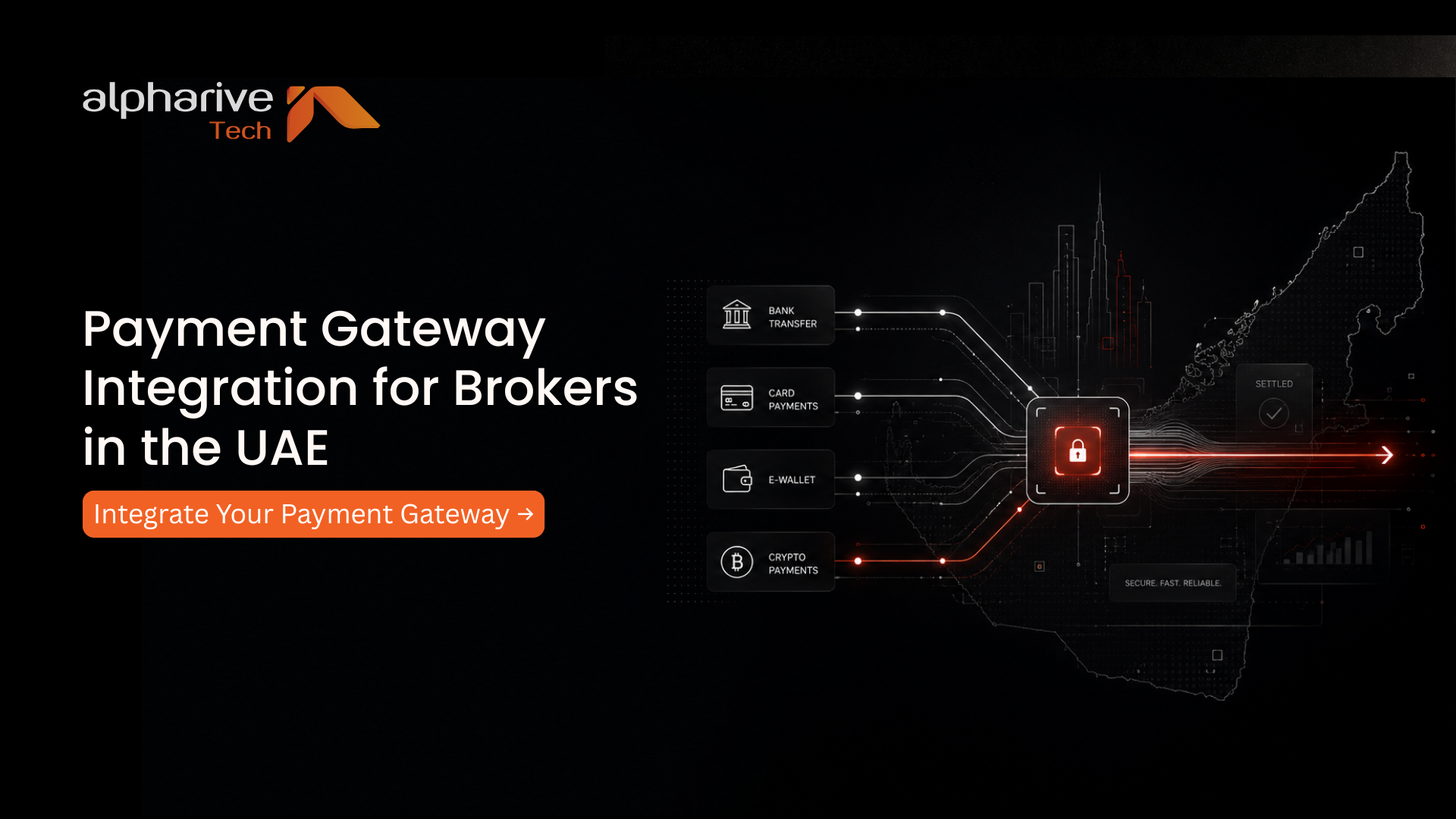
Payment gateway integration for brokers in the UAE works best when it is built around local payment behavior first and technology second: brokers operating out of Dubai or the DIFC typically need a mix of UAE bank transfers, regional and international card processing, and crypto on/off ramps, routed through more than one PSP and tied directly into the CRM and trader's room for instant deposit crediting.
Key Takeaways
- Multi-PSP routing is standard, not optional: most UAE-facing brokers run at least two payment service providers side by side because forex is classified as high-risk and single-provider setups get suspended without warning.
- Local bank rails still dominate large deposits: IBAN transfers through UAE banks like Emirates NBD, ADCB, and FAB remain the preferred method for six-figure AED deposits, even as card and crypto usage grows.
- Crypto on-ramps are now near-standard: USDT and USDC deposit support has moved from "nice to have" to expected for brokers targeting traders across the wider GCC and South Asian expat base in the UAE.
- Regulatory path shapes your banking options: a DIFC entity under DFSA oversight and an onshore entity under the SCA face different banking relationships and settlement expectations.
- Reconciliation, not just checkout, decides trader retention: the integration point that matters most for client trust is real-time crediting into MT4/MT5 accounts, not the payment page design.
UAE Broker Payment Gateway Setup at a Glance
Payment Method | Typical Settlement Time | Currency Handling | Best Suited For |
|---|---|---|---|
UAE bank wire transfer (IBAN) | Same day to 2 business days | AED, USD | Large deposits, institutional clients |
Local & international card processing | Instant to 24 hours | AED, USD, EUR | Retail traders, first-time deposits |
E-wallets (regional & global) | Instant | Multi-currency | Smaller, frequent deposits |
Crypto (USDT/USDC on-ramp) | 10-30 minutes | Stablecoin equivalents | Expat and GCC clients avoiding FX conversion |
Payment aggregator / PSP routing layer | Depends on underlying method | Multi-currency | Reducing single-provider risk |
Withdrawal processing (all methods) | 1-5 business days typical | AED, USD, stablecoins | Client trust and retention |

Why Payment Gateway Integration Looks Different in the UAE
A broker that copies its European payment stack into the UAE market usually finds out the hard way that it doesn't translate. Traders in the region split fairly evenly between three habits: wiring funds from a local bank account, paying with a UAE-issued card, and increasingly, moving stablecoins in and out through a crypto on-ramp. A gateway strategy that only supports one of those paths will bleed deposits to competitors that support two or three.
The regulatory backdrop adds another layer. Brokers operating from the Dubai Financial Services Authority (DFSA) jurisdiction inside the DIFC face a different set of banking relationships than firms licensed onshore by the Securities and Commodities Authority (SCA). The Central Bank of the UAE also has its own rules around stored value facilities and payment service providers, which affects which local PSPs a broker can legally route funds through. Get this wrong at the integration stage and you end up rebuilding the payment layer six months after launch.
Multi-currency handling matters too. A brokerage serving clients across the UAE, Saudi Arabia, and wider GCC needs to settle in AED and USD at minimum, while still giving traders a familiar local currency experience at checkout. And because withdrawal speed is one of the top complaints traders raise about brokers in this region, the integration has to prioritize fast, reliable payout processing just as much as deposit conversion.
1. Map Local Payment Methods Before Choosing a Gateway
Start with the payment habits of the traders you actually want, not a generic global list. In the UAE, that mapping typically includes:
- UAE bank transfers: IBAN-based transfers from Emirates NBD, Abu Dhabi Commercial Bank (ADCB), First Abu Dhabi Bank (FAB), and other local banks remain the default for larger deposits, particularly from clients who are cautious about card fraud holds.
- Card processing: Visa and Mastercard issued by UAE banks cover the bulk of retail deposits, but decline rates spike when a broker only uses an international acquirer unfamiliar with regional issuing banks' fraud rules.
- E-wallets: Regional and global e-wallet options give smaller, more frequent depositors a faster path than a bank transfer, and they tend to have lower cart abandonment on mobile.
- Crypto on/off ramps: USDT and USDC deposits have grown quickly among expat traders and clients across South Asia and the broader GCC who want to skip currency conversion fees entirely.
Skipping this mapping step is the single biggest reason brokers end up with high decline rates on their first payment gateway. If your acquirer doesn't recognize local card BINs correctly, a meaningful share of legitimate deposit attempts get flagged as fraud before they ever reach your forex broker CRM.
2. Choose a Gateway or PSP With Forex-Friendly Risk Appetite
Most mainstream payment processors classify forex and CFD trading as high-risk, right alongside gambling and adult content. That classification isn't personal, but it does mean a broker can't simply sign up with a generic PSP built for e-commerce and expect it to hold up. Look for providers with a track record of processing for brokers specifically, ideally ones that already understand MetaTrader deposit flows and how account crediting needs to work.
A few things separate a workable PSP relationship from one that collapses in year one:
- Chargeback handling: ask exactly how disputes are managed and how much documentation the PSP requires from your compliance team before funds are released back.
- Rolling reserves: many high-risk PSPs hold back a percentage of processed volume for weeks or months. Get the exact reserve percentage and release schedule in writing before signing.
- Local settlement currency: confirm whether the PSP can settle in AED directly or only in USD, since forced conversion adds cost and delay.
Because any single PSP can freeze an account, get hit with a compliance review, or simply stop supporting forex overnight, most established brokers in the region run at least two providers in parallel, with routing logic that shifts volume automatically if one goes down. This is less about redundancy for its own sake and more about protecting the business from a single point of failure that could stop all deposits for days.
3. Build the Technical Integration Around Your CRM, Not Around One Gateway
The mistake many brokers make is treating payment gateway integration as a standalone project handled by whichever PSP they signed with. That approach creates a brittle system where every new payment method requires a separate, disconnected build. A better approach treats the forex CRM and trader's room as the center of the payment architecture, with gateways plugged into it as interchangeable modules.

In practice, that means designing for four things from day one:
- API-first connections: each PSP or bank integration should expose deposit and withdrawal events through a consistent internal API layer, so your CRM doesn't need custom logic for every provider.
- Real-time reconciliation: deposits need to post directly to the trader's MT4 or MT5 account balance without a manual finance team step in between. Delayed crediting is one of the fastest ways to lose a new client's trust.
- Webhook and callback handling: your system needs to reliably catch payment confirmation callbacks, retry failed webhook deliveries, and flag mismatches for the finance team automatically.
- Failover routing: if PSP A is down or declining an unusual number of transactions, the system should be able to route new deposit attempts to PSP B without the trader noticing a difference in experience.
Tying KYC/AML verification to payment triggers closes a real compliance gap too. A deposit above a certain threshold, or a payment method that doesn't match the client's verified profile, should automatically flag for a manual review rather than processing silently. This kind of rule-based checkpoint is far easier to build when payments and CRM data live in the same integrated system rather than two disconnected platforms.
4. Red Flags to Avoid When Selecting a Payment Partner
Not every provider that says it "supports forex" is actually set up to support a broker operating in the UAE market. Watch for these warning signs during vendor evaluation:
- Vague settlement terms: if a provider can't tell you exactly when funds settle to your account, or gives a wide range like "3 to 15 business days," expect ongoing cash flow headaches.
- No local banking relationships: a PSP with no actual banking partner in the UAE will route everything through international correspondent banking, adding delay and cost to every transaction.
- Weak chargeback support: a provider that pushes all dispute handling back onto your team, with no template documentation or dedicated support contact, will cost you time during every dispute cycle.
- No AED settlement option: forcing every transaction through USD conversion adds an invisible cost on every deposit and withdrawal that adds up fast at scale.
- Hidden reserve clauses: some contracts bury reserve percentages or "risk holdback" clauses deep in the terms. Read the full agreement, not just the sales deck.
These red flags matter more in the UAE market specifically because the pool of PSPs genuinely comfortable underwriting forex brokers is smaller than in, say, the UK or US. A broker that skips proper due diligence often finds this out only after a provider freezes funds mid-quarter.
5. Compliance Checkpoints Specific to the UAE
Payment integration and compliance can't be separated in this market. A few checkpoints deserve specific attention:
- DFSA vs. SCA distinction: a DIFC-based broker under DFSA rules and an onshore broker under SCA rules have different reporting obligations and, in practice, different appetite among local banks to open accounts for them. Confirm your licensing path before locking in a payment partner.
- CBUAE payment rules: the Central Bank of the UAE regulates stored value facilities and payment service providers operating in the country. Confirm any local PSP you work with holds the appropriate CBUAE authorization.
- AML transaction monitoring: the UAE's anti-money laundering framework expects brokers to monitor transaction patterns, not just verify identity once at onboarding. Payment data should feed directly into ongoing AML monitoring rather than sitting in a separate silo.
- Source of funds checks: large or unusual deposits, especially crypto-to-fiat conversions, typically require additional source-of-funds documentation before funds are released for trading.
Getting this wrong doesn't just risk a fine. It risks a bank or PSP terminating the relationship outright, which for a brokerage means deposits stop overnight. Building compliance checks into the payment flow itself, rather than treating them as a separate department's problem, is one of the more overlooked parts of forex CRM software development for brokers entering this region.
6. Testing and Go-Live Checklist
Before any payment method goes live for real clients, run it through a structured test cycle. Skipping this step is how brokers discover payment bugs in production, usually during a high-volume week.

- Sandbox testing across every method: test bank transfer, card, e-wallet, and crypto flows individually in a sandbox environment before combining them, including deliberately triggering failure states.
- Load testing for peak windows: simulate deposit spikes around market open or promotional periods to confirm the system doesn't queue or drop transactions under load.
- Reconciliation dry runs: run a full day of test transactions through to account crediting and confirm every entry matches between the PSP dashboard, the CRM, and the trading platform ledger.
- Staff training on disputes: make sure support and compliance staff know the exact chargeback and refund process for each payment method before the first real dispute lands on their desk.
A go-live checklist that covers these four areas catches the majority of integration issues before a client ever notices them.
How Alpharive Approaches Payment Gateway Integration for UAE Brokers
Alpharive builds payment gateway integration as part of a broader forex CRM software and trader's room deployment, not as an isolated plug-in. That means deposits and withdrawals route through the same system that handles KYC/AML checks, IB commission tracking, and MT4/MT5 account management, so reconciliation happens automatically instead of through manual finance work.
For brokers and white-label providers expanding into the UAE, this typically involves connecting multiple PSPs for card and bank transfer coverage, adding crypto on/off ramp support for stablecoin deposits, and building failover logic so a single provider outage never stops deposits entirely. The same integration layer feeds compliance monitoring, so unusual transaction patterns get flagged without slowing down legitimate clients.
If your brokerage is planning a UAE launch or your current payment setup is causing declined deposits, slow withdrawals, or reconciliation headaches, it's worth reviewing the full architecture rather than patching one provider at a time. You can explore Alpharive's broader forex technology solutions to see how payment integration fits alongside CRM, liquidity, and compliance systems, or contact us to walk through your specific payment setup.
Frequently Asked Questions
Which payment methods do UAE traders actually prefer?
Most brokers see a split between UAE bank transfers for larger deposits, card payments for everyday retail deposits, and growing crypto usage, particularly USDT and USDC, among expat and GCC clients who want to avoid currency conversion costs. E-wallets fill the gap for smaller, more frequent transactions.
Is crypto deposit support necessary for a UAE-focused broker?
It's close to necessary now if you're targeting a broad client base across the UAE and GCC. Crypto on-ramps have moved from a niche option to a mainstream expectation, especially among younger traders and expat communities who already hold stablecoins.
How long does payment gateway integration typically take for a broker?
Timelines vary with scope, but connecting two or three PSPs with full CRM reconciliation, webhook handling, and compliance triggers is a multi-week project, not a plug-and-play setup. Rushing it usually shows up later as reconciliation errors or missed chargebacks.
Do I need a DIFC or onshore SCA license before integrating payments?
You need clarity on your licensing path before locking in a payment partner, since DFSA-regulated DIFC entities and SCA-regulated onshore entities tend to have different banking relationships available to them. This affects which local PSPs and banks will actually onboard you.
Can a broker use just one payment gateway to keep things simple?
It's possible, but risky. A single-provider setup means any account freeze, compliance review, or policy change stops all deposits at once. Most established brokers in the UAE run at least two PSPs with automatic failover routing for this reason.
Whether you're launching a new brokerage or expanding into the UAE, payment gateway integration should be part of a broader Forex Trading App Development strategy. A well-designed trading platform connects payments, CRM, compliance, and trader account management into a single ecosystem that supports faster transactions and a better trading experience. Book a consultation with the Alpharive team to discuss your UAE brokerage requirements.