Secure & Scalable White Label Crypto Exchange Software
Launch your own branded crypto trading platform faster with white label crypto exchange development designed for scalability, security, and global compliance. These ready-to-deploy solutions allow businesses to enter the digital asset market with a fully functional exchange, customizable branding, integrated liquidity, and advanced trading features without building infrastructure from scratch.
What Is a White Label Crypto Exchange?
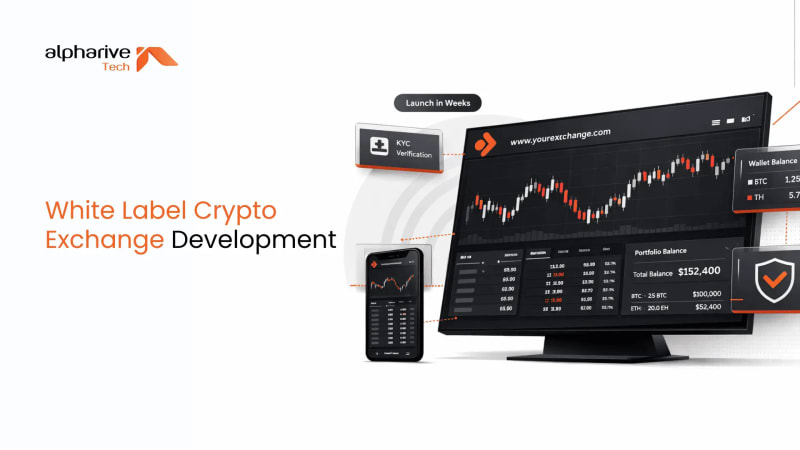
A white label crypto exchange is a pre-built trading platform that businesses can customize, brand, and launch as their own cryptocurrency exchange without developing the entire system from the ground up. Instead of spending months building infrastructure, companies deploy a ready-made solution that already includes the essential components required to operate a digital asset marketplace.
A typical white label cryptocurrency exchange comes with a high-performance matching engine, integrated cryptocurrency wallets, built-in KYC/AML verification systems, a complete trading interface, and an administrative control panel. This ready-to-launch exchange software allows operators to focus on branding, user acquisition, and liquidity strategies while the underlying technology is already operational. With full customization capabilities, the platform becomes a branded crypto trading platform tailored to a company's identity, trading features, and compliance requirements. In practice, a white label exchange solution provides a faster, lower-risk way to enter the crypto trading market while maintaining complete ownership of the exchange brand and user experience.
White Label vs Custom Crypto Exchange Development - Which Is Right for You?
Choosing between white label crypto exchange development and custom crypto exchange development is one of the most important decisions founders make when planning to launch a trading platform. Both approaches enable businesses to enter the digital asset market, but they differ significantly in terms of time, cost, flexibility, and technical complexity.
The most noticeable difference is time to market. A white label exchange can be launched within weeks because the core infrastructure like matching engine, wallet system, trading interface, and admin panel is already built and tested. In contrast, custom exchange development typically requires several months since every component must be designed and engineered from the ground up. Development cost follows a similar pattern. White label platforms offer a budget-efficient entry point, while fully custom exchanges demand higher investment due to extended development cycles, larger engineering teams, and complex testing processes.
Another important factor is customization depth. A white label exchange solution allows significant branding and feature customization, including UI/UX design, fee structures, and asset listings. However, custom development gives businesses complete control over architecture, allowing them to build proprietary trading mechanisms, unique order types, or specialized financial products. This flexibility often appeals to enterprises planning highly differentiated platforms.
Technical risk also varies between the two approaches. Since white label platforms rely on already tested technology, the risk of system instability or critical vulnerabilities is significantly lower. Custom-built exchanges, on the other hand, require extensive security engineering, infrastructure testing, and performance optimization to reach production-grade stability.
When evaluating long-term scalability, both models can support growth, but the path differs. White label exchanges are ideal for startups and fintech companies that want to launch quickly, validate their market, and scale operations with proven infrastructure. Custom exchanges are better suited for organizations with unique technical requirements or specialized trading ecosystems that cannot be supported by existing frameworks.
For most startups and fintech companies, a white label crypto exchange offers the fastest and most cost-effective route to market. Businesses that require unique trading architecture or highly specialized financial features may benefit more from custom crypto exchange development. You can explore this option further through our crypto exchange development solutions designed for fully customized trading platforms.
White Label Crypto Exchange Platform Types We Deliver
White label crypto exchange platform types allow businesses to launch different trading models depending on their target market, regulatory strategy, and liquidity approach. At Alpharive, we deliver multiple exchange architectures designed to support diverse trading ecosystems.
White Label Centralized Exchange
A White Label Centralized Exchange (CEX) provides a traditional trading infrastructure where the platform operator manages custody, order matching, and liquidity management. This model supports high transaction throughput, advanced order types, margin trading, and integrated fiat gateways. Businesses choosing centralized platforms benefit from faster trade execution, strong liquidity aggregation, and a familiar trading experience for mainstream users. Our centralized crypto exchange development solutions enable businesses to launch fully branded CEX platforms with enterprise-grade trading engines and secure wallet infrastructure.
White Label Decentralized Exchange (DEX)
A White Label Decentralized Exchange (DEX) allows users to trade cryptocurrencies directly from their wallets without relying on centralized custody. Transactions are executed through smart contracts, ensuring transparency and on-chain settlement for every trade. This model appeals to users who prioritize self-custody and decentralized governance. Alpharive supports decentralized exchange development with smart contract-powered trading systems, liquidity pool integrations, and automated market maker mechanisms.
White Label P2P Exchange
A White Label P2P Exchange enables direct cryptocurrency transactions between buyers and sellers without intermediaries controlling the order flow. The platform facilitates secure trade matching, escrow protection, dispute resolution systems, and payment method integrations. This exchange model is widely used in regions where users prefer local payment methods or direct peer trading. Through our P2P crypto exchange development, businesses can launch platforms that support multiple fiat payment channels and user-to-user trading networks.
White Label Hybrid Exchange
A White Label Hybrid Exchange combines the strengths of both centralized and decentralized trading systems. Users benefit from the speed and liquidity of centralized infrastructure while maintaining greater control over their assets through decentralized settlement mechanisms. Hybrid exchanges offer a balanced architecture that improves security without sacrificing trading performance. Alpharive's hybrid crypto exchange development approach builds platforms that integrate centralized matching engines with decentralized asset control layers.
White Label OTC Exchange
A White Label OTC Exchange is designed for high-volume traders and institutional participants who need to execute large cryptocurrency transactions without causing major market price fluctuations. Over-the-counter trading desks allow buyers and sellers to negotiate deals privately while maintaining secure settlement processes. This model is commonly used by funds, brokers, and institutional investors entering the digital asset market.
White Label Crypto Exchange App
A White Label Crypto Exchange App extends the trading platform experience to mobile users through fully branded applications. Mobile trading apps include real-time price charts, order management tools, wallet access, and push notifications for market activity. Businesses launching exchanges today rely heavily on mobile trading accessibility, which is why Alpharive delivers custom-branded crypto exchange apps optimized for both iOS and Android environments.
Our White Label Crypto Exchange Development Services
White Label Exchange Development & Customization
White label exchange development services focus on delivering a ready-to-launch crypto trading platform that can be tailored to specific business requirements. The platform infrastructure includes trading engines, wallet integrations, and admin controls while allowing deep customization for trading features, fee models, supported assets, and platform architecture.
Beyond basic deployment, customization ensures the exchange aligns with the operator's operational goals, target users, and market positioning. This approach allows businesses to launch faster while still maintaining flexibility to evolve the platform as trading volumes and user demands grow.
White Label Exchange Branding & UI/UX Design
Branding and interface design play a critical role in building trust and recognition in competitive crypto markets. A white label exchange can be fully customized with unique brand identity, including platform themes, trading dashboards, custom domains, and branded mobile applications.
User experience design also focuses on simplifying complex trading activities for both beginners and professional traders. Clear navigation, intuitive order placement tools, and responsive interfaces help improve engagement and retention across web and mobile trading environments.
Liquidity Integration & Management
Liquidity integration ensures that a crypto exchange launches with sufficient order book depth and trading activity from the beginning. This service connects the platform with global liquidity providers, liquidity aggregation APIs, and market-making partners that maintain consistent buy and sell orders.
Effective liquidity management also involves monitoring order book balance, optimizing spreads, and integrating multiple liquidity sources to maintain trading stability. These mechanisms allow exchange operators to offer competitive trading experiences while minimizing slippage for users.
KYC/AML & Compliance Integration
KYC and AML integration ensures that a crypto exchange operates within global regulatory frameworks while protecting the platform from fraudulent activity. Identity verification tools, transaction monitoring systems, and automated risk screening help exchanges maintain secure and compliant operations.
Compliance modules can also be adapted to different jurisdictions, allowing the platform to support region-specific reporting standards, user verification processes, and transaction auditing requirements for regulated digital asset markets.
API Integration & Third-Party Connectivity
Modern crypto exchanges rely heavily on APIs to integrate external financial services and platform functionalities. These integrations enable connections with payment gateways, liquidity providers, blockchain networks, market data feeds, and trading bots.
Third-party connectivity also expands the ecosystem around the exchange by allowing developers and institutional traders to access platform data, automate strategies, and build additional services on top of the trading infrastructure.
Security Audit & Penetration Testing
Security audits and penetration testing are essential steps in preparing a crypto exchange for public launch. These processes examine the platform's infrastructure, smart contracts, wallet systems, and backend services to identify vulnerabilities before they can be exploited.
Regular penetration testing simulates real-world cyberattack scenarios to strengthen defenses against threats such as unauthorized access, data breaches, and distributed denial-of-service attacks.
Post-Launch Maintenance & Support
Launching a crypto exchange is only the beginning of platform operations. Continuous maintenance ensures that the exchange remains stable, secure, and compatible with evolving blockchain technologies and market conditions.
Ongoing support includes system monitoring, performance optimization, security updates, feature enhancements, and technical troubleshooting. This long-term operational support allows exchange operators to focus on business growth while the platform infrastructure remains reliable and up to date.
Core Features of Our White Label Crypto Exchange Software
Trading Engine Features
White label crypto exchange software is built with a powerful trading infrastructure that supports real-time market activity, secure transactions, and scalable platform performance. At the core of the platform is a high-speed matching engine capable of processing thousands of transactions per second while maintaining low latency. The system supports both spot and derivatives trading, allowing users to trade across multiple markets within a single interface. A real-time order book ensures accurate price discovery, while multi-currency support allows exchanges to list and manage a wide range of digital assets. The platform can support 200+ cryptocurrencies and integrates fiat-to-crypto gateways, enabling users to buy and trade assets using traditional payment methods.
Customization & Branding Features
Customization plays a major role in building a recognizable exchange brand. The platform allows full UI and UX customization so businesses can design a trading interface that aligns with their brand identity and user expectations. Custom domains ensure the exchange operates under its own branded web environment, while fully branded mobile applications extend the platform experience to both iOS and Android users. A white-labeled admin panel provides complete control over platform operations, user management, asset listings, and trading parameters. Exchange operators can also configure custom fee structures, allowing them to adjust trading fees, withdrawal fees, and promotional incentives based on their business model.
Security Features
Security remains one of the most critical aspects of operating a digital asset exchange. The platform incorporates multiple layers of protection, including two-factor authentication and biometric login options that strengthen user account security. A cold wallet architecture protects the majority of exchange assets by storing them offline, reducing exposure to online threats. Additional protections include DDoS mitigation systems, end-to-end encryption for transaction data, and multi-signature wallet authorization for secure asset transfers. Regular penetration testing and ongoing security assessments help maintain platform resilience against evolving cyber threats.
AI-Powered Features
Advanced exchanges are increasingly integrating intelligent automation into their trading infrastructure. AI-powered features enable fraud detection systems that analyze transaction patterns and identify suspicious activity in real time. Automated KYC verification accelerates user onboarding while reducing manual compliance workloads. The platform can also analyze historical trading data to forecast market volume trends and identify liquidity patterns. Integrated market intelligence dashboards provide exchange operators with insights into trading behavior, asset performance, and platform activity, while automated risk management tools help maintain operational stability as the exchange grows.
Revenue Model Architecture for White Label Exchange Operators
A white label crypto exchange is not just a trading platform it is a digital financial infrastructure capable of generating multiple revenue streams. Once the exchange is live and active users begin trading, operators can monetize different aspects of the platform. The most common revenue source is trading fees, where the exchange charges a small percentage on every buy or sell transaction executed on the platform. These fees typically follow a maker-taker model or a flat percentage structure. As trading volume grows, even small fee percentages can generate substantial recurring revenue for the exchange operator.
Beyond trading activity, exchanges also earn income through withdrawal and deposit fees. Withdrawal fees are charged when users transfer cryptocurrency from the exchange to external wallets, while some platforms may apply small processing fees for fiat deposits through payment gateways. Another profitable revenue stream is token listing fees, where blockchain projects pay the exchange to list their tokens and gain access to the platform's trading community.
Many exchanges further increase revenue through margin trading services, where traders borrow funds to open leveraged positions and pay interest on those borrowed assets. In addition, platforms offering crypto staking services allow users to earn rewards by locking tokens on the exchange, while the operator receives a percentage of the staking yield as a service fee. Some exchanges introduce premium membership tiers, giving users benefits such as lower trading fees, faster withdrawals, advanced analytics tools, or priority customer support in exchange for a subscription fee.
Advanced platforms also monetize API access by providing high-frequency trading firms and institutional traders with premium data feeds and automated trading infrastructure. Finally, referral and affiliate programs create another revenue channel by encouraging users and partners to bring new traders onto the platform, expanding the exchange's user base while sharing a portion of generated fees. By combining multiple revenue streams, a well-operated white label crypto exchange can evolve into a scalable and highly profitable digital trading business.
Liquidity Integration in White Label Crypto Exchange Platforms
Liquidity integration in white label crypto exchange platforms determines how smoothly trades are executed and how attractive the platform becomes to active traders. Without sufficient liquidity, exchanges suffer from large spreads, slow order execution, and unstable price movement. To prevent these issues, modern white label exchanges integrate pre-sourced liquidity connections that provide immediate access to active buy and sell orders as soon as the platform launches. This ensures the exchange begins operations with a functional and competitive order book rather than starting from zero market activity.
Advanced platforms use liquidity aggregation APIs to connect with multiple liquidity providers simultaneously. These systems combine orders from different sources into a unified order book, improving price stability and reducing slippage for traders. In addition, many exchanges integrate market maker partnerships that continuously place buy and sell orders to maintain trading activity and balanced spreads. Market makers play a key role in ensuring consistent trading volume, especially during the early growth stage of a new exchange.
Maintaining order book depth management is another important aspect of liquidity architecture. Deep order books allow large trades to be executed without causing dramatic price fluctuations. Automated systems monitor trading activity and help maintain healthy spread ranges between buy and sell orders. To support long-term stability, exchanges may also implement automated liquidity rebalancing mechanisms that redistribute liquidity across trading pairs depending on market demand.
With these mechanisms in place, a white label crypto exchange with liquidity launches with strong trading infrastructure from day one. Operators benefit from stable market activity, improved trader confidence, and the ability to scale the exchange ecosystem as new assets and trading pairs are introduced.
Global Compliance & Regulatory Architecture
A modern white label crypto exchange must operate within global regulatory frameworks, which is why compliance architecture is built directly into the platform from the beginning. Instead of developing regulatory systems separately after launch, the exchange infrastructure includes a complete KYC and AML verification pipeline that supports identity checks, risk profiling, and transaction monitoring. This built-in compliance layer helps exchanges verify users, prevent fraudulent activity, and maintain transparent operational records required for regulated digital asset markets.
The platform architecture is designed to align with globally recognized regulatory frameworks used across financial ecosystems. It supports VASP-compatible infrastructure, enabling exchanges to operate under virtual asset service provider standards. Integrated Travel Rule compliance ensures that required transaction information can be securely transmitted between participating financial institutions during cryptocurrency transfers. Additionally, the platform includes MiCA-ready reporting capabilities, allowing exchanges to generate regulatory reports required for digital asset oversight frameworks.
To strengthen financial monitoring, the exchange integrates transaction tracking systems aligned with global financial crime monitoring standards, helping operators detect suspicious behavior and flag unusual transaction patterns. Built-in audit trail systems compatible with financial reporting requirements allow exchanges to maintain transparent transaction histories and operational records for compliance audits.
Another important advantage is the platform's adaptable compliance modules, which allow the exchange to adjust verification processes, reporting formats, and monitoring rules depending on the regulatory requirements of the jurisdiction where it operates. With these systems in place, a white label exchange launches compliance-ready for regulated markets globally, allowing operators to focus on platform growth rather than building complex regulatory infrastructure from scratch.
White Label Crypto Exchange Development Process
The white label crypto exchange development process follows a structured workflow designed to move a trading platform from concept to launch with clear deliverables at every stage.
Discovery & Requirements
This stage analyzes business goals, target users, compliance requirements, and trading features while delivering exchange type recommendations, compliance roadmap, feature scope documentation, and an estimated development cost.
System Architecture Design
Engineers define the technical architecture by selecting technology stacks, designing infrastructure layers, and preparing a security protocol plan while delivering a complete platform architecture document.
Platform Development & Configuration
Core exchange infrastructure is configured during this stage, including deployment of the matching engine, wallet systems, trading modules, and backend administration tools required for platform functionality.
Customization & Branding
The platform interface is customized to match the exchange brand, including UI and UX adjustments, branded trading dashboards, custom domain configuration, and white-labeled mobile app environments.
Liquidity & API Integration
Liquidity providers, market data sources, payment gateways, and third-party APIs are integrated to activate trading pairs, establish order book depth, and enable external financial service connectivity.
Security Audit & QA Testing
Comprehensive security and performance testing evaluates the platform's resilience through vulnerability scans, penetration testing simulations, bug identification, and system optimization before deployment approval.
Deployment & Launch Support
The exchange is deployed on production infrastructure with monitoring tools, operational dashboards, team training materials, and post-launch support agreements to ensure stable trading operations.
White Label Crypto Exchange Development Cost & Timeline
The cost of white label crypto exchange development varies depending on the level of customization, liquidity infrastructure, and compliance architecture required. An entry-level white label crypto exchange platform with core trading features, wallet integration, and a standard admin panel typically starts from $15,000. A fully branded platform with advanced UI customization, expanded asset support, liquidity integrations, and mobile applications usually ranges between $25,000 and $40,000. For organizations planning to launch enterprise-grade exchanges with institutional trading capabilities, custom liquidity infrastructure, and advanced regulatory compliance systems, the development cost can exceed $60,000 depending on the platform complexity and feature scope.
The timeline for launching a white label crypto exchange platform is significantly shorter compared to building an exchange from scratch. A basic white label exchange with essential trading functionality can typically go live within 3 to 4 weeks once configuration and integrations are completed. A fully branded platform with custom UI, mobile apps, and expanded trading features generally requires 5 to 7 weeks for deployment. Enterprise-level exchanges that include advanced liquidity architecture, full compliance modules, and institutional-grade infrastructure may take 8 to 10 weeks to reach production launch.
Why Choose Alpharive for White Label Crypto Exchange Development?
Choosing the right development partner plays a major role in the long-term success of a crypto exchange. Alpharive is a custom crypto exchange development company delivering white-label solutions with institutional-grade trading infrastructure designed for performance, scalability, and security. using institutional-grade trading infrastructure designed for performance, scalability, and security. Our platforms are powered by high-performance matching engines capable of processing large trading volumes with minimal latency. Exchanges launched with Alpharive also benefit from built-in liquidity connections from day one, helping platforms maintain active order books and competitive spreads from the moment trading begins.
The development approach supports complete white label flexibility across multiple exchange models, including centralized, decentralized, P2P, and hybrid platforms. Each project follows a milestone-based delivery structure, where clients receive clear deliverables at every stage of development from architecture planning and platform configuration to launch readiness. Branded mobile trading apps are included as part of the platform ecosystem, ensuring seamless trading experiences across web and mobile environments. In addition, the platform architecture is built with compliance-ready frameworks for regulated markets globally, helping businesses launch exchanges that align with evolving regulatory expectations while benefiting from long-term technical support and a structured post-launch support.