
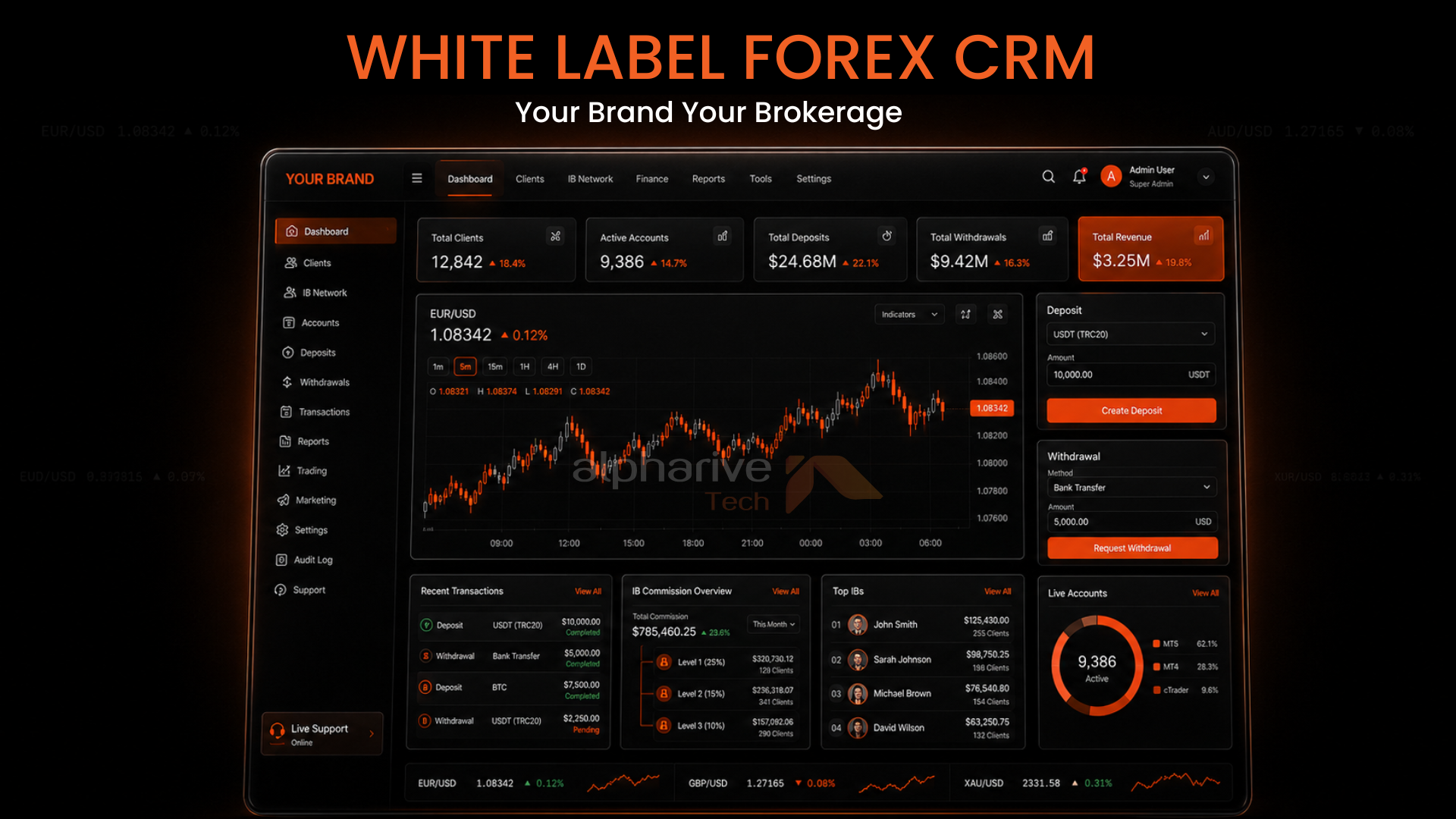
Choosing a white-label Forex solution is not simply about finding a platform that can be launched quickly.
The market includes different types of Forex technology providers. Some focus mainly on trading platforms, while others specialize in CRM and back-office systems. Full-stack providers combine multiple brokerage technologies, while customizable providers offer ready-made infrastructure with room for additional development.
These providers can differ in their technology, integrations, liquidity setup, customization, pricing, support, and contract terms.
For a brokerage, the important question is not just which white-label Forex solution to choose. It is finding a provider whose technology matches the brokerage's requirements, target market, and long-term plans.
This guide explains the types of white-label Forex providers available, what they offer, how they differ, and what brokers should evaluate before signing an agreement.
Key Takeaways
- White-label Forex providers generally fall into platform-first, CRM-first, full-stack, and customizable solution categories.
- Providers can offer different combinations of trading platforms, CRM, liquidity, payments, KYC/AML, IB management, and back-office tools.
- Pricing can include setup fees, monthly licensing, hosting, integrations, custom development, and transaction-based charges.
- Data ownership, API access, migration, and termination terms should be reviewed before signing a contract.
- The lowest setup price does not necessarily mean the lowest long-term cost.
- A live demo and workflow testing can reveal gaps that are not obvious from a provider's feature list.
White Label Forex Provider
The white-label Forex market is not made up of one standard type of vendor.
Providers generally fall into several categories, and each category can suit a different brokerage requirement.
Provider Type | Main Focus | Usually Best For | What to Watch For |
|---|---|---|---|
Trading Platform Provider | Trading infrastructure | Brokers that mainly need trading technology | CRM and back-office capabilities may be limited |
Forex CRM Provider | CRM and brokerage operations | Brokers that need stronger client management | Trading infrastructure may need separate providers |
Full-Stack Provider | End-to-end brokerage technology | Businesses looking for multiple systems from one vendor | Higher overall cost and vendor dependency |
Customizable Provider | Ready-made technology with customization | Growing brokers with specific workflows | Custom development may cost extra |
Understanding this difference is important because a provider that fits one brokerage may not provide everything another brokerage requires.
Which Type of White Label Forex Provider Do You Need?
The right provider type depends on which part of your brokerage infrastructure you need to solve.
You mainly need trading infrastructure
A trading platform-focused provider may be suitable if your brokerage already has CRM, payment, compliance, and back-office systems.
Your priority would be trading infrastructure, account management, platform access, and related technology.
You need stronger client and sales management
A Forex CRM provider may be more appropriate if your main requirement is managing leads, clients, sales teams, onboarding, IBs, and brokerage operations.
In this case, evaluate the CRM independently rather than choosing a vendor based only on its trading platform.
You want several systems from one vendor
A full-stack provider may be suitable if you want trading, CRM, trader's room, liquidity, payments, and other brokerage technology under one technology partner.
However, check exactly which components are included in the package.
You want a ready-made foundation with flexibility
A customizable provider can be useful if you want to launch using existing infrastructure but expect to need custom workflows, integrations, or functionality later.
Before signing, clearly separate standard features from paid customization.
How to Choose the Right Type of Provider
1. Trading Platform Providers
Trading platform providers primarily focus on the technology that allows clients to access and manage their trading activity.
Depending on the vendor, the solution may include:
- MT4 or MT5 integration
- Trading infrastructure
- Trader account management
- Mobile trading access
- Trading interfaces
- Reporting tools
- Administrative controls
- API connectivity
This type of provider can work well for a brokerage that already has its CRM, payment, compliance, and back-office systems.
However, check whether additional systems will be required to manage leads, clients, IBs, payments, and onboarding.
2. Forex CRM Providers
A Forex CRM provider focuses more heavily on client management and brokerage operations.
A typical Forex CRM can help manage:
- Leads
- Sales teams
- Client onboarding
- KYC workflows
- Trading accounts
- Deposits and withdrawals
- IB relationships
- Commission structures
- Client communication
- Reports and analytics
This can be useful for brokers that already have trading infrastructure but need a better system for managing leads and clients.
When comparing a Forex CRM provider, look beyond the dashboard design. Check whether the CRM supports the actual workflows your brokerage uses.
For example, ask whether it can handle your lead distribution process, account creation, IB structure, payment workflow, and reporting requirements.
3. Full-Stack Forex Technology Providers
Full-stack providers combine multiple parts of brokerage infrastructure into a broader technology package.
Depending on the vendor, this may include:
- Trading platform integration
- Forex CRM
- Trader's room
- Back office
- Liquidity connectivity
- Payment integrations
- KYC/AML tools
- IB management
- Reporting
- Risk management
- APIs
The main benefit is that several systems can be obtained from one technology partner.
However, brokers should not assume that every feature is included simply because a provider describes its offering as full-stack.
Ask for a detailed breakdown of what is included, what requires third-party services, and what is charged separately.
4. Customizable White Label Providers
Some technology vendors provide ready-made Forex infrastructure but allow businesses to customize the solution.
Customization may include:
- Branding
- User interface
- CRM workflows
- Client onboarding
- Payment integrations
- API integrations
- Reporting
- Admin workflows
- Additional modules
This model can be useful for brokers that want to launch using an existing technology foundation but do not want to be restricted to a completely standard package.
Before choosing this model, ask the provider to clearly define its customization limits.
A feature described as "customizable" may only mean branding changes, while another provider may support actual workflow and functionality changes. If a brokerage needs CRM workflows that are not available in the standard package, custom forex CRM development can be used to extend the platform with tailored workflows, integrations, and brokerage-specific functionality.
What Do White Label Forex Solutions Include?
There is no universal feature list for every white-label solution.
A typical offering may include some combination of the following:
Component | What to Check |
|---|---|
Trading Platform | MT4, MT5, cTrader, or other supported platforms |
Forex CRM | Lead, client, sales, and account management |
Trader's Room | Client account and transaction management |
IB Management | Referral tracking, commissions, multi-level structures |
Liquidity | Liquidity providers, aggregation, execution setup |
KYC/AML | Verification and compliance integrations |
Payments | Card, bank, crypto, and local payment options |
Back Office | User management, reporting, administrative controls |
APIs | API availability, documentation, and access |
Customization | Branding, workflows, integrations, modules |
Support | Technical support, maintenance, response times |
The important point is to compare how each feature works, not just whether the feature appears on a provider's website.
For example, two vendors may both offer IB management, but one may support only basic referral tracking while another may support multiple commission structures and multi-level IB arrangements.
How to Compare White Label Forex Providers
Once you have identified the type of provider you need, compare vendors using the same criteria.
Technology and Infrastructure
Start with the underlying infrastructure.
Ask:
- Where is the system hosted?
- How is the infrastructure monitored?
- How does the platform handle increased trading activity?
- What backup systems are available?
- How is system security managed?
- What happens during an infrastructure failure?
- Can the system scale as your client base grows?
A demo can show you what the platform looks like, but it does not necessarily tell you how the infrastructure behaves under real operational conditions.
CRM and Back Office
The CRM and back office become increasingly important as the brokerage acquires more clients.
Check how the system handles:
- Lead assignment
- Sales agents
- Client onboarding
- KYC
- Trading accounts
- Deposits
- Withdrawals
- IB management
- Commission calculations
- Client communication
- Reporting
If the CRM does not support your required workflows, you may eventually need another system or custom development.
If CRM functionality is a major part of your requirements, compare dedicated Forex CRM software separately from the trading infrastructure.
Liquidity and Execution
Liquidity should be evaluated separately from the trading interface.
Ask:
- Which liquidity providers can be connected?
- Is liquidity aggregation supported?
- How are spreads configured?
- How is execution managed?
- Can additional liquidity providers be added?
- Who manages the liquidity connection?
- Are there additional liquidity-related costs?
The answers should be clear before implementation begins.
Integrations
Most brokerages require several third-party systems.
Check whether the provider can integrate with:
- Payment gateways
- KYC providers
- AML systems
- Trading platforms
- Liquidity providers
- Accounting systems
- Marketing platforms
- Analytics tools
- Communication systems
- Custom APIs
Also confirm whether integrations are included in the package or charged separately.
Customization
Ask the vendor to separate customization into three categories:
Included configuration
Changes that are already part of the standard package.
Paid customization
Changes that require additional development.
Unsupported changes
Requirements the provider cannot currently deliver.
This simple distinction can prevent misunderstandings after the contract is signed.
Scalability
A solution that works for a small brokerage may not necessarily be suitable when the client base and trading activity increase.
Ask how the infrastructure can scale across:
- Client accounts
- Trading activity
- Transactions
- Leads
- IBs
- API requests
- Reporting requirements
You should also understand whether higher usage changes your monthly or transaction-based costs.
Technical Support and SLA
Support should be evaluated as part of the technology, not as an afterthought.
Check:
- Support hours
- Emergency support
- Response times
- Escalation process
- Dedicated account management
- Maintenance notifications
- Service-level agreements
- Development support
If the provider says it offers 24/7 support, ask what that actually means and which issues are covered.
White Label Forex Solution Pricing
The initial setup fee is only one part of the cost.
Depending on the provider, you may encounter:
- Initial setup fees
- Platform licensing
- Monthly subscriptions
- Hosting fees
- CRM licensing
- Liquidity costs
- Payment integration costs
- KYC/AML integration costs
- Custom development
- API integration
- Maintenance
- Technical support
- Transaction fees
- Volume-based charges
- Migration costs
For this reason, compare the total cost of ownership rather than comparing only the advertised setup price.
A useful calculation is:
Total Cost = Initial Setup + Monthly Costs + Integrations + Customization + Transaction Fees + Support
Also ask how pricing changes as your brokerage grows.
A solution that appears inexpensive at launch may become more expensive when you add more users, transactions, integrations, or custom features.
Data Ownership and Vendor Lock-In
Data ownership is one of the areas brokers should investigate before signing a contract.
Ask the provider:
- Who owns client data?
- Who owns trading data?
- Can data be exported?
- Which export formats are supported?
- Are APIs available?
- Is there a data export fee?
- Are migration services available?
- What happens after contract termination?
- How long will data remain accessible?
You should also understand whether your brokerage can continue using its data if it decides to change technology vendors.
A clear exit process can reduce the operational problems associated with changing providers.
Questions to Ask a White Label Forex Provider
Before selecting a vendor, ask these questions:
- Which trading platforms do you support?
- What exactly is included in the package?
- Which features require additional payment?
- What CRM and back-office functions are included?
- Which liquidity providers can be connected?
- Can we integrate our preferred payment providers?
- Which KYC/AML providers can be integrated?
- What APIs are available?
- What level of customization do you support?
- How does pricing change as our client and trading volume increases?
- What technical support and SLA are included?
- Who owns our brokerage and client data?
- Can we export our data if we change providers?
- What happens when the contract ends?
- Will you support migration to another system?
Ask the provider to answer these questions in writing wherever possible.
How to Evaluate a Provider Before Signing
A simple evaluation process can help you compare vendors.
Step 1: Define Your Requirements
Create a list of the systems your brokerage actually needs:
- Trading platform
- CRM
- Trader's room
- IB management
- Liquidity
- Payments
- KYC/AML
- Reporting
- APIs
- Custom development
Separate must-have features from features that are simply nice to have.
Step 2: Shortlist Similar Providers
Compare providers offering a similar level of infrastructure.
A basic trading-platform provider should not be compared directly with a full-stack technology vendor without considering the difference in scope.
Step 3: Request a Live Demo
Do not evaluate the platform only through screenshots or sales presentations.
Ask the vendor to demonstrate real workflows such as:
- Creating a lead
- Assigning a lead to a sales agent
- Onboarding a client
- Completing KYC
- Creating a trading account
- Making a deposit
- Processing a withdrawal
- Managing an IB
- Calculating commissions
- Generating reports
This can reveal limitations that are not obvious from a feature list.
Step 4: Review the Commercial Agreement
Check:
- Setup costs
- Monthly fees
- Integration fees
- Development costs
- Support fees
- Transaction charges
- Renewal terms
- Price increases
Make sure you understand what happens when your usage increases.
Step 5: Review the Exit Strategy
Before signing, confirm how your brokerage can retrieve its data and move to another technology provider.
Review the:
- Data export process
- API access
- Migration support
- Termination period
- Migration fees
- Data retention period
This should be considered before implementation, not after a problem occurs.
White Label vs Custom Forex Software
White-label and custom Forex software solve different business requirements.
A white-label solution can provide a ready-made technology foundation and reduce the work involved in launching a brokerage.
Custom software provides greater control over architecture, workflows, integrations, and functionality but usually requires more development time and planning.
The comparison should therefore go beyond the initial price.
Consider how much customization, control, integration, and scalability your brokerage will need over time.
For a detailed comparison, see our guide on Custom vs White Label Forex CRM for US Brokers.
Where Alpharive Fits in the White Label Forex Market
Alpharive supports brokerages that need more flexibility than a standard white-label package can provide.
Depending on the brokerage's requirements, the technology can support:
- Forex CRM
- Trading platform integrations
- Client onboarding
- IB management
- Payment integrations
- KYC/AML integrations
- Brokerage workflows
- APIs
- Custom modules
- Custom Forex software development
The focus is not simply on providing a fixed package. The technology can be configured around the brokerage's operational requirements and expanded when additional functionality is needed.
This can be useful for businesses that want a ready-made technology foundation while keeping the option to customize their CRM, workflows, integrations, and other brokerage components.
White Label Forex Provider Evaluation Checklist
Before selecting a provider, review these areas:
- Trading platform compatibility
- CRM functionality
- Back-office capabilities
- Trader's room
- IB management
- Liquidity connectivity
- Payment integrations
- KYC/AML integrations
- API access
- Customization options
- Scalability
- Security and infrastructure
- Technical support
- SLA terms
- Complete pricing structure
- Data ownership
- Data export
- Migration support
- Contract termination terms
Final Thoughts
The white-label Forex market includes several types of technology providers, and they are not interchangeable.
A platform-focused provider may suit a brokerage that mainly needs trading infrastructure. A Forex CRM provider may be more relevant when client management and brokerage operations are the priority. Full-stack providers can combine multiple systems, while customizable providers can provide a ready-made foundation with additional flexibility.
The best way to compare them is to look beyond the feature list.
Evaluate the technology, CRM, liquidity, integrations, customization, scalability, support, pricing, data ownership, and exit terms together.
This gives your brokerage a clearer picture of what it is actually buying—and what its relationship with the technology provider will look like after launch.