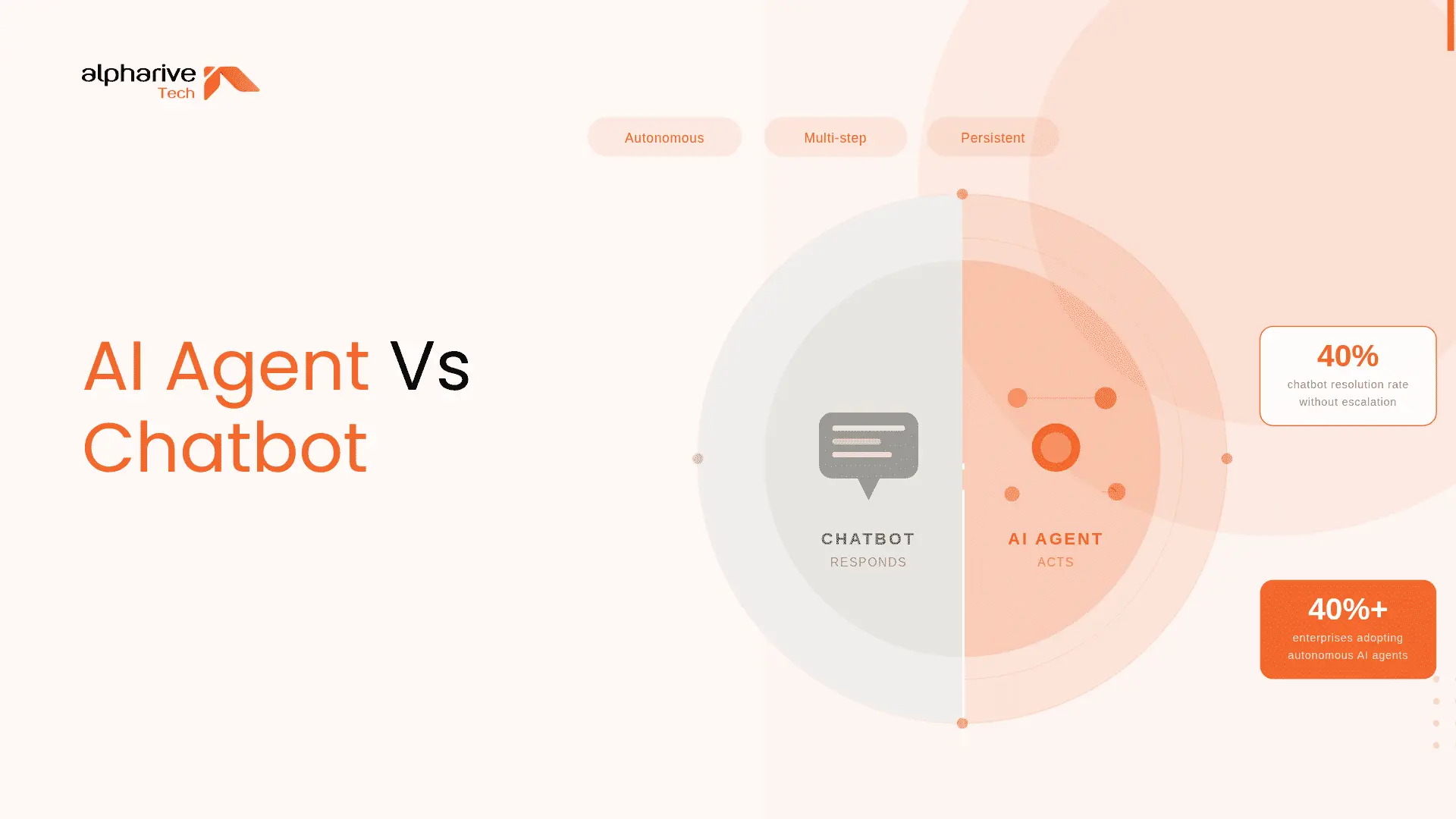
Chatbots respond, AI agents act. That single difference defines how businesses approach automation today. When comparing AI agents vs chatbots, many teams start with chatbots for quick wins but soon face limitations they didn’t expect. Conversations get handled, but real tasks remain unfinished. This is the difference between an AI agent and a chatbot, it becomes clear where one reacts, while the other can plan, decide, and execute.
As businesses move toward smarter automation, the shift is happening fast. Research suggests that over 40% of enterprises are already exploring autonomous AI systems to improve operations. In this guide, we break down the key differences, real-world use cases, and decision factors so you can confidently choose the right solution for your business.
What Is a Chatbot?
A chatbot is a conversational software system designed to respond to user inputs using predefined rules or AI-driven language models. When discussing AI agents vs chatbots, it’s important to understand that chatbots primarily focus on handling conversations rather than completing tasks. They are widely used for customer support, FAQs, and basic interactions where responses can be predicted or guided through structured flows.
At the same time, chatbots operate within clear boundaries. They depend heavily on prompts and predefined logic, which limits their ability to go beyond simple interactions. Industry data shows that chatbots typically resolve only 20 - 40% of queries without human intervention, especially when requests involve multiple steps or decision-making. This limitation often becomes the turning point for businesses exploring more advanced solutions.
Rule-based vs LLM-powered chatbots
Traditional chatbots follow fixed decision trees where responses are triggered by specific keywords or user inputs, while LLM-powered chatbots use AI models to generate more flexible, human-like replies within conversational limits.
The Hard Ceiling: Where Chatbots Reliably Breakdown
Challenges arise when users request actions beyond scripted responses, such as processing refunds or accessing multiple systems, where chatbots lack the ability to reason, retain context, or execute complex workflows independently.
What Is an AI Agent?
An AI agent is an advanced software system designed to not just respond, but to act, decide, and complete tasks autonomously. In the context of AI agents vs chatbots, the key difference lies in capability while chatbots handle conversations, AI agents handle outcomes. They can understand goals, break them into steps, interact with multiple systems, and execute actions without constant human input.
Unlike traditional tools, AI agents are built to operate across workflows rather than within a single interaction. They don’t stop at answering a question, they move forward to complete the task behind it. This makes them useful in business environments where processes involve multiple steps, systems, and decisions that need to be handled in real time.
Four Core Capabilities that Define an AI Agent
AI agents operate through reasoning, memory, tool usage, and autonomy, enabling them to understand goals, retain context, interact with systems, and execute multi-step workflows without constant human intervention.
Agentic AI vs AI agent: Why the Distinction Matters
Agentic AI refers to the broader concept of autonomous decision-making systems, while an AI agent is the practical implementation that applies those capabilities within specific workflows and real-world business use cases.
AI Agent vs Chatbot: 7 Key Differences
AI agent vs chatbot comparisons highlight how these two technologies differ in capability, purpose, and business impact. While both are used for automation, their approach to solving problems is fundamentally different. Chatbots are built for handling conversations, whereas AI agents are designed to complete tasks end-to-end across systems.
To make this distinction clear, here’s a side-by-side comparison across the seven areas that matter most when choosing between them:
Dimension | Chatbot | AI Agent |
|---|---|---|
Autonomy | Responds only when prompted | Works toward goals independently |
Memory | Limited to current session | Retains short- and long-term context |
Tool Access | No direct system interaction | Integrates with APIs, CRMs, databases |
Task Scope | Single interaction | Multi-step workflows |
Learning | Static or limited improvement | Continuously improves with feedback |
Cost & Complexity | Quick to deploy, low cost | Requires architecture, higher investment |
Outcome | Deflects queries | Resolves tasks end-to-end |
Autonomy: reactive vs goal-directed
Chatbots operate reactively, meaning they wait for user input before responding, while AI agents can proactively plan and execute actions based on defined goals without needing constant prompts.
Memory: session-only vs persistent
Most chatbots forget context once a session ends, whereas AI agents retain both short-term and long-term memory, allowing them to build continuity across interactions and improve decision-making over time.
Tool access: none vs full system integration
Chatbots typically lack the ability to interact with external systems, but AI agents connect with tools like CRMs, APIs, and databases to perform real actions within business workflows.
Task scope: single-turn vs multi-step workflows
A chatbot usually handles one query at a time, while an AI agent can break down complex tasks into multiple steps and complete them from start to finish without manual intervention.
Learning: static vs iteratively improving
Chatbots rely on predefined responses or limited training updates, whereas AI agents continuously learn from interactions, feedback, and data to refine their performance over time.
Cost and complexity: low barrier vs engineered solution
Deploying a chatbot is relatively quick and cost-effective, but AI agents require deeper system design, integration, and monitoring, making them a more advanced but powerful investment.
Measurable outcome: deflection vs resolution
Chatbots are measured by how many queries they can handle or deflect, while AI agents are evaluated based on their ability to fully resolve tasks and deliver tangible outcomes.
Same Scenario, Two Outcomes: Chatbot vs AI Agent in Action
The difference between AI agents vs chatbots becomes much more clear when you see how each performs in real situations. While both interact with users, their ability to handle tasks varies significantly once complexity increases. Real-world scenarios reveal where chatbots stop and where AI agents take over to complete the job.
Looking at the use cases of AI agents, you can see how these technologies impact day-to-day business operations. Below are three common scenarios where the contrast between a chatbot and an AI agent becomes immediately visible.
Scenario: Customer Requests a Refund
When a customer asks for a refund, a chatbot typically provides policy details, asks a few scripted questions, and may create a support ticket, but it often stops short of completing the actual refund process.
An AI agent, on the other hand, verifies the purchase, checks eligibility, initiates the refund through backend systems, updates records, and confirms completion to the customer without requiring human intervention.
Scenario: an IT help desk ticket is raised
In an IT support scenario, a chatbot collects basic information, suggests troubleshooting steps, and escalates the issue if the problem goes beyond predefined responses or scripts.
An AI agent can diagnose the issue by accessing system logs, run automated fixes, reset configurations, update tickets in real time, and resolve the problem while keeping the user informed throughout the process.
Scenario: a sales lead fills out a contact form
When a potential customer submits a form, a chatbot may respond with a generic message, share information, or route the lead to a sales representative for follow-up.
An AI agent evaluates the lead, enriches data from external sources, schedules meetings, updates the CRM, and triggers personalized follow-ups, ensuring the opportunity moves forward without delays.
How to Decide: Chatbot, AI Agent, or Both?
Choosing between a chatbot, an AI agent, or a combination of both depends on the complexity of your workflows and the outcomes you expect. In the context of AI agents vs chatbots, the decision is not about which is better overall, but which fits your current stage of automation and business needs. Many organisations begin with chatbots for simple use cases and gradually move toward AI agents as requirements grow.
At the same time, the most effective approach in recent days is often a hybrid model. Instead of replacing one with the other, businesses combine both technologies to handle different layers of interaction. This ensures efficiency at scale while still enabling deeper automation where it truly matters.
Start with a chatbot when
Your use cases involve handling high-volume, repetitive queries such as FAQs, basic customer support, or initial user interactions that do not require system access or complex decision-making.
Upgrade to an AI agent when
Tasks require multi-step execution, system integrations like CRM or payment processing, or the ability to retain context and make decisions across workflows without human intervention.
The hybrid approach
A chatbot manages front-line interactions and filters simple queries, while an AI agent takes over complex requests that need reasoning, system access, and end-to-end task execution.
What AI Agents Still Can’t Do?
AI agents are powerful, but understanding their limitations is just as important as knowing their strengths. When evaluating AI agents vs chatbots, it’s easy to focus only on capabilities, but real-world implementation comes with constraints that businesses need to plan for. These systems require careful design, monitoring, and control to operate effectively within defined boundaries.
At the same time, these limitations are not deal-breakers they are factors to consider during planning and deployment. With the right approach, most of these challenges can be managed, but ignoring them early often leads to delays, higher costs, or unexpected risks during production.
Governance and Bounded Autonomy Requirements
AI agents need clear rules, approval layers, and defined boundaries to ensure they act safely and align with business policies, especially when handling sensitive data or critical operations.
Infrastructure Complexity and Time-to-Production
Building AI agents involves integrating multiple systems, setting up orchestration layers, and ensuring reliability, which makes development more complex and time-intensive compared to deploying standard chatbots.
How Alpharive Helps You Choose and Build the Right Solution?
Deciding between AI agents vs chatbots is not always straightforward, especially when your workflows involve multiple systems, teams, and customer touchpoints. The right choice depends on how your business operates today and how far you want to take automation in the future. This is where having the right technical partner makes a real difference.
Alpharive, as a leading AI Agent Development Company the focus is not just on building solutions, but on understanding your workflows first. The team evaluates where chatbots can deliver quick efficiency and where AI agents can drive deeper automation through reasoning, integrations, and execution. This approach ensures that you invest in the right technology at the right stage, without overengineering or limiting future growth.
From AI Agent Architecture design to deployment, every solution is built to handle real business scenarios whether it’s customer support, operations, or sales automation. With experience in developing scalable AI systems, Alpharive helps businesses move beyond basic automation and implement solutions that actually complete tasks, not just conversations.