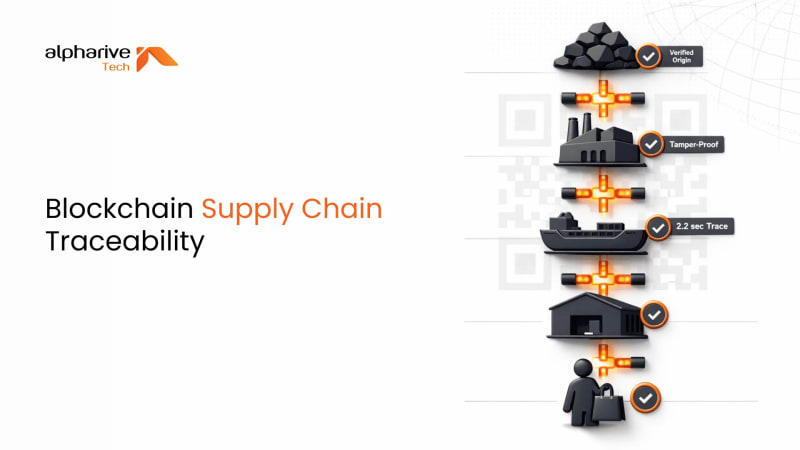
It takes the average company seven days to trace the origin of a contaminated food product. With blockchain, Walmart can do it in just 2.2 seconds. That difference shows how outdated traditional traceability systems have become in today's global supply chains. Most companies still depend on disconnected databases, paper records, and fragmented supplier systems that make it extremely difficult to identify where products come from or where they have been.
This is where blockchain supply chain transparency changes the entire model. Instead of relying on isolated data points, blockchain creates a shared, tamper-proof record of every product movement across suppliers, manufacturers, logistics providers, and retailers. Every step-from raw materials to the final customer-can be recorded and verified in real time.
In this guide, we'll explain how blockchain enables reliable product tracking, how it improves end to end supply chain visibility, and how businesses can implement blockchain-powered traceability systems in real-world supply chains.
What Is Supply Chain Traceability?
Supply chain traceability refers to the ability to track a product's journey across every stage of the supply chain, from raw material sourcing to the final customer purchase. Unlike basic tracking systems, true traceability records every transformation, transfer, and handling event a product experiences throughout its lifecycle. When implemented correctly, it allows companies to identify where materials originated, how they were processed, and which partners handled them along the way.
However, many companies confuse traceability with end to end supply chain visibility, even though the two serve different purposes. Visibility shows where goods are in transit at a given moment, while traceability provides a historical record of everything that happened to a product over time. In practice, most organizations struggle to achieve both because supply chain data is scattered across ERP systems, spreadsheets, supplier portals, and paper documentation.
The result is a fragmented environment with no single source of truth. When a recall, compliance audit, or fraud investigation occurs, companies must manually gather information from multiple systems and partners. This process is slow, error-prone, and vulnerable to data manipulation, which is why traditional traceability systems often fail when speed and accuracy matter most.
How Blockchain Enables End-to-End Traceability
Blockchain enables end to end supply chain visibility by creating a shared digital ledger where every supply chain event is permanently recorded and verified. Instead of storing information in isolated systems, blockchain allows manufacturers, suppliers, distributors, and retailers to record product movements on a single distributed network. Each transaction is validated and added to the chain as a new block, forming a chronological record that cannot be altered later.
This structure creates what many organizations call an immutable audit trail supply chain system. Every event-such as harvesting raw materials, manufacturing components, shipping goods, or receiving inventory-becomes a timestamped entry on the ledger. Because records cannot be edited or deleted, all participants can trust the accuracy of the data without relying on a central authority.
As a result, businesses can use blockchain track and trace capabilities to identify the exact path a product followed through the supply chain. When issues such as contamination, counterfeit goods, or compliance checks arise, companies can quickly verify product history and isolate affected batches without disrupting the entire supply network.
How a Product Gets a Digital Identity on Blockchain
For product traceability blockchain systems to work, every item or batch must first receive a unique digital identity. This identity is typically created when raw materials enter the supply chain, and it is linked to a digital record on the blockchain that stores key information such as origin, production date, certifications, and supplier details.
As the product moves through manufacturing, packaging, shipping, and distribution, new data points are continuously added to the same record. Sensors, IoT devices, and enterprise systems can automatically update these entries, allowing companies to track product movement in real time while maintaining a secure and tamper-resistant history.
QR Code Consumer-Facing Verification
Many brands extend blockchain traceability to customers through QR code verification systems. By scanning a QR code on the product package, consumers can instantly view verified information about where the product was sourced, how it was manufactured, and the path it followed through the supply chain.
This level of transparency builds trust while also helping brands combat counterfeiting. Because the verification data is pulled directly from the blockchain ledger, customers and regulators can independently confirm product authenticity without relying solely on company-provided claims.
Blockchain Traceability vs Traditional Track-and-Trace Systems
Traditional supply chain systems were built to monitor shipments and inventory movements, but they were never designed to support true blockchain supply chain traceability. Most legacy platforms rely on centralized databases where each company maintains its own records. As products move across suppliers, logistics providers, warehouses, and retailers, information becomes fragmented across multiple systems, making it difficult to verify the full product history.
Blockchain-based traceability changes this structure by creating a shared and tamper-resistant ledger where all authorized participants can record and verify supply chain events. Instead of passing data between disconnected systems, every stakeholder works from the same synchronized record. This approach improves end to end supply chain visibility, reduces reconciliation work between partners, and strengthens trust across global supply networks.
| Feature | Blockchain Traceability | ERP-Based Systems | Barcode Track-and-Trace |
| Data Integrity | Tamper-proof records stored on a distributed ledger with an immutable audit trail | Data stored in centralized databases that can be modified by system administrators | Relies on manual scanning and internal databases, which may allow data edits |
| Speed of Traceability | Product origin and movement can be traced within seconds across the entire network | Requires querying multiple internal systems and supplier records | Depends on manual scanning and data sharing between organizations |
| Tamper Resistance | Cryptographically secured entries prevent unauthorized changes to historical records | Data can potentially be altered within internal systems | Barcode data can be modified or incorrectly recorded |
| Cross-Company Visibility | Shared ledger enables verified access for all authorized supply chain participants | Each company maintains its own database with limited external visibility | Information typically stays within individual company systems |
| Cost Structure | Initial implementation investment with long-term efficiency and fraud reduction benefits | Ongoing operational costs for maintaining multiple systems and integrations | Lower upfront cost but limited scalability for complex supply chains |
For organizations that need reliable blockchain track and trace capabilities across global suppliers, distributors, and regulators, blockchain offers a more resilient foundation than traditional tracking technologies. As supply chains become more complex and compliance requirements increase, many enterprises are beginning to move beyond basic tracking systems toward blockchain-powered traceability networks.
Real-World Examples of Blockchain Traceability
Several global companies have already adopted blockchain supply chain traceability to improve transparency, reduce fraud, and accelerate product tracking. These real-world implementations show how blockchain track and trace systems can transform complex supply chains that involve multiple suppliers, regulators, and logistics partners.
One of the most well-known examples is Walmart's collaboration with IBM Food Trust, which focuses on food safety and contamination tracking. Before blockchain adoption, tracing the origin of fresh produce across farms, distributors, and stores could take days. By recording supply chain events on a blockchain ledger, Walmart can now identify the exact origin of food products in seconds. This improvement allows the company to isolate contaminated batches quickly without removing large volumes of safe products from shelves.
Another widely recognized case is Everledger's blockchain platform for diamond traceability. The luxury industry has long struggled with verifying the authenticity and ethical sourcing of diamonds. Everledger records detailed information about each diamond-including origin, ownership, and certification-on blockchain. This system helps jewelers, insurers, and buyers confirm whether a diamond is genuine and responsibly sourced.
In the global shipping sector, Maersk partnered with IBM to develop TradeLens, a blockchain-based platform designed to track shipping containers across international trade routes. The system digitized shipping documentation and created a shared ledger where shipping lines, ports, customs authorities, and logistics companies could record cargo movements. This significantly reduced paperwork delays and improved coordination between supply chain partners.
What These Companies Achieved in Numbers
The impact of blockchain traceability becomes clearer when looking at measurable results. Walmart reduced food traceability time from nearly seven days to just 2.2 seconds, dramatically improving its ability to respond to contamination risks. Everledger has recorded millions of diamond data points on blockchain, helping the industry combat fraud and verify ethical sourcing across global markets.
Meanwhile, TradeLens processed tens of millions of shipping events and documents, enabling participants to track containers more efficiently while reducing administrative friction in international logistics. These results demonstrate how product traceability blockchain systems can deliver both operational efficiency and stronger trust across supply chain ecosystems.
Industries That Need Blockchain Traceability Most
As global supply chains grow more complex, blockchain supply chain traceability is becoming critical for industries where product authenticity, safety, and regulatory compliance are essential. Traditional systems often struggle to track materials across multiple suppliers and countries, creating risks related to counterfeiting, contamination, and data manipulation. Blockchain helps solve these challenges by creating a shared, verifiable record of every product movement across the ecosystem.
Food and Beverage
Food safety incidents often require companies to quickly trace the origin of ingredients across farms, processing facilities, and distribution networks. With blockchain track and trace systems, food producers and retailers can identify contamination sources within seconds rather than days. This faster traceability helps protect consumers while reducing unnecessary product recalls across unaffected inventory.
Pharmaceutical
The pharmaceutical industry relies heavily on accurate tracking to prevent counterfeit drugs from entering the market. Product traceability blockchain solutions allow manufacturers, distributors, and pharmacies to record each transaction in a secure ledger. This creates a verifiable history for every medication batch, helping companies meet strict regulatory requirements while strengthening patient safety.
Luxury Goods
Luxury brands face constant challenges related to counterfeit products and unauthorized resale channels. Blockchain traceability enables companies to assign unique digital identities to luxury items such as watches, handbags, and diamonds. Customers can verify authenticity through QR codes or digital certificates, improving trust while protecting brand reputation.
Automotive
Modern vehicles rely on thousands of components sourced from suppliers around the world. Blockchain traceability allows manufacturers to monitor the origin, movement, and compliance status of each critical component. If a defect occurs, companies can quickly identify affected parts and suppliers without recalling entire production batches.
Electronics
Electronics supply chains involve rare materials, complex manufacturing stages, and global distribution networks. Blockchain helps track components from raw material extraction to final device assembly. This improves transparency around sourcing practices while supporting compliance with sustainability and ethical sourcing regulations.
US Regulatory - FDA & FSMA Traceability Requirements
Food safety regulations in the United States are becoming stricter, and blockchain supply chain traceability is emerging as a practical way for companies to meet these requirements. The Food Safety Modernization Act (FSMA) introduced new rules that require businesses to maintain detailed records about where food products come from, how they are processed, and where they are distributed. With supply chains often spanning multiple countries and suppliers, maintaining accurate traceability records using traditional systems can be extremely difficult.
A key regulation shaping this shift is FSMA Rule 204, also known as the Food Traceability Final Rule. This rule requires companies that handle high-risk foods to maintain Key Data Elements (KDEs) and Critical Tracking Events (CTEs) across the entire supply chain. Starting January 2026, businesses must be able to quickly provide detailed traceability records during food safety investigations. Blockchain-based systems make this process easier by automatically capturing and storing every supply chain event in a tamper-resistant ledger.
Blockchain also supports FDA traceability blockchain initiatives by creating a secure and verifiable audit trail for regulators. Instead of manually collecting documents from suppliers, manufacturers can provide a complete digital history of a product's journey-from farm to store shelf. This reduces investigation time, improves recall accuracy, and strengthens regulatory compliance across the supply chain.
Another important regulation is the Drug Supply Chain Security Act (DSCSA), which focuses on pharmaceutical traceability. The law requires drug manufacturers, distributors, and dispensers to implement interoperable systems capable of tracking prescription medicines at the package level. Blockchain-powered product traceability blockchain platforms can support DSCSA compliance by recording serialized drug information and verifying every transfer of ownership throughout the pharmaceutical distribution network.
EU Regulatory - EUDR, CSRD and Supply Chain Due Diligence
Across Europe, new regulations are pushing companies to improve supply chain due diligence, especially when it comes to verifying product origins and sustainability claims. These regulations require businesses to maintain reliable records that prove where materials were sourced, how they were processed, and whether they meet environmental and ethical standards. As a result, many organizations are exploring blockchain supply chain traceability to create verifiable digital records that regulators can trust.
One of the most significant policies is the EU Deforestation Regulation (EUDR), which requires companies selling products such as cocoa, coffee, rubber, soy, and timber in the EU to prove that their materials were not sourced from deforested land. Businesses must provide detailed geolocation data and supply chain documentation that verifies the origin of raw materials. Blockchain systems can support this requirement by recording sourcing data at each stage of the supply chain, creating a tamper-resistant record that regulators can audit when necessary.
Another major regulation is the Corporate Sustainability Reporting Directive (CSRD), which expands ESG reporting obligations for thousands of companies operating in the European market. Under CSRD, businesses must disclose detailed information about environmental and social risks across their supply chains. Blockchain-based traceability platforms help companies gather reliable data from suppliers and maintain a transparent history of sourcing, production, and logistics activities.
The EU is also introducing the Battery Passport initiative, which requires batteries sold in the European market to include digital records tracking materials from mining through manufacturing, usage, and recycling. These passports will include information such as carbon footprint, raw material origin, and lifecycle data. By enabling secure data sharing across manufacturers, recyclers, and regulators, product traceability blockchain systems can support the serialized tracking needed for these next-generation compliance frameworks.
How to Implement Blockchain Traceability in Your Supply Chain
Implementing blockchain supply chain traceability requires more than simply deploying a blockchain network. Businesses need a structured approach that connects suppliers, logistics partners, and internal systems while ensuring accurate data capture across every stage of the product lifecycle.
Step 1 - Map your current supply chain data flows
Start by documenting how supply chain data currently moves between suppliers, manufacturers, warehouses, and logistics partners to identify traceability gaps, manual data entry points, and missing product tracking events.
Step 2 - Choose the right blockchain architecture
Select a blockchain network model based on supply chain requirements, governance structure, scalability needs, and data privacy rules between participating partners across the ecosystem.
Step 3 - Integrate with existing ERP/WMS systems
Connect the blockchain platform with existing ERP, warehouse management, and logistics systems so operational data automatically updates blockchain records without requiring manual input from employees.
Step 4 - Onboard suppliers and set data standards
Successful blockchain traceability depends on supplier participation, which requires standardized data formats, clear governance policies, and onboarding processes that ensure every partner records supply chain events consistently.
Step 5 - Deploy smart contracts for automated verification
Smart contracts automate compliance rules by verifying product origin, shipment conditions, certifications, and ownership transfers, ensuring that supply chain data is validated before new records are added to the blockchain ledger.
Alpharive - Your Tech Partner for Blockchain Powered Supply Chain Solution
Building a reliable blockchain powered supply chain traceability system requires more than just deploying blockchain technology-it demands deep expertise in supply chain architecture, enterprise integrations, and scalable distributed systems. Alpharive works closely with businesses to design and implement blockchain-powered traceability platforms that connect suppliers, logistics providers, manufacturers, and retailers through a secure and transparent digital infrastructure.
From defining blockchain architecture and integrating ERP systems to deploying smart contracts and supplier onboarding frameworks, the focus remains on creating practical solutions that improve end to end supply chain visibility and strengthen trust across the ecosystem. If your organization is exploring blockchain-powered traceability or preparing for upcoming regulatory requirements, connect with experts at Alpharive to build a future-ready supply chain solution.