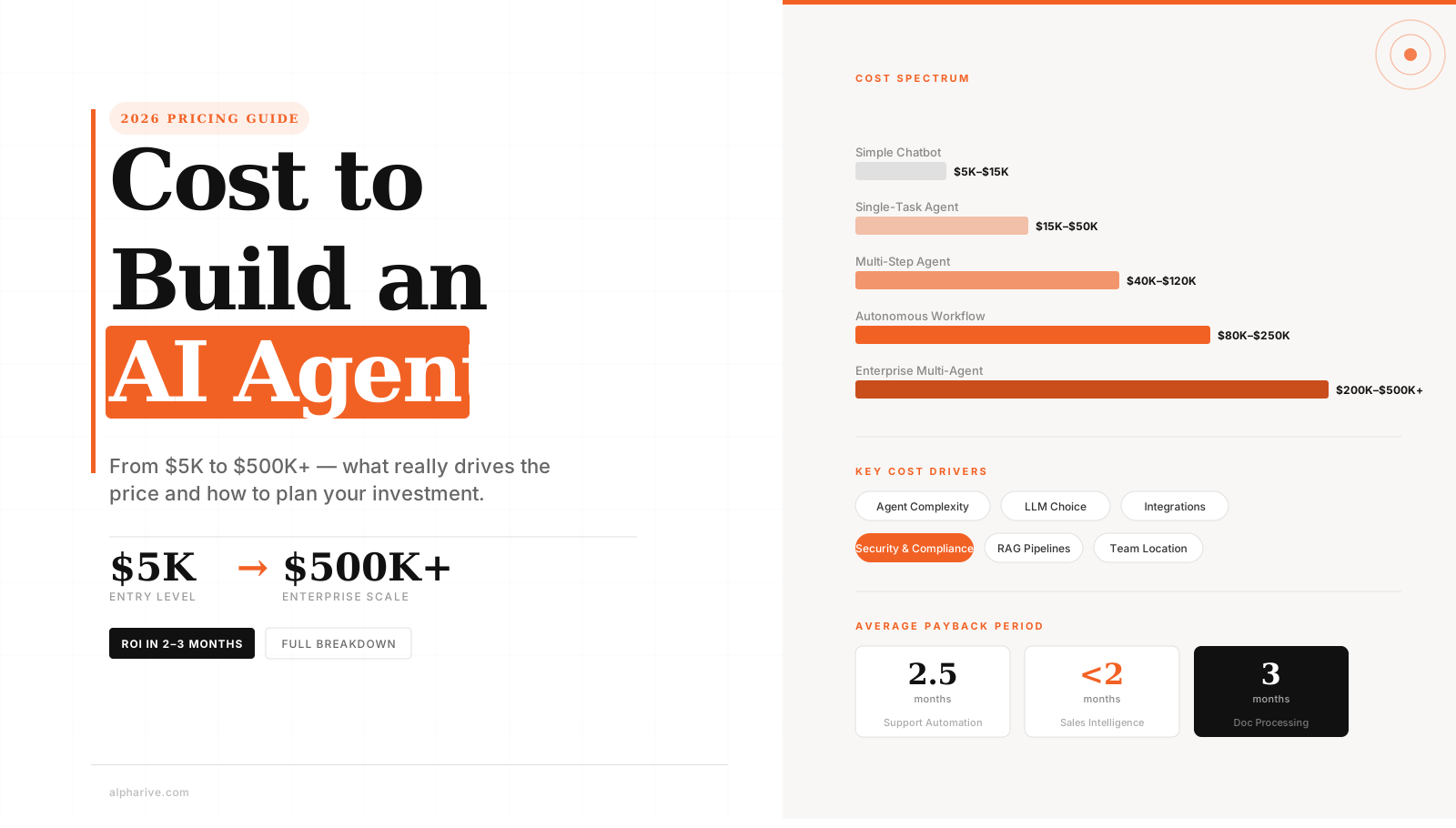
Building an AI agent costs anywhere from $5,000 to $500,000+, and the difference depends on complexity, integrations, and scale. With AI adoption rising fast in 2026, businesses are actively exploring agentic solutions. In this guide, we break down real pricing, key cost drivers, hidden expenses, ROI potential, and smart ways to plan your investment.
What Is an AI Agent?
An AI agent is a software system designed to perceive input, reason through tasks, and take actions without constant human guidance. Unlike traditional tools, it can handle multi-step workflows by combining data access, decision-making, and execution within a single system. This ability to operate with a level of autonomy is what makes AI agents valuable for modern business processes.
At the same time, not all AI agents are built the same, which is why pricing can vary widely. A basic chatbot responds to a single prompt, while an advanced AI agent can query databases, call APIs, and adapt its behavior based on context. As complexity, integrations, and intelligence increase, the development effort grows significantly, directly influencing the overall cost.
AI Agent Development Cost
AI agent development cost can vary widely depending on the type of solution, its capabilities, and how deeply it integrates into your business systems. To give you a clear starting point, here’s a quick breakdown of typical cost ranges, timelines, and ideal use cases across different types of AI agents.
This table helps you quickly understand where your idea fits before diving deeper into specific cost factors. It also reflects how complexity, autonomy, and scale directly influence both pricing and development time.
Agent Type | Cost Range | Timeline | Best For |
|---|---|---|---|
Simple / Rule-Based Agent | $5,000 - $20,000 | 2-6 weeks | FAQ bots, basic automation |
Contextual / Semi-Autonomous | $20,000 - $80,000 | 6-12 weeks | CRM-integrated assistants, copilots |
Autonomous AI Agent | $80,000 - $150,000 | 3-5 months | Multi-step workflow automation |
Enterprise Multi-Agent System | $150,000 - $500,000+ | 6-12 months | End-to-end business process automation |
Key Factors That Drive AI Agent Development Cost
AI agent development cost is primarily influenced by several technical and business factors that shape how the solution is built and deployed. Understanding these elements early helps avoid budget surprises and allows you to plan a more realistic investment based on your actual use case.
Each factor below contributes differently to the final cost, and in most projects, it’s the combination of these elements not just one that determines the total budget. Let’s break down the most important ones in detail.
Agent Complexity & Autonomy Level
The level of intelligence and independence an AI agent requires is the biggest cost driver in any project. A simple rule-based agent that follows predefined instructions is far less expensive than a goal-driven system that can make decisions, learn from context, and execute multi-step tasks.
As autonomy increases, so does the need for advanced logic, better models, and more rigorous testing. For example, moving from a basic assistant to a fully autonomous workflow agent can multiply development effort several times, making this the most critical factor in pricing.
LLM Model Choice: OpenAI vs Open-Source
The choice of language model plays a major role in both development and ongoing operational costs. Using premium APIs like GPT-4 or Claude offers high performance but comes with recurring usage costs based on tokens, which can scale quickly at enterprise levels.
On the other hand, open-source models like Llama or Mistral can significantly reduce costs during early stages. However, they may require additional infrastructure and optimization efforts, which adds to development complexity depending on performance expectations.
System Integrations (CRM, ERP, APIs)
Integrating an AI agent with existing business systems is often one of the most expensive parts of development. Each integration whether it’s a CRM, ERP, payment system, or internal API it requires custom logic, testing, and ongoing maintenance.
In many real-world projects, integrations can account for a large portion of the total budget. The more systems your agent needs to interact with, the more time and resources are required to ensure everything works smoothly and securely.
Data Preparation & RAG Pipelines
Data is the foundation of any effective AI agent, and preparing it properly takes time and effort. Cleaning, structuring, and organizing data often adds a significant portion to the overall timeline, especially for large or unstructured datasets.
Retrieval-Augmented Generation (RAG) pipelines are commonly used to improve accuracy without expensive fine-tuning. While RAG is cost-efficient in the long run, setting up vector databases and retrieval logic still requires careful planning and technical expertise.
Security, Compliance & Regulatory Requirements
Security and compliance requirements can substantially increase development costs, especially for industries handling sensitive data. Building features like access control, audit logs, and encryption adds additional layers of complexity to the system.
For businesses operating in regions like Europe, regulations such as GDPR or upcoming AI laws require extra validation and safeguards. These requirements are not optional and must be factored into the budget from the beginning.
Geography & Team Location
The location of your development team directly affects hourly rates and overall project cost. Different regions offer varying levels of expertise, pricing, and time zone alignment, which can influence both budget and collaboration efficiency.
Here’s a general comparison of global development rates to help you understand how geography impacts cost:
Region | Hourly Rate Range | Project Cost Impact | Notes |
|---|---|---|---|
United States / Canada | $150 - $300/hr | Highest | Top-tier talent; strong local collaboration |
United Kingdom / Western Europe | $100 - $200/hr | High | GDPR-ready teams; mature AI ecosystem |
Eastern Europe | $50 - $90/hr | Moderate | Strong engineering quality at lower cost |
India | $25 - $65/hr | Lower | Fast-growing AI market; cost-effective delivery |
Latin America | $40 - $80/hr | Moderate | Good timezone alignment for US clients |
Hidden & Recurring Costs Most Vendors Don't Tell You
Hidden and recurring costs in AI agent development often appear after deployment, when the system starts running at scale and interacting with real users. While initial build costs get most of the attention, ongoing expenses can quietly grow and significantly impact the total cost of ownership over time.
Beyond development, businesses must account for infrastructure, monitoring, and continuous improvement to keep the agent performing effectively. Many teams underestimate these costs, which is why planning for long-term expenses early can prevent budget overruns and operational challenges later.
Cost Component | Estimated Monthly Cost | Details |
|---|---|---|
LLM API Usage | $500 - $5,000+ | Depends on token volume and usage scale |
Vector Database (RAG) | $25 - $500 | Managed services or self-hosted setups |
Monitoring & Observability | $200 - $1,000 | Tools for tracking performance and errors |
Prompt Engineering & Updates | $1,000 - $4,000 | Ongoing optimization and improvements |
Maintenance & Model Updates | 15 - 30% annually | Based on initial development cost |
Compliance & Security Updates | ~10% annually | Required for evolving regulations |
Staff Training & Change Management | $5,000 - $20,000 | Especially for enterprise adoption |
Over time, these recurring elements define the real investment required to sustain an AI agent. In many cases, businesses underestimate total costs by a significant margin, making it essential to view AI not just as a one-time build, but as an evolving system that requires continuous attention.
Build vs Buy vs No-Code: A Decision Framework
Build vs buy vs no-code decisions play a key role in determining the overall AI agent development cost and long-term flexibility. Each approach comes with its own trade-offs in terms of investment, scalability, and control, so choosing the right path depends on your business goals and technical needs.
Instead of jumping straight into development, it’s important to evaluate whether you truly need a custom solution or if an existing platform can meet your requirements. The table below gives a clear comparison to help you make a confident and informed decision.
Approach | Upfront Cost | Best When… | Flexibility | Vendor Lock-in |
|---|---|---|---|---|
No-Code Platforms | $0 - $500/month | Validating a use case quickly | Low | High |
Low-Code / Framework | $1K - $15K | Need customization without full build | Medium | Medium |
Custom Build | $25K - $500K+ | Unique workflows, sensitive data, compliance needs | Full | None |
Hybrid (SaaS + Custom) | $10K - $100K | Scaling a proven use case with flexibility | High | Low |
Development Timeline & Phase-by-Phase Cost Breakdown
AI agent development timeline and cost breakdown give a clearer picture of how your investment is distributed across each stage of the project. Instead of viewing the cost as a single number, breaking it into phases helps you understand where time, effort, and budget are actually spent.
Each phase serves a specific purpose, from defining the use case to optimizing performance after launch. This structured approach not only improves clarity but also allows better control over budget and progress at every step.
Development Phase | Duration | Typical Cost | What Happens |
|---|---|---|---|
Discovery & Scoping | 1-2 weeks | $5,000 - $15,000 | Define use cases, audit data, and design system architecture |
Prototype / PoC | 2-4 weeks | $5,000 - $20,000 | Build initial workflows and validate technical feasibility |
MVP Development | 4-8 weeks | $15,000 - $60,000 | Develop core features, integrations, and early deployment |
Production Hardening | 2-4 weeks | $10,000 - $30,000 | Strengthen security, monitoring, and system reliability |
Post-Launch Optimization | Ongoing | $1,000 - $5,000/month | Improve prompts, update models, and add new features |
By breaking development into phases, businesses can take a step-by-step approach instead of committing the full budget upfront. This makes it easier to validate results early and scale confidently based on performance.
AI Agent ROI: Is the Investment Worth It?
AI agent ROI becomes clear when you measure how much time, cost, and manual effort the system replaces across daily operations. While the upfront investment may seem high, most businesses start seeing returns within a few months when the agent is applied to high-impact workflows.
The real value lies in consistent efficiency at scale, where repetitive tasks are handled automatically without increasing headcount. Instead of focusing only on cost, it’s more practical to compare the investment against the ongoing savings and productivity gains it delivers.
ROI Example 1: Customer Support Automation
A customer support team handling 5,000 tickets per month at an average cost of $12 per ticket spends around $60,000 monthly. If an AI agent deflects just 40% of those queries, that results in $24,000 saved every month.
With a development cost of approximately $60,000, the system pays for itself in about 2.5 months. Beyond that point, every month adds direct savings, making it one of the fastest-return use cases for AI agents.
ROI Example 2: Sales Intelligence Agent
Consider a sales team of 10 representatives, each saving 10 hours per week through an AI-powered assistant. At an average value of $120 per hour, this translates to $12,000 saved every week in productivity.
With an estimated build cost of $80,000, the investment can be recovered in less than two months. Over time, the increased efficiency also leads to better deal velocity and improved revenue outcomes.
ROI Example 3: Document Processing Automation
Manual document processing that takes 20 hours per file can be reduced to just minutes using an AI agent. For a business handling 200 documents per month at $80 per hour, the cost quickly adds up to over $30,000 monthly.
With a development cost of around $100,000, the payback period comes to just over three months. From there, the system continues to generate significant cost savings while improving turnaround time and accuracy.
The question is not whether an AI agent is expensive, it's whether the cost of not building one is already affecting your efficiency, scalability, and growth.
How to Reduce AI Agent Development Cost Without Cutting Quality
Reducing AI agent development cost starts with making smarter decisions early in the project rather than cutting corners later. A focused and well-planned approach helps avoid unnecessary complexity, keeping both time and budget under control while still delivering strong performance.
One of the most effective ways to lower cost is to begin with a single, clearly defined use case instead of building a broad, all-in-one agent. This alone can reduce initial investment significantly while allowing faster validation. At the same time, using open-source models during early stages and shifting to premium models only when needed helps manage ongoing expenses more efficiently.
Another practical strategy is to leverage existing frameworks like LangChain or similar orchestration tools instead of building everything from scratch. This reduces development time and speeds up deployment without compromising quality. Choosing Retrieval-Augmented Generation over expensive fine-tuning is also a cost-effective way to achieve strong results in most business scenarios.
Planning development in phases further improves cost control by allowing you to validate outcomes step by step. By investing in monitoring, prompt optimization, and scalable architecture from the beginning, businesses can avoid expensive rework later and build a system that grows efficiently with their needs.
How Alpharive Approaches AI Agent Development
Custom AI agent development at Alpharive focuses on building solutions that are practical, scalable, and aligned with real business outcomes. Instead of pushing generic implementations, the approach starts with understanding the exact workflow, data environment, and expected ROI before defining the architecture. This ensures every component, from RAG pipelines to multi-agent coordination, is purpose-built rather than over-engineered.
The process combines proven frameworks like LangChain and modern agentic systems with a strong emphasis on performance, security, and adaptability. Whether it’s integrating with enterprise tools or designing autonomous workflows, the goal is to create systems that deliver measurable value from day one. If you're planning an AI agent and want a clear, realistic cost estimate tailored to your needs, connect with experts.