
A prop firm trader in Chicago once ran a manual scalping strategy for two years, catching London-New York overlap moves by watching four charts at once. He was profitable, but exhausted. When he finally coded his rules into an automated system, the same strategy produced 30% more trade signals in month one, simply because the bot never blinked, never got distracted, and never hesitated on a valid entry. That gap between a trader's best intentions and a machine's consistency is exactly why so many US brokers, prop firms, and fintech founders now ask the same question: how do you actually build a forex trading bot that survives contact with a live market?
Building a Forex trading bot involves far more than writing trading rules. It requires scalable Forex Trading Software Development capabilities, including reliable market data pipelines, low-latency execution, independent risk controls, and infrastructure designed to operate continuously in live markets. This guide examines the architecture and engineering practices behind production-ready automated trading systems.
Why Automated Forex Trading Is Growing
The forex market trades nearly 24 hours a day, five days a week, across overlapping sessions in Sydney, Tokyo, London, and New York. No human can watch all of that. A forex trading bot can. That single fact explains most of the shift from discretionary trading desks to systematic execution over the last decade.
Retail platforms made automation accessible first, through MetaTrader's Expert Advisors. Institutional desks followed with FIX API connections to liquidity providers, running latency-sensitive strategies that a human simply cannot execute by hand. Today, prop trading firms, hedge funds, and even mid-size brokers building proprietary strategy desks are investing in custom algorithmic trading software instead of relying on generic, off-the-shelf robots.
Three forces are accelerating this in the US and other major markets: cheaper cloud compute for backtesting at scale, wider access to tick-level market data, and a maturing regulatory environment (the CFTC's automated trading oversight framework is a good reference point) that gives firms clearer guardrails for deploying automated systems responsibly.
What Is a Forex Trading Bot?
A forex trading bot is software that reads market data, applies a defined set of rules or a trained model, and places, modifies, or closes orders without manual input at the moment of execution. It is not a magic profit generator. It's a decision-and-execution engine that removes emotion and hesitation from a strategy a human already understands.
There are two broad categories worth separating clearly:
- Rule-based bots (often called Expert Advisors on MT4/MT5): if-then logic built on indicators, price action, or statistical rules.
- AI-driven bots: systems that use machine learning models to generate signals, adapt position sizing, or classify market regimes, layered on top of a rule-based execution and risk framework.
Inside a brokerage's technology stack, the trading bot works alongside the Forex CRM Software, Trader's Room, and risk management systems. For brokers offering copy trading or signal services to clients, the bot becomes a product feature; for prop firms, it's proprietary IP that never leaves internal infrastructure.
How a Forex Trading Bot Works ?
Every production-grade Forex trading bot follows a structured data-to-execution pipeline. Whether you're building a bot for a brokerage, prop trading firm, or fintech platform, understanding this architecture is more important than choosing a trading strategy because most production failures originate in the infrastructure rather than the trading logic.

Workflow
Trader: Defines the trading strategy and risk parameters.
Strategy Engine: Analyzes market data and generates buy or sell signals.
Risk Engine: Validates position size, exposure, and risk limits before approving trades.
Execution Engine: Routes approved orders with minimal latency.
Broker API: Sends trade requests to the brokerage platform.
MT5 / FIX API: Connects the bot to MetaTrader or institutional trading infrastructure.
Liquidity Provider: Executes the order at the best available market price.
A well-designed architecture separates strategy, risk, and execution into independent components, making the trading bot more reliable, scalable, and easier to maintain.
Types of Forex Trading Bots
Not every strategy needs the same architecture. Choosing the wrong bot type for your capital, latency access, or risk tolerance is one of the most common early mistakes we see from founders approaching forex trading bot development for the first time.
- Trend-following bots: ride sustained directional moves using moving averages, breakouts, or momentum indicators. Lower trade frequency, tolerant of moderate latency.
- Mean-reversion bots: bet on price returning to an average after a deviation. Works well in ranging markets, dangerous during strong trends without a regime filter.
- Scalping bots: take small, frequent profits on tight spreads. Highly latency-sensitive, often requires FIX API or VPS colocation near the broker's servers.
- Arbitrage bots: exploit price discrepancies across brokers or venues. Needs ultra-low latency infrastructure and multiple liquidity connections.
- Market-making bots: quote both sides of the market, common among liquidity providers and some prop desks, requiring deep risk and inventory management logic.
- News and sentiment bots: react to economic releases or social sentiment shifts, requiring a real-time news or NLP data feed.
- AI/ML-based bots: use trained models for signal generation or regime classification, layered on top of any of the above execution styles.
Core Components of a Production-Grade Bot
A bot that works in a demo account and a bot that survives a live account with real drawdowns are two different engineering problems. The gap is almost always in these seven components.

Market Data Ingestion
Clean, low-latency price feeds, normalized across symbols and time frames, stored in a time-series format that supports fast historical queries for both live decisions and backtesting.
Strategy Engine
The logic core: indicators, statistical models, or ML inference that converts data into buy, sell, or hold signals.
Risk Management Module
Position sizing, exposure caps, drawdown limits, and correlation checks that sit between signal generation and order placement, discussed in detail below.
Order Management System (OMS)
Tracks order state, handles partial fills, retries, and reconciles broker confirmations against expected positions.
Execution Engine
The layer that actually talks to MT4/MT5, cTrader, or a FIX API gateway, converting internal order objects into broker-specific requests.
Backtesting Engine
Simulates the strategy against historical data with realistic spread, slippage, and commission modeling, not just theoretical fills.
Monitoring and Alerting
Real-time dashboards, logging, and automated alerts (Slack, SMS, email) for drawdown breaches, connectivity loss, or abnormal behavior.
Step-by-Step Development Process
Here's the sequence we follow when building a forex trading bot for a client, whether it's a solo prop trader or a brokerage building a client-facing copy trading product.
- Define the strategy and the actual edge. Write the rules in plain English before writing a single line of code. If you can't explain why the strategy should make money, no amount of code will fix that.
- Choose the platform and data source. MT4, MT5, cTrader, or a direct FIX API connection, each with different execution and data implications (covered in the next section).
- Build the data pipeline. Ingest historical and live tick or bar data into a normalized, queryable store.
- Code the strategy logic. Implement signal generation as a testable, isolated module, separate from execution code.
- Build the risk and OMS layer. This should never be an afterthought bolted on after the strategy "works" in backtest.
- Backtest and optimize carefully. Use walk-forward testing, not just a single in-sample optimization run.
- Paper trade in a live market environment. Confirm the strategy behaves the same with real-time data and real broker latency.
- Deploy to live trading with monitoring and kill switches active from day one.
MT4 vs MT5 vs cTrader vs FIX API
Platform choice shapes almost every downstream engineering decision, from language to latency ceiling. Here's how the four most common options compare for bot development.
Platform | Primary Language | Execution Speed | Broker Support (US/UK/Global) | Best For |
|---|---|---|---|---|
MT4 | MQL4 | Moderate | Wide, legacy standard | Retail EAs, simple rule-based strategies |
MT5 | MQL5 | Improved over MT4 | Growing, replacing MT4 | Multi-asset bots, more complex order types |
cTrader | C# (cAlgo) | Fast, modern architecture | Moderate, popular with ECN brokers | Developers who prefer clean C# tooling |
FIX API | Any (C++, Java, Python via FIX engine) | Institutional-grade, lowest latency | Prime brokers, liquidity providers | Scalping, arbitrage, institutional volume |
If you're a retail-facing brokerage building copy trading tools for clients, MT4/MT5 account integration is usually the pragmatic starting point, since your client base is likely already there. If you're a prop firm or hedge fund chasing microsecond-level execution, a direct FIX API connection to a liquidity provider is worth the added engineering complexity.
Technology Stack for Forex Bot Development
There's no single "correct" stack, but there are patterns that hold up in production across the US and international brokerages we've worked with.
- Strategy and execution logic: MQL4/MQL5 for native MT4/MT5 EAs, Python for research and AI model development, C++ or Rust for latency-critical execution paths, Go for concurrent microservices.
- Data storage: Time-series databases like InfluxDB or kdb+ for tick data, PostgreSQL for trade history and account state.
- Messaging and integration: Kafka or ZeroMQ for internal event streaming, gRPC for service-to-service communication.
- Infrastructure: AWS or Azure for scalable backtesting and non-latency-critical services, colocated VPS near your broker's or liquidity provider's data center for execution.
Mixing a research stack (Python, Jupyter, pandas) with a production execution stack (C++/Rust with strict typing) is normal. The mistake is trying to run production execution directly from research-grade code.
AI in Forex Trading Bots
AI has real, specific uses in forex automation, and it's important to be precise about where it helps rather than treating it as a black box. An AI forex trading bot typically applies machine learning in one or more of these ways:
- Signal generation: LSTM or transformer-based models trained on price sequences to predict short-term direction or volatility.
- Regime classification: Models that detect whether the market is trending, ranging, or highly volatile, so the bot can switch strategy logic accordingly.
- Reinforcement learning: Agents trained to optimize position sizing or entry/exit timing within a simulated market environment.
- Sentiment analysis: NLP models scanning news feeds or social data to flag events likely to move a currency pair.
The biggest risk with AI-driven strategies is overfitting: a model that memorizes historical noise instead of learning a repeatable pattern. Walk-forward validation, out-of-sample testing, and strict feature engineering discipline are non-negotiable. In our experience, AI works best as a signal filter layered on top of a solid rule-based execution and risk framework, not as a standalone replacement for one.
If you're planning to integrate AI into your trading platform, Alpharive's AI Trading Software Development Company provides custom solutions for brokerages, prop firms, and fintech businesses.
Risk Management Features Every Bot Needs
This is the section most first-time bot builders underweight, and it's the one that determines whether a strategy survives its first bad month.
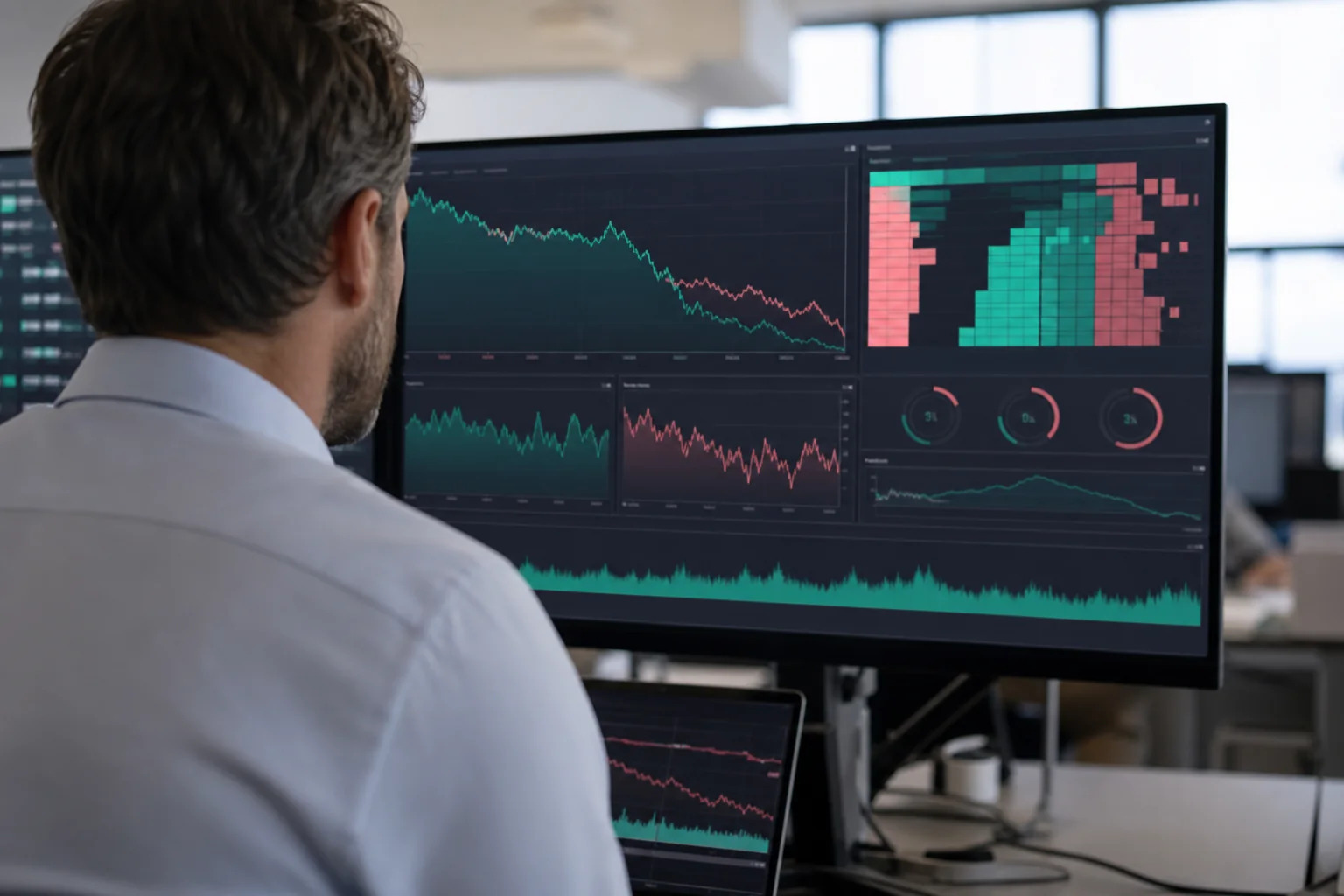
- Position sizing rules based on account equity and volatility, not fixed lot sizes.
- Maximum drawdown limits that pause or shut down the bot automatically when breached.
- Per-trade stop loss enforced at the OMS level, not just in strategy logic that could fail silently.
- Circuit breakers and kill switches for abnormal volatility, connectivity loss, or repeated execution errors.
- Correlation exposure limits so the bot doesn't unknowingly stack risk across correlated pairs like EUR/USD and GBP/USD.
- Slippage and latency-based rejection rules that cancel orders when market conditions have moved beyond acceptable execution tolerance.
A bot without a hard-coded kill switch is not production-ready, regardless of how good its backtest results look.
Backtesting vs Paper Trading vs Live Trading
These three stages serve different purposes, and skipping one is one of the fastest ways to blow up an account.
Backtesting validates the strategy logic against historical data, ideally with realistic spread, commission, and slippage modeling. Watch for look-ahead bias (using data that wouldn't have been available at that point in time) and curve-fitting (over-optimizing parameters to historical noise).
Paper trading runs the strategy against live market data in real time without risking capital. This exposes issues backtests can't, such as feed latency, broker-specific execution quirks, and unexpected connectivity drops. We generally recommend a minimum of four to six weeks of paper trading across varied market conditions before going live.
Live trading starts small, with reduced position sizing, close monitoring, and a clear rollback plan if performance diverges meaningfully from paper trading results.
Cloud Infrastructure for Trading Bots
Infrastructure choices directly affect execution quality. For latency-sensitive strategies, a VPS colocated near your broker's or liquidity provider's servers can shave milliseconds off round-trip execution time, which matters enormously for scalping and arbitrage strategies.
For less latency-critical strategies, cloud platforms like AWS or Azure offer scalable compute for backtesting, model training, and multi-strategy orchestration. Regardless of provider, production systems need redundancy: failover servers, automated health checks, and geographic distribution across regions relevant to your service area, whether that's US-East for New York liquidity or London for European sessions.
For brokers and prop firms operating across the US, UK, Canada, and Australia, infrastructure should be planned around where your primary liquidity providers and client base sit, not just where compute is cheapest.
Security Considerations
A trading bot with access to a live brokerage account is a high-value target. Security has to be built in, not added later.
- API key management: encrypted storage, no hardcoded credentials in source code, regular key rotation.
- DDoS protection for any exposed endpoints, especially if the bot serves signals to client-facing applications.
- Audit logging of every order, modification, and cancellation, both for debugging and for regulatory compliance.
- Secure credential storage using dedicated secrets management tools rather than environment files checked into version control.
For brokers operating under US, UK, or Australian regulatory frameworks, audit trails and data handling practices also need to align with applicable financial data protection requirements, something worth reviewing with compliance counsel alongside your development team.
Common Mistakes in Forex Bot Development
After 5+ years building trading systems, the same failure patterns show up again and again, regardless of strategy type or client size.
- Overfitting to historical data: a strategy tuned to perform perfectly on the past rarely performs well on the future.
- Ignoring slippage and spread costs in backtests, producing results that look profitable but aren't achievable live.
- No kill switch for black swan events like flash crashes or broker feed outages.
- Underestimating broker execution differences: the same strategy can perform very differently across brokers due to spread, slippage, and requote behavior.
- Skipping the paper trading phase to rush into live deployment, often under pressure to show results quickly.
Development Timeline
Timelines vary significantly based on complexity, but here's a realistic range based on projects we've delivered:
- MVP rule-based bot (single strategy, MT4/MT5, basic risk controls): roughly 6 to 10 weeks.
- Multi-strategy or AI-driven bot with custom risk engine, monitoring dashboard, and cloud infrastructure: roughly 4 to 7 months.
- Institutional-grade system with FIX API connectivity, multi-broker execution, and compliance-ready audit logging: 6 months or longer.
Factors that extend timelines include integrating with multiple liquidity providers, building a client-facing copy trading interface, and adding regulatory reporting features for regulated entities.
Cost of Building a Forex Trading Bot
Cost depends heavily on strategy complexity, AI components, and infrastructure requirements. A simple rule-based MT4/MT5 EA sits at the lower end of the spectrum. Adding AI-driven signal generation, custom risk management, FIX API connectivity, and enterprise monitoring pushes cost significantly higher, since it requires specialized quant development, DevOps, and ongoing model retraining.
Ongoing costs also matter and are often underestimated: market data feed subscriptions, VPS or cloud hosting, model retraining cycles for AI components, and continuous monitoring or on-call support. Because every strategy and infrastructure requirement is different, the most reliable way to get an accurate number for your specific project is to get a quote based on your strategy type, target platform, and required integrations.
Project | Estimated Cost |
|---|---|
Basic MT5 Bot | $10K–30K |
Multi Strategy Bot | $30K–60K |
AI Trading Bot | $50K–100K+ |
Institutional Platform | $100K–250K+ |
Build vs Buy vs White Label
Founders and brokers evaluating forex trading bot development usually face three paths. Each has real trade-offs worth weighing against your goals.
Approach | Ownership | Customization | Time to Launch | Best Fit |
|---|---|---|---|---|
Custom Development | Full IP ownership | Unlimited, built around your exact strategy | Weeks to months | Prop firms, brokers, and firms with a proprietary edge |
Off-the-Shelf EA | None, licensed use only | Minimal, limited parameter tweaks | Immediate | Individual traders testing an idea quickly |
White Label Bot | Partial, vendor-dependent | Moderate, within vendor's framework | Days to weeks | Brokers wanting a fast client-facing product |
Off-the-shelf robots are fast but generic, often shared across thousands of users, which erodes any edge quickly once a strategy becomes widely known. White label solutions offer speed with some customization, but leave you dependent on the vendor's roadmap and infrastructure decisions. Custom development takes longer but gives you full control over the logic, data, and scaling path.
Why Custom Development Wins Long Term
For brokers, prop firms, and fintech companies planning to scale, custom development consistently pays off over a multi-year horizon. You own the intellectual property behind your strategy logic, which matters enormously if that strategy becomes a competitive advantage or a client-facing product. You can extend the system into multi-asset trading, institutional FIX connectivity, or a full copy trading platform without being boxed in by a third-party vendor's architecture decisions. And you avoid the vendor lock-in risk that comes with white label platforms, where pricing, feature roadmaps, and even continued support are outside your control.
Why Alpharive for Forex Trading Bot Development
Alpharive has spent over 5 years building forex trading software, MT4/MT5 integrations, and brokerage infrastructure for clients across the US, UK, Canada, Australia, and other global markets. Our engineering team works across the full stack this guide describes: strategy architecture, FIX API and liquidity provider integration, AI-driven signal systems, risk management engines, and the cloud infrastructure that keeps it all running reliably.

We also understand the broader ecosystem a trading bot has to plug into, from forex CRM and trader's room platforms to KYC/AML compliance, payment gateway integration, and multi-level commission management for brokers running IB networks. Whether you're a startup founder validating a strategy or an established brokerage building a compliance-ready, institutional-grade execution system, our team designs solutions around your specific edge instead of forcing you into a generic template.
Frequently Asked Questions
Is forex bot trading legal in the US?
Yes, automated forex trading is legal in the US when conducted through licensed brokers and in accordance with applicable regulations. Firms operating regulated trading desks should review guidance from bodies like the Commodity Futures Trading Commission and the National Futures Association for compliance requirements relevant to automated trading systems.
How much does a forex trading bot cost?
Cost depends on strategy complexity, whether AI components are involved, and infrastructure requirements like FIX API connectivity or multi-broker execution. A simple rule-based EA costs far less than an institutional-grade AI system with custom risk management and compliance logging. Contact Alpharive for a project-specific quote.
Can I build a forex bot without coding?
Basic rule-based bots can be assembled using MT4/MT5's visual strategy builders or third-party no-code tools, but these are limited in flexibility, risk control depth, and scalability. Any strategy intended for serious capital deployment benefits from custom-coded logic and a properly engineered risk layer.
Do forex trading bots really work?
A well-built bot executes a defined strategy consistently and without emotional bias, which is a real advantage over manual trading. It does not guarantee profits. Performance depends entirely on the quality of the underlying strategy, risk management, and how well it's tested before going live.
Should I use MT4 or MT5 for bot development?
MT5 is generally the better choice for new projects, since it supports more order types, additional timeframes, and improved execution architecture. MT4 remains relevant mainly for legacy systems or brokers with an established MT4 client base.
Building a forex trading bot that survives real market conditions takes more than a clever indicator and a backtest that looks good. It takes disciplined architecture: clean data pipelines, a risk layer that can override the strategy when things go wrong, rigorous testing across backtesting and paper trading, and infrastructure built for the latency and reliability your strategy actually needs. Cut corners on any one of these, and the bot that looked great in simulation will struggle the first time the market does something the historical data didn't show it.
Conclusion
Building a Forex trading bot requires far more than implementing a profitable trading strategy. Success depends on combining quantitative models with reliable software architecture, disciplined risk management, and scalable infrastructure that performs consistently under live market conditions.
Before moving into development, keep these principles in mind:
- Design the system architecture before optimizing the trading strategy. A reliable platform provides a stronger foundation than a highly optimized algorithm running on weak infrastructure.
- Treat risk management as a core component, not an optional safeguard. Independent risk controls protect trading capital and improve long-term system stability.
- Build for scalability from the beginning. Modular services, broker-agnostic integrations, and cloud-native infrastructure make it easier to expand into multi-broker, multi-asset, and AI-powered trading environments without costly redesigns.
Whether you're building an automated trading solution for a brokerage, prop trading firm, hedge fund, or fintech startup, the goal should be to create a platform that remains reliable as trading volume, users, and market complexity increase.
If you're planning to develop a custom Forex trading bot, the engineering team at Alpharive can help design and build a production-ready solution tailored to your trading strategy, broker integrations, and long-term business objectives.