Hybrid Crypto Exchange Development
Crypto trading infrastructure has evolved quickly over the past few years, and exchanges are no longer limited to purely centralized or fully decentralized models. Businesses entering the digital asset market are now looking for trading platforms that deliver high execution speed while maintaining strong asset security and transparency. A hybrid crypto exchange answers this need by combining the efficiency of centralized trading systems with the trustless architecture of decentralized networks.
This model allows exchanges to process trades quickly through off-chain order matching while settling assets securely on-chain. As a result, traders gain the speed and liquidity typically found in centralized exchanges without giving up control of their assets. For companies planning to launch a digital asset trading platform, hybrid exchanges offer a balanced approach that supports scalability, regulatory readiness, and long-term market competitiveness. Alpharive delivers custom software development services to design and develop hybrid cryptocurrency exchanges that integrate advanced trading infrastructure, secure settlement mechanisms, and modern blockchain technologies.
What Is a Hybrid Crypto Exchange?
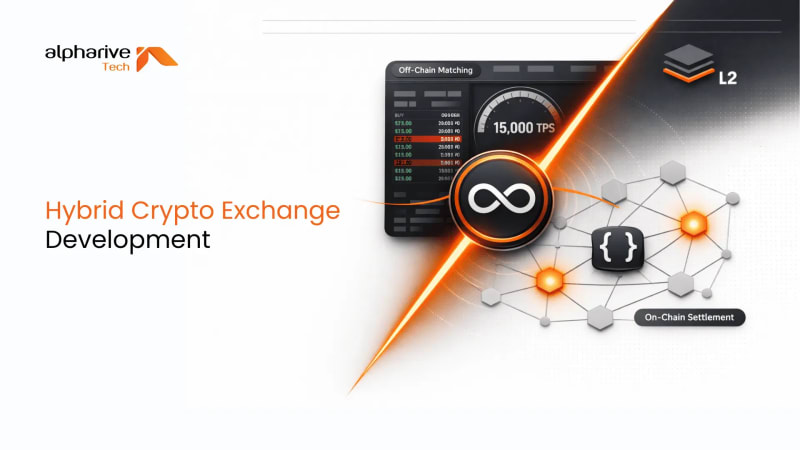
A hybrid cryptocurrency exchange is a trading platform that combines centralized trading efficiency with decentralized asset security. In this model, the trading engine performs off-chain order matching, which allows buy and sell orders to be processed quickly through a high-performance matching system similar to a centralized exchange. Once trades are matched, the transaction is finalized through on-chain settlement, where the blockchain records and verifies the asset transfer.
This structure enables non-custodial trading with centralized speed, allowing users to retain control of their assets while still benefiting from fast execution and deep liquidity. By bridging both infrastructures, a hybrid exchange removes the single point of failure and custodial risk commonly associated with centralized exchanges while also addressing the slower execution and liquidity challenges often seen in decentralized platforms. For this reason, hybrid platforms are often described as a semi-decentralized exchange architecture.
Why Hybrid Exchanges Are the Future of Crypto Trading?
The structure of digital asset markets is changing quickly, and the numbers behind decentralized trading infrastructure show why hybrid exchange models are gaining momentum. Decentralized exchanges alone have seen significant growth, with trading volumes increasing by roughly 37% in 2025 and averaging around $412 billion in monthly activity, reflecting the strong adoption of non-custodial trading environments across the crypto ecosystem.
Market share is also shifting toward on-chain trading. Decentralized platforms handled around 20% of global crypto spot trading volume in 2025, up from about 10% the previous year, while weekly DEX trading volumes averaged $18.6 billion, highlighting the rapid expansion of decentralized liquidity.
Hybrid exchange models are gaining particular attention because they solve the speed limitations that many decentralized platforms still face. Platforms using hybrid architectures, such as derivatives exchanges built on off-chain order books with on-chain settlement layers, have already processed hundreds of billions of dollars in trading volume, demonstrating that high-performance trading infrastructure can operate alongside decentralized asset custody.
Another key factor accelerating hybrid adoption is the rise of Layer 2 infrastructure. Rollup-based networks such as Arbitrum, Optimism, and other scaling layers are now handling a rapidly growing share of decentralized finance transactions while securing billions of dollars in value and processing a significant portion of decentralized exchange activity.
At the same time, the global regulatory environment is increasingly encouraging trading architectures that reduce custodial risk and improve transparency. Regulators across multiple major financial markets are pushing for stronger asset protection, transaction traceability, and clearer compliance frameworks. Hybrid exchanges align naturally with these expectations because they combine high-performance trading systems with blockchain-based settlement that preserves user ownership and provides verifiable transaction records.
For founders, fintech platforms, and Web3 startups entering the market, this shift creates a clear opportunity. Hybrid cryptocurrency exchanges deliver the speed, liquidity, and usability traders expect from centralized platforms while maintaining the transparency and asset control that decentralized finance was designed to provide.
Our Hybrid Crypto Exchange Development Services
Custom Hybrid Crypto Exchange Development
Every exchange business has different requirements depending on its target market, trading model, and regulatory environment. custom crypto exchange development focuses on building a platform architecture designed specifically around those needs. This includes designing the off-chain order matching engine, implementing on-chain settlement contracts, integrating multi-chain asset support, and developing trading infrastructure capable of handling real market activity. At Alpharive, the development approach centers on building scalable exchange systems that combine centralized trading performance with decentralized asset custody. The platform architecture is designed to support spot and derivatives trading, liquidity aggregation, advanced order types, and regulatory-ready compliance modules so that businesses can operate securely across global markets.
White Label Hybrid Exchange Software
For companies that want to launch faster without building everything from the ground up, white label hybrid exchange software provides a ready-to-deploy platform with hybrid trading architecture already implemented. This includes the trading engine, user interface, wallet system, liquidity integration, and core security framework. Businesses can customize branding, trading pairs, fee structures, and feature modules while keeping development time significantly shorter than a fully custom build. Alpharive's white label hybrid exchange solution is designed to maintain the core benefits of hybrid architecture, including off-chain trade execution and on-chain settlement, while allowing companies to enter the market quickly with a stable and scalable trading platform.
Hybrid Exchange App Development
Modern traders expect access to markets from mobile devices, which makes mobile exchange applications an essential component of any trading platform. Hybrid exchange app development focuses on creating iOS and Android applications that connect directly with the hybrid trading infrastructure. These applications provide real-time order book updates, trade execution, portfolio management, wallet access, and advanced charting tools. Alpharive develops mobile applications optimized for secure authentication, high-speed data synchronization, and smooth trading performance so that users can manage their assets and execute trades without delays. The mobile environment is designed to mirror the performance and functionality of the web trading platform while maintaining strong security and usability standards.
Hybrid Exchange Consulting & Architecture Design
Launching a hybrid exchange requires careful planning at the architecture level because it involves coordinating centralized trading systems with decentralized settlement layers. Hybrid exchange consulting focuses on defining the platform architecture, selecting the appropriate blockchain networks, designing the off-chain matching infrastructure, and planning compliance-ready operational workflows. Alpharive works with exchange founders and fintech teams to design system architectures that align with their business goals, liquidity strategies, and regulatory requirements. This process ensures that the final platform design can support long-term scalability, cross-chain asset management, and secure trading operations from the initial launch.
Hybrid Exchange Upgrade & Migration Services
Many existing trading platforms were originally built as either centralized exchanges or decentralized exchanges, and businesses often reach a stage where they want to transition toward a hybrid architecture. Hybrid exchange upgrade and migration services focus on transforming an existing trading platform by introducing off-chain order matching systems or on-chain settlement layers without disrupting current operations. Alpharive helps companies redesign exchange infrastructure, migrate liquidity systems, and integrate hybrid trading mechanisms while maintaining platform stability and user continuity. This approach allows existing exchanges to evolve toward a more secure and scalable trading architecture while preserving their established user base and trading activity.
Hybrid Exchange Maintenance & Support
A crypto exchange requires continuous monitoring, updates, and performance optimization to operate reliably in a fast-moving market environment. Hybrid exchange maintenance and support services ensure that the trading infrastructure remains stable, secure, and responsive as trading volume grows. This includes system performance monitoring, security patching, infrastructure scaling, liquidity optimization, and smart contract updates when necessary. Alpharive provides ongoing technical support and operational maintenance so that exchange operators can focus on growing their trading ecosystem while the underlying platform infrastructure continues to run smoothly and securely.
Off-Chain Order Matching & On-Chain Settlement Architecture
The defining characteristic of a hybrid cryptocurrency exchange is the way it separates trade execution from asset settlement. Instead of processing every action directly on the blockchain, the exchange uses off-chain order matching to handle trading activity while relying on on-chain settlement to finalize asset transfers. This architecture allows the platform to deliver high trading speed while maintaining blockchain-level transparency and user asset ownership.
In a hybrid exchange environment, the matching engine operates off-chain within a high-performance trading infrastructure similar to what centralized exchanges use. When traders place buy or sell orders, the engine processes these orders in real time, updates the order book, and matches trades based on price and availability. Because this matching process occurs outside the blockchain, the system can execute thousands of transactions per second without the latency or gas costs typically associated with on-chain execution.
Once the trade is matched, the settlement layer records the final asset transfer through smart contracts on the blockchain. This on-chain settlement ensures that the transaction is verified and permanently recorded, preserving transparency while allowing users to maintain control of their assets. In many implementations, the settlement process interacts with non-custodial wallet systems where users retain ownership of private keys instead of depositing funds into a centralized custody system.
Technologies such as state channels and rollups help bridge the off-chain trading layer and the on-chain settlement layer. These mechanisms enable multiple trade updates to be processed off-chain and then finalized on-chain in batches, significantly reducing network congestion and transaction fees. Some hybrid exchanges also integrate zero-knowledge proofs to verify trade validity while protecting sensitive transaction details, allowing platforms to maintain both privacy and verifiability.
This combination of high-speed off-chain trading infrastructure and blockchain-based settlement creates a balanced exchange architecture. Traders benefit from fast execution and deep liquidity, while blockchain settlement ensures that transactions remain transparent, verifiable, and resistant to centralized custody risks.
Layer 2 Integration in Hybrid Exchange Development
Layer 2 infrastructure has become an important component in modern hybrid crypto exchange development because it helps solve one of the biggest challenges in blockchain trading systems: scalability. While on-chain settlement provides transparency and security, executing every transaction directly on the base blockchain can lead to high gas fees and slower confirmation times during periods of network congestion. Integrating Layer 2 networks into a hybrid exchange architecture allows trading platforms to maintain blockchain-backed settlement while significantly improving transaction efficiency.
Popular Layer 2 ecosystems such as Arbitrum, Optimism, zkSync, and Polygon zkEVM are widely used for this purpose. These networks operate as scaling layers on top of major blockchains and use rollup technology to process transactions more efficiently. In a hybrid exchange environment, trades may be matched off-chain by the trading engine, while settlement transactions are submitted to a Layer 2 network instead of the base chain. This reduces gas costs for traders while still maintaining the security guarantees provided by the underlying blockchain.
Layer 2 networks also support rollup-based transaction batching, where multiple transactions are grouped together and submitted as a single batch to the base chain. This approach is particularly valuable for high-frequency trading environments where thousands of trades may occur within a short period. By batching settlement transactions through rollups, the exchange can maintain high throughput without overwhelming the base blockchain network.
Another important element is cross-layer liquidity management. Hybrid exchanges that integrate Layer 2 infrastructure often allow assets and liquidity to move between the base chain and Layer 2 networks through bridging systems. This ensures that liquidity pools, trading pairs, and settlement mechanisms remain synchronized across layers while still allowing users to benefit from lower transaction costs.
By combining hybrid trading architecture with Layer 2 scaling solutions, exchanges can support faster settlement, lower operational costs, and higher trading capacity. This integration allows businesses to build trading platforms that maintain blockchain transparency while delivering the performance required for global digital asset markets.
Core Features of Our Hybrid Crypto Exchange Platform
A hybrid exchange platform must combine the reliability of centralized trading systems with the transparency and asset control provided by blockchain infrastructure. To support real trading environments, the platform requires a set of features that address trading performance, liquidity management, security protection, and operational intelligence. The hybrid exchange platforms developed by Alpharive are structured around these core components so that businesses can launch a trading system capable of handling high transaction volumes while maintaining strong asset protection and regulatory readiness.
Trading & Matching Features
Trading and matching capabilities form the foundation of the exchange. The platform includes a high-performance off-chain matching engine that processes buy and sell orders instantly while maintaining an accurate order book. Once orders are matched, the trade is finalized through on-chain settlement, ensuring that asset transfers are verified on the blockchain. The trading system supports both spot and derivatives markets, allowing exchanges to offer multiple trading instruments on a single platform. Additional capabilities such as cross-chain swaps, multi-currency trading pairs, and fiat gateway integration allow the exchange to connect traditional financial systems with digital asset markets while giving traders access to a wide range of assets.
Liquidity Features
Liquidity infrastructure is another critical component because a trading platform must maintain active markets to attract and retain traders. Hybrid exchange platforms integrate centralized order book liquidity alongside decentralized liquidity sources. This includes AMM liquidity pools, automated market making systems, and liquidity aggregation mechanisms that pull trading depth from multiple sources. By combining centralized liquidity management with decentralized market participation, the platform can support deeper order books and smoother trade execution even during periods of high trading activity.
Security Features
Security architecture is designed to protect both user assets and platform infrastructure. The exchange operates through a non-custodial wallet architecture, allowing users to maintain control over their private keys while still interacting with the trading system. Additional protections include two-factor authentication, biometric login systems, and cold wallet custody mechanisms for long-term asset storage. Infrastructure-level protections such as DDoS mitigation, multi-signature authorization, and independent smart contract audits help maintain platform integrity while preventing unauthorized access or transaction manipulation.
AI-Powered Features
Modern exchanges also benefit from intelligent automation that improves operational efficiency and trading safety. The platform integrates AI-driven monitoring systems capable of identifying suspicious activity through real-time fraud detection models. Analytical tools powered by machine learning help provide predictive market insights, allowing exchange operators to monitor trading trends and liquidity conditions. Automated KYC and AML verification systems streamline compliance processes, while trade volume forecasting and risk management automation help exchanges maintain stable operations during volatile market conditions.
Real-World Hybrid Exchange Models - What You Can Build
When companies plan to launch a hybrid cryptocurrency exchange, the architecture can be designed in several different ways depending on the target market, trading products, and regulatory environment. Hybrid exchanges are not limited to a single structure. Instead, businesses typically adopt a model that balances performance, decentralization, and operational control according to their strategic goals. Below are three widely recognized hybrid exchange models that illustrate what a finished platform can look like.
The dYdX Model
The dYdX Model focuses heavily on derivatives trading and high-frequency market activity. In this architecture, the exchange operates with an off-chain order book and matching engine that processes trades at centralized exchange speeds. However, settlement and asset custody occur on-chain through blockchain-based smart contracts or a dedicated network designed for trading. This model allows platforms to handle large trading volumes while maintaining non-custodial asset control for users. Exchanges that follow this approach typically prioritize advanced trading features such as perpetual futures, leverage trading, and institutional-grade liquidity infrastructure.
The Coinbase Advanced Model
The Coinbase Advanced Model represents a structure where centralized exchange performance is combined with optional non-custodial trading mechanisms. In this setup, the platform maintains a high-performance centralized trading engine and liquidity management system while also enabling blockchain settlement layers and decentralized asset control for certain services. This approach is often used by exchanges that want to maintain strong regulatory alignment while gradually introducing decentralized infrastructure into their trading ecosystem. The result is a platform that offers fast trade execution and deep liquidity while giving users more flexibility in how their assets are stored and transferred.
The Custom Hybrid Model
The Custom Hybrid Model is designed specifically around the business objectives of the exchange operator. Instead of following a predefined structure, the platform architecture is built from the ground up to match the exchange's target market, regulatory requirements, and trading products. Some exchanges may focus on cross-chain trading environments, while others prioritize derivatives markets, institutional liquidity, or decentralized finance integrations. Alpharive develops custom hybrid exchange architectures that combine off-chain trading infrastructure, on-chain settlement mechanisms, and scalable blockchain integrations so that businesses can launch a platform tailored precisely to their market strategy and operational goals.
Global Compliance Architecture for Hybrid Exchanges
Compliance has become a central requirement for any digital asset trading platform operating in today's regulatory environment. Hybrid cryptocurrency exchanges are particularly well positioned to meet these requirements because their architecture allows trading efficiency while maintaining transparent and verifiable asset settlement. A well designed compliance framework begins with a structured KYC and AML verification pipeline that validates user identities, monitors suspicious transactions, and ensures that platform activity aligns with global anti money laundering standards. These verification systems are integrated directly into the onboarding and transaction monitoring processes so that compliance checks occur continuously rather than only during registration.
Hybrid exchanges can also be designed to operate under VASP compatible non custodial architecture, allowing platforms to maintain regulatory compliance while reducing custodial risks associated with centralized asset storage. This structure allows users to retain control over their wallets while the exchange maintains the operational infrastructure required for trading and settlement verification. To support cross border trading environments, exchanges must also integrate Travel Rule compliance mechanisms, which enable secure information sharing between virtual asset service providers when transactions move between regulated platforms.
Another important component is regulatory reporting infrastructure that can adapt to evolving digital asset regulations. Hybrid exchange platforms often integrate reporting modules capable of generating transaction records, audit logs, and compliance documentation aligned with frameworks such as MiCA style regulatory reporting standards. These systems allow exchange operators to produce detailed reports on trading activity, asset transfers, and user transactions when required by regulators.
Blockchain settlement also provides a built in advantage through on chain audit trails. Because asset transfers are recorded on the blockchain, transactions can be independently verified and traced when necessary, improving transparency and regulatory confidence. To support exchanges operating across multiple jurisdictions, the compliance architecture is typically designed with modular regulatory components. These modules allow the platform to adapt verification rules, reporting formats, and operational requirements based on the regulatory expectations of different markets while maintaining a consistent trading infrastructure.
Hybrid Crypto Exchange Development Process
Building a hybrid cryptocurrency exchange requires careful coordination between trading infrastructure, blockchain settlement systems, and compliance architecture. The development process must ensure that the platform operates efficiently while maintaining security, transparency, and regulatory readiness. At Alpharive, the hybrid exchange development workflow follows a structured approach that moves from strategic planning to production deployment, with clear deliverables at every stage.
Discovery & Business Requirements
The first phase focuses on understanding the business objectives, target markets, and operational requirements of the exchange. During this stage, the team evaluates trading models, liquidity strategies, and regulatory considerations that may affect the platform architecture. The key deliverables from this phase include a detailed architecture recommendation, a compliance roadmap, and a feature scope document outlining the technical and operational capabilities required for the exchange.
Hybrid Architecture Design
Once the strategic framework is defined, the next step involves designing the technical structure of the platform. This includes planning how the off-chain trading infrastructure will interact with the blockchain settlement layer. The design phase produces a full off-chain and on-chain system architecture, a Layer 2 integration strategy, and detailed smart contract specifications that define how settlement and asset custody will operate within the exchange.
Smart Contract Development & Audit
Smart contracts play a critical role in the settlement process of hybrid exchanges. During this stage, developers build the settlement contracts that handle asset transfers, trading confirmations, and blockchain verification. These contracts are deployed on test networks and undergo independent security reviews to identify vulnerabilities. The deliverables include audited settlement smart contracts, testnet deployment, and a security audit report documenting the results of the contract verification process.
Trading Engine Development
The trading engine is responsible for processing orders and maintaining the order book within the exchange environment. This stage focuses on building a high-performance off-chain matching engine capable of executing trades with minimal latency. The development process also includes creating the order book management system and integrating the liquidity management module that connects the platform with internal and external liquidity sources.
UI/UX Design
A trading platform must present complex market data in a way that is clear and accessible for users. During the design phase, the interface for the web platform and mobile applications is created. Designers develop wireframes, build detailed UI mockups, and produce mobile-responsive prototypes that allow stakeholders to review the trading interface before final development begins.
Wallet & Payment Integration
Once the trading infrastructure and interface design are in place, the platform integrates asset storage and payment systems. This stage includes implementing a non-custodial wallet architecture that allows users to control their private keys while interacting with the exchange. Additional integrations include fiat gateway support for traditional payment methods and multi-chain asset compatibility so the exchange can support a wide range of cryptocurrencies.
Security Audit & Penetration Testing
Before launching the exchange, the entire system undergoes a comprehensive security evaluation. Specialists conduct infrastructure testing, vulnerability assessments, and penetration testing to identify potential weaknesses within the platform. The outcome of this phase includes a complete security audit report, documented vulnerability remediation, and compliance verification confirming that the system meets required operational standards.
Mainnet Deployment & Post-Launch Support
After successful testing and verification, the platform is deployed to the main network where real trading activity can begin. This phase includes configuring the production infrastructure, activating monitoring tools, and ensuring system stability during launch. Deliverables include the live exchange platform, a performance monitoring dashboard, and an ongoing support and maintenance agreement that ensures the platform continues to operate reliably as trading activity grows.
Hybrid vs CEX vs DEX - Which Exchange Model Is Right for You?
When planning a crypto trading platform, one of the first strategic decisions founders must make is choosing the right exchange model. Centralized exchanges, decentralized exchanges, and hybrid exchanges each operate on different infrastructure principles, and the choice directly affects trading performance, regulatory alignment, liquidity access, and long-term operational complexity.
The biggest difference appears in asset custody. Centralized exchanges manage user funds through custodial wallets controlled by the platform, which simplifies trading but introduces custodial risk because assets are held by the exchange operator. Decentralized exchanges take the opposite approach by allowing users to trade directly from their own wallets, ensuring full asset ownership but often limiting execution speed and liquidity depth. Hybrid exchanges combine both concepts by enabling non-custodial asset control while still operating a centralized trading engine, allowing traders to retain ownership of their assets while executing trades through a high-speed order matching system.
Transaction speed is another key factor. Centralized exchanges typically provide the fastest execution because trades are processed entirely within internal infrastructure. Decentralized exchanges rely on blockchain transactions, which can introduce delays due to network confirmation times. Hybrid exchanges solve this by performing off-chain order matching while finalizing trades through on-chain settlement, delivering execution speeds similar to centralized platforms without sacrificing blockchain transparency.
In terms of liquidity depth, centralized exchanges often dominate because they maintain large order books and institutional liquidity providers. Decentralized exchanges rely on liquidity pools and automated market makers, which can sometimes limit trade size or price stability in volatile markets. Hybrid exchanges can combine centralized order book liquidity with decentralized liquidity sources, allowing the platform to maintain deeper markets while still supporting decentralized asset control.
Regulatory compliance also varies across models. Centralized exchanges generally follow strict compliance frameworks because they directly manage user funds and trading infrastructure. Decentralized exchanges operate with minimal custodial responsibility, which can complicate regulatory alignment in certain markets. Hybrid exchanges offer a balanced structure by supporting compliance mechanisms such as identity verification, transaction monitoring, and reporting systems while still allowing users to maintain control of their assets through blockchain settlement.
Finally, development complexity and cost differ significantly between the three models. Centralized exchanges require strong backend infrastructure and security controls but are technically easier to scale because the system operates within a controlled environment. Decentralized exchanges require extensive smart contract development and blockchain integration. Hybrid exchanges involve both high-performance trading infrastructure and blockchain settlement architecture, making them more complex to build but often delivering the most flexible and future-ready platform.
For founders evaluating which exchange model to build, the decision usually depends on the balance between performance, decentralization, and compliance requirements. Centralized exchanges remain ideal for businesses focused on high-frequency trading and large liquidity markets, while decentralized exchanges are better suited for fully on-chain ecosystems. Hybrid exchanges provide a middle path by combining the strengths of both architectures, making them a strong choice for businesses that want to deliver fast trading performance without compromising on transparency and asset security.
Hybrid Crypto Exchange Development Cost & Timeline
The cost of hybrid crypto exchange development depends on the complexity of the platform, the level of customization required, and the infrastructure that supports trading operations. A white label hybrid exchange typically starts from $20,000, providing a ready-to-launch platform with core trading features, wallet integration, and hybrid order matching architecture. Businesses that require deeper customization, advanced trading modules, and tailored infrastructure usually choose a custom hybrid exchange platform, which generally starts from $50,000. For companies building enterprise-grade exchanges with advanced trading engines, Layer 2 blockchain integration, cross-chain liquidity infrastructure, and AI-powered analytics or risk management systems, the development investment can start from $100,000 or more, depending on the scope of features and security requirements.
The development timeline also varies based on the level of platform customization and infrastructure design. A white label hybrid exchange can usually be launched within 5 to 7 weeks, since the core system architecture and trading modules are already developed and only require configuration and branding adjustments. A custom-built hybrid exchange typically requires 12 to 16 weeks, as the platform must be designed, developed, and tested according to the specific operational requirements of the exchange operator. Enterprise-level hybrid exchanges that include advanced security layers, Layer 2 scaling infrastructure, and full smart contract audit processes are usually planned on a project-specific timeline, as these platforms require deeper architecture design, extended testing, and regulatory readiness checks before launch.
Why Choose Alpharive for Hybrid Crypto Exchange Development?
Hybrid requires strong expertise in both high performance trading infrastructure and blockchain settlement architecture. Alpharive focuses on building platforms that combine off-chain order matching with on-chain settlement, allowing exchanges to deliver centralized trading speed while maintaining transparent and non-custodial asset control. The development approach also includes Layer 2 integration capabilities, helping exchanges scale transaction throughput and reduce settlement costs while preserving blockchain security.
Alpharive delivers audit-ready smart contracts, AI-enabled monitoring tools, and a non-custodial security model designed for modern crypto trading environments. Projects follow a milestone-based development process where each stage produces verified deliverables, giving businesses clear visibility throughout the build cycle. After launch, the team continues to support platforms with liquidity integration, performance monitoring, and long-term maintenance services, ensuring the exchange infrastructure remains stable as trading activity grows. These capabilities are part of our broader cryptocurrency exchange development services, helping businesses build and scale exchange platforms based on their specific trading and business requirements.