
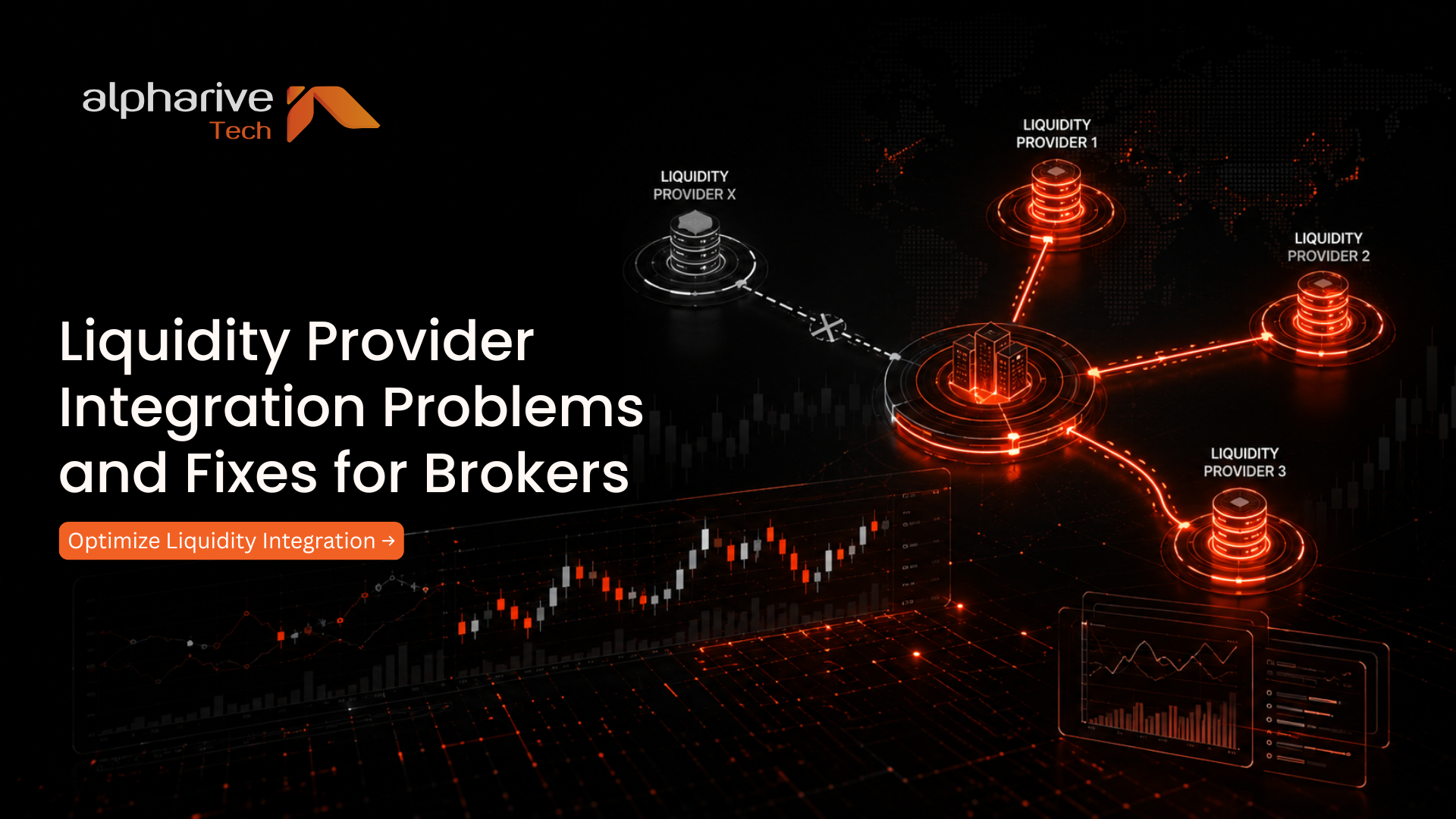
A broker's dealing desk in New Jersey once watched its EUR/USD spread balloon to nine pips during a routine NFP release, while the raw feed from its liquidity provider showed the market moving normally. The cause wasn't the market. It was a stale price cache sitting between the bridge and the trading server. That single misconfiguration cost the firm real client trust before anyone traced it back. Liquidity provider integration problems like this rarely announce themselves loudly; they show up as slippage complaints, mismatched quotes, or silent order rejections, and the fixes are usually more straightforward than brokers expect.
Key Takeaways
- Five root causes cover most failures: latency spikes, price feed mismatches, FIX session drops, weak failover design, and symbol mapping errors account for the majority of LP connectivity complaints.
- Latency has a real threshold: round-trip times above 20-30ms between broker and LP servers are strongly correlated with slippage disputes and requote volume during volatile sessions.
- Single-LP dependency is a structural risk: brokers relying on one provider with no automated failover face full trading outages when that provider has downtime or a bad print.
- Most fixes don't require switching providers: a proper audit of bridge configuration, clock synchronization, and instrument mapping resolves the majority of chronic issues.
- Multi-asset expansion multiplies risk: brokers adding stocks or commodities on top of forex often discover integration gaps that never surfaced on a forex-only book.
At a Glance: Common LP Integration Issues and Fixes
Problem | Typical Cause | Practical Fix | Fix Complexity |
|---|---|---|---|
Latency spikes | Poor server colocation, public internet routing | Cross-connects near LP data centers, dedicated lines | Medium-High |
Price feed mismatches | Normalization errors, clock drift, stale quotes | Quote validation logic, NTP/PTP sync, deviation thresholds | Medium |
FIX session drops | Heartbeat mismatch, sequence number errors | Tuned heartbeat intervals, automatic sequence recovery | Medium |
Single-LP outage risk | No failover logic, one provider dependency | Multi-LP aggregation with smart order routing | High |
Symbol mapping errors | Manual mapping, inconsistent naming conventions | Automated mapping templates, regular reconciliation | Low-Medium |
Order rejections | Weak pre-trade checks, bad execution parsing | Pre-trade risk validation, standardized report parsing | Medium |

Why Liquidity Provider Integration Breaks Down for Brokers
A broker's connection to its liquidity provider is really a chain of separate systems: the LP's own pricing engine, a network path, a bridge or aggregator, and the broker's trading server. Each link has its own failure modes, and none of them announce a problem until a client notices bad execution. When brokers only test this chain once, at go-live, they miss the failures that show up later under real volume.
Growth is usually what exposes the cracks. A brokerage handling a few hundred lots a day can run on a modest setup for years without issue. Add a marketing push, a new IB network, or a jump into CFD instruments beyond spot forex, and the same bridge configuration starts dropping ticks it never had to handle before. Multi-asset platforms compound this: stocks, commodities, and indices each come from different liquidity sources with their own quoting conventions, so the number of feeds that must reconcile in real time multiplies fast.
Regulatory and regional factors add another layer. Brokers operating across the United States, United Kingdom, Canada, Australia, and Gulf markets like Saudi Arabia often connect to LPs in different regions to meet local licensing or client execution requirements. Every additional LP relationship is another integration surface that has to be tested, monitored, and maintained, not just switched on and forgotten.
1. Latency Spikes Between Broker Servers and LP Feeds
Latency is the most visible symptom of a struggling LP integration, because clients feel it directly. Slippage complaints, requotes during news events, and execution delays that only appear when volume spikes are the classic signs. The market didn't move against the client; the price the platform quoted was already stale by the time the order reached the LP.
The root cause is almost always physical distance or inefficient routing. A broker's trading server sitting in one data center while the LP's matching engine sits in another, connected over public internet rather than a dedicated line, adds milliseconds that compound during volatile periods. Bridge software that batches or queues ticks instead of streaming them in real time makes it worse.
- Colocate servers near LP infrastructure: hosting trading servers in the same or adjacent facility as the LP's matching engine (common hubs include Equinix LD4 in London and NY4 in New Jersey) cuts round-trip time significantly.
- Use dedicated cross-connects: a direct line between broker and LP infrastructure avoids the unpredictable hops of public internet routing.
- Benchmark continuously: tick-to-trade latency should be monitored around the clock, not just checked once during onboarding. A target under 20-30ms round trip is a reasonable baseline for most forex and CFD flows.
- Audit the bridge itself: some latency problems have nothing to do with network distance and everything to do with inefficient tick processing inside the bridge software.
Brokers building or upgrading their trading infrastructure often find that a bridge designed for a smaller book simply wasn't architected for low-latency streaming at scale, which is where working with a dedicated forex technology solutions partner to re-architect the pipeline pays off faster than blaming the liquidity provider.
2. Price Feed Mismatches and Quote Discrepancies
When the price on a client's trading screen doesn't match the LP's raw feed, two bad outcomes follow. Clients get executed at prices that look wrong to them, and the broker takes on arbitrage exposure from traders who spot the gap before it corrects. Neither outcome is good for retention or for the dealing desk's risk book.

Three causes show up repeatedly. First, price normalization logic that applies markup or spread incorrectly across different LP feeds. Second, clock synchronization drift, where the broker's server and the LP's server disagree on timestamps by even a few hundred milliseconds, which is enough to create phantom arbitrage windows. Third, stale quotes that aren't purged from the aggregation layer fast enough, so the platform keeps publishing a price the market has already left behind.
- Implement quote validation: sanity-check every incoming quote against recent price history before it's published to clients.
- Synchronize clocks properly: use NTP or, for latency-sensitive setups, PTP (Precision Time Protocol) to keep broker and LP timestamps aligned within milliseconds.
- Aggregate and compare feeds: a price aggregation engine that checks multiple LP quotes against each other before publishing catches outlier prices before they reach a client screen.
- Set deviation thresholds: automatically reject or flag any quote that deviates beyond a defined percentage from the consensus price across LPs.
This is one of the areas where a purpose-built forex CRM software and trading platform stack, rather than a patchwork of disconnected tools, makes ongoing reconciliation manageable instead of a manual daily headache.
3. FIX API Session Drops and Reconnection Failures
FIX (Financial Information eXchange) protocol connections are the backbone of most broker-to-LP relationships, and session stability issues are one of the most common liquidity provider integration problems brokers report. A session drops silently, orders sent during that window sit in limbo, and nobody notices until a client asks why their trade never filled.
The technical causes are well documented by the FIX Trading Community, which maintains the protocol specifications most LPs and brokers build against. Common triggers include mismatched heartbeat intervals between broker and LP systems, sequence number resets that aren't handled correctly on reconnect, and firewall or VPN interruptions that cut the session without a clean logout message.
- Tune heartbeat intervals per LP specification: every LP publishes its expected heartbeat interval; mismatches here are a leading cause of unnecessary disconnects.
- Build automatic sequence number recovery: the bridge should detect a sequence gap and request resend automatically rather than requiring manual intervention.
- Log every session event: full audit logs of logon, logout, heartbeat, and resend requests make root-cause diagnosis a matter of minutes instead of days.
- Use redundant network paths: a secondary connection path that can take over if the primary FIX session drops prevents a single network blip from becoming a full outage.
Brokers that don't have in-house FIX expertise often underestimate how much of their "liquidity problem" is actually a session management problem, one that's fixable without renegotiating a single LP contract.
4. Poor Failover and Single-LP Dependency Risk
Relying on a single liquidity provider is the equivalent of running a business with one supplier and no backup plan. When that LP has downtime, a bad print, or a connectivity issue on their end, the broker's entire execution flow stops. During high-volatility events, this is exactly when clients need reliable pricing the most.

The fix is architectural, not incremental. Brokers need multi-LP aggregation with defined failover priority rules, so if the primary provider's feed degrades or drops, the system automatically routes to a secondary or tertiary LP without manual intervention. Just as important: failover logic should be tested quarterly, not only at initial setup. Systems that worked perfectly at launch often drift out of sync as LPs update their own infrastructure.
Single-LP vs Multi-LP Aggregation Architecture
Architecture | Redundancy | Relative Cost | Setup Complexity | Best Fit |
|---|---|---|---|---|
Single-LP direct connection | None | Lowest | Low | Very early-stage brokers testing volume |
Bridge-aggregated multi-LP (2-3 providers) | Moderate, manual failover | Medium | Medium | Growing brokers needing basic redundancy |
Full liquidity aggregation with smart order routing | High, automatic failover | Higher | High | Multi-asset brokers and CFD platforms at scale |
Multi-asset broker platforms trading stocks and commodities alongside forex have even more reason to invest in true aggregation, since each asset class often depends on a different liquidity source with its own uptime pattern.
5. Symbol Mapping and Instrument Configuration Errors
Symbol mapping sounds like a minor technical detail until it produces the wrong lot size, an incorrect swap rate, or a contract specification that doesn't match what the LP is actually quoting. These errors are especially common when brokers expand from pure forex pairs into commodities, indices, or equities, where naming conventions and contract specs vary widely between providers.
Manual mapping is the usual culprit. When instrument configuration is updated by hand every time a new symbol is added, small inconsistencies creep in: a broker's "XAUUSD" might not align with how a particular LP defines gold contract size or tick value, leading to pricing that's technically correct on the LP side but wrong once it reaches the client platform.
- Automate mapping templates: build a standardized mapping layer that translates LP-side symbols and specs into the broker's platform configuration automatically.
- Reconcile regularly: schedule periodic checks comparing LP contract specifications against what's configured on the trading platform, not just at onboarding.
- Version-control configuration changes: track every change to instrument mapping so a bad update can be rolled back quickly.
6. Order Rejection and Execution Reporting Errors
High order rejection rates frustrate clients and create reconciliation headaches for back-office teams. The common causes are sending incorrect order types to the LP, insufficient pre-trade margin checks, or execution reports that don't parse cleanly into the broker's CRM and reporting systems.
Fixing this requires validating orders before they ever reach the LP, not after a rejection comes back. Pre-trade risk checks that confirm margin, instrument availability, and order type compatibility catch most rejection causes early. On the reporting side, standardizing how execution reports are parsed and fed into the back office prevents the kind of data mismatch that shows up as unexplained discrepancies during month-end reconciliation.
This is also where the connection between liquidity integration and broader platform architecture matters. A trading platform, forex CRM development, and LP bridge that were built as separate, loosely connected systems will always have more friction here than one designed as a unified pipeline from the start.
How to Audit Your Current LP Integration Before Switching Providers
Many brokers jump to switching liquidity providers when the real problem sits in their own bridge or server configuration. Before making that call, a structured audit usually reveals the actual fault line:
- Benchmark latency end to end: measure tick-to-trade time from LP feed to client execution, not just network ping.
- Review FIX session logs: look for patterns in disconnects, sequence gaps, and heartbeat timing over the past 60-90 days.
- Run a failover test: simulate a primary LP outage and confirm the system actually reroutes without manual steps.
- Reconcile price feeds: compare published client prices against raw LP feeds for a sample trading day, checking for deviation patterns.
- Audit instrument mapping: cross-check contract specs, lot sizes, and swap rates against current LP documentation for every active symbol.
- Check reject rate trends: pull rejection statistics by order type and instrument to spot systemic patterns versus one-off events.
This kind of audit is exactly the work an experienced forex CRM software and integration partner does before recommending any infrastructure change. It's far cheaper to fix a misconfigured bridge than to renegotiate LP agreements and rebuild connectivity from scratch.
When to Rebuild vs Patch Your Liquidity Bridge
Not every integration problem calls for a full rebuild. Isolated latency issues, a handful of symbol mapping errors, or occasional FIX disconnects in an otherwise stable system are patchable. The signs that a bridge genuinely needs replacement look different:
- Recurring outages that persist despite repeated patches and vendor support tickets.
- Vendor lock-in where the bridge provider controls the only documentation and no internal team can maintain it independently.
- No usable API documentation, making it impossible to add new LPs or asset classes without months of reverse engineering.
- Scaling ceilings where adding volume or a new market (US, UK, Canada, Australia, or Gulf region clients) requires a disproportionate engineering effort each time.
Brokers hitting these walls are usually better served by custom forex software built around their actual liquidity architecture, rather than another round of patches on a system that was never designed for their current scale. A rebuild is a bigger commitment, but it removes the recurring cost of firefighting the same three or four issues every quarter.
Frequently Asked Questions
What causes most liquidity provider integration failures?
Most failures trace back to five areas: network latency between broker and LP servers, price feed normalization or clock sync errors, unstable FIX API sessions, weak or absent failover logic, and inconsistent symbol mapping across instruments. Very few chronic issues are actually caused by the liquidity provider's pricing itself.
How much latency is acceptable for a forex broker's LP connection?
A round-trip time under 20-30 milliseconds between the broker's trading server and the LP's matching engine is a reasonable working target for most retail forex and CFD flows. High-frequency or institutional setups often push for single-digit millisecond latency through colocation and dedicated cross-connects.
Can a broker use multiple liquidity providers at the same time?
Yes, and for any broker beyond the earliest startup stage, it's the more resilient approach. Multi-LP aggregation with smart order routing lets a broker pull the best available price across providers while maintaining automatic failover if one LP's feed degrades or drops entirely.
How long does it typically take to fix a broken LP integration?
Isolated issues like symbol mapping errors or FIX heartbeat mismatches can often be resolved within days once diagnosed. Structural problems, such as building proper multi-LP failover or re-architecting a bridge for lower latency, typically take several weeks of focused engineering work, which is faster and cheaper than most brokers assume once the actual root cause is identified.
Does adding stocks or commodities make LP integration harder?
Yes. Each additional asset class typically comes from a different liquidity source with its own quoting conventions, contract specifications, and uptime patterns. Brokers running a multi-asset broker platform for stocks and commodities alongside forex need aggregation and mapping logic built to handle that variety from the start, not bolted on after the fact.
Chronic slippage complaints, mystery disconnects, and price disputes are rarely a sign that a broker chose the wrong liquidity provider. They're usually a sign that the bridge, server placement, or failover logic behind that connection was never built or maintained for the volume and asset mix the broker runs today. Alpharive software solutions help forex brokers and multi-asset CFD platforms across the United States, United Kingdom, Canada, Australia, and Gulf markets audit existing LP connections, rebuild bridges that have outgrown their original design, and implement multi-LP aggregation with proper failover. Liquidity provider integration has a direct impact on execution quality, pricing accuracy, and platform reliability. Building the right integration from the beginning helps brokerages reduce operational risk while creating a better trading experience for their clients. Book a consultation with the Alpharive team to discuss your liquidity integration requirements.