P2P Exchange Development Company
Alpharive is a P2P crypto exchange development company that builds secure peer-to-peer trading platforms with escrow-backed transactions, smart contract automation, and compliance-ready infrastructure for global crypto markets.
What is P2P Crypto Exchange Development?
P2P crypto exchange development refers to building a peer-to-peer cryptocurrency exchange that allows users to trade digital assets directly with each other without relying on a central intermediary. Unlike traditional exchanges that hold user funds, a P2P platform operates on a non-custodial trading model where buyers and sellers maintain control of their assets throughout the transaction process. The platform simply facilitates the interaction, matching trade orders and managing transaction workflows.
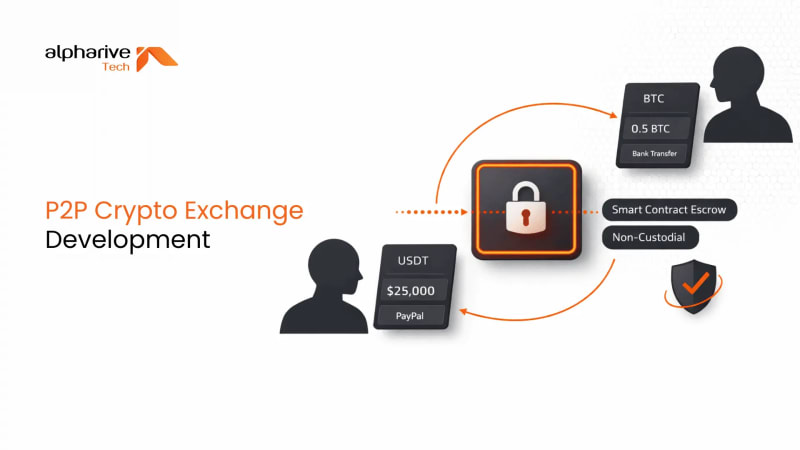
To ensure secure and fair trades, these platforms rely on escrow-based transactions powered by blockchain technology and smart contracts. When a trade begins, the cryptocurrency is temporarily locked in escrow until the payment conditions are confirmed. Once both parties meet the agreed terms, the smart contract automatically releases the funds. This mechanism creates a trustless trading environment, allowing users to trade safely even without knowing each other while reducing the risk of fraud or manipulation.
Why the P2P Crypto Exchange Market Is Growing Globally?
The P2P crypto exchange market has expanded rapidly as more users look for flexible and direct ways to trade digital assets. According to industry reports, global peer-to-peer cryptocurrency trading volume has grown by over 35% year-over-year since 2021, reflecting strong demand for decentralized trading alternatives. This growth is largely driven by users who prefer platforms where they can trade directly with others rather than relying on centralized intermediaries.
At the same time, the number of active users on major P2P trading platforms has surpassed 15 million globally, showing how quickly peer-to-peer models are gaining traction. The broader decentralized finance ecosystem is also fueling this expansion, with DeFi total value locked (TVL) exceeding $90 billion across blockchain networks. As decentralized financial tools become more accessible, many users are naturally moving toward P2P trading environments that offer greater control over funds.
Financial inclusion is another major driver behind this shift. In many regions where access to traditional banking is limited, peer-to-peer crypto platforms provide an alternative way to buy and sell digital assets using local payment methods. At the same time, users in developed markets are increasingly adopting P2P exchanges for privacy, flexible pricing, and direct negotiation between buyers and sellers. This combination of emerging market adoption and advanced-market demand continues to push the global P2P exchange ecosystem forward.
Our P2P Crypto Exchange Development Services
Custom P2P Crypto Exchange Development
Custom P2P crypto exchange development focuses on building a platform from the ground up with features tailored to specific business models, user flows, and regulatory requirements. At Alpharive, development begins with defining the trading architecture, escrow logic, and order-matching mechanisms that shape how users interact on the platform. This approach allows full control over the user experience, supported cryptocurrencies, payment integrations, and dispute management systems. Businesses launching large-scale trading platforms often choose this route because it allows deeper customization, stronger security layers, and long-term scalability aligned with evolving crypto market needs.
White Label P2P Exchange Software
White label P2P exchange software provides a faster path to launching a peer-to-peer crypto trading platform with a ready-built infrastructure. Instead of building the system entirely from scratch, businesses receive a fully functional platform that can be customized with their branding, supported currencies, payment methods, and feature configurations. This setup reduces development time while still allowing flexibility for future upgrades and integrations. Many startups and fintech companies use white label solutions to enter the market quickly while maintaining professional-grade trading functionality and compliance-ready architecture.
P2P Exchange App Development
Mobile-first trading is becoming the standard for crypto users, which is why P2P exchange app development plays a critical role in modern platforms. Dedicated iOS and Android applications allow traders to create offers, negotiate trades, manage escrow transactions, and monitor balances directly from their smartphones. Development focuses on delivering fast trade execution, secure authentication systems, and intuitive user interfaces designed for high-frequency mobile interactions. A well-designed P2P mobile app expands user reach significantly and allows trading activity to continue seamlessly across devices.
Enterprise P2P Exchange Solutions
Enterprise-grade P2P exchange solutions are designed for organizations planning to operate large-scale crypto marketplaces with high transaction volumes. These platforms require advanced infrastructure, including high-performance matching engines, multi-layer security frameworks, and robust compliance management systems. Enterprise deployments also integrate extensive administrative controls, analytics dashboards, and scalable cloud architecture capable of supporting thousands of concurrent users. With proper planning and architecture, these platforms can operate across multiple regions while maintaining consistent trading performance and regulatory readiness.
P2P Exchange Maintenance & Support
Ongoing P2P exchange maintenance and support ensures the platform continues operating smoothly as trading activity grows and new blockchain updates emerge. Regular monitoring helps identify performance issues, security vulnerabilities, and infrastructure scaling requirements before they affect users. Maintenance also includes smart contract updates, API upgrades, wallet integration improvements, and compliance-related adjustments. With continuous technical support, P2P exchanges can maintain reliable performance while adapting to the rapidly evolving cryptocurrency ecosystem.
Escrow System Architecture in P2P Exchange Development
The P2P exchange escrow system forms the core infrastructure that allows buyers and sellers to trade cryptocurrency directly while maintaining security and transparency. In a typical peer-to-peer platform, once a buyer initiates a trade, the seller's cryptocurrency is temporarily locked into a smart contract–controlled escrow wallet. This smart contract based escrow flow ensures that the digital assets remain secure while the buyer completes the agreed payment using an external method such as bank transfer or digital payment.
Many advanced platforms also implement multi-signature escrow mechanisms, where transaction approval requires multiple cryptographic signatures before funds can be released. This additional layer of verification protects users from unauthorized access and reduces the risk of fraudulent trades. If both parties confirm the transaction conditions, the smart contract automatically releases the cryptocurrency to the buyer, eliminating the need for manual intervention.
A well-designed escrow architecture also includes built-in dispute resolution mechanics that allow platform administrators to step in if a disagreement occurs during a transaction. Administrators can review payment evidence, communication history, and transaction logs before making a final decision on escrow release. To prevent funds from remaining locked indefinitely, timelock mechanisms are introduced, allowing the system to trigger predefined outcomes when certain time thresholds are reached. Combined with automated release conditions, these safeguards create a secure and reliable escrow framework that supports safe peer-to-peer crypto trading at scale.
Core Features of Our P2P Crypto Exchange Software
Trading & Matching Features
A strong P2P trading platform depends on efficient trading and matching features that connect buyers and sellers quickly. The software supports algorithmic order matching that intelligently pairs compatible trade offers based on price, payment method, and asset availability. Location-based matching further improves the experience by helping users discover traders within their region or preferred payment ecosystem. The platform also supports multi-currency trading, allowing users to exchange different cryptocurrencies alongside fiat payment options. In addition, limit and market order functionality gives traders flexibility when setting prices, while integrated fiat-to-crypto gateways allow seamless entry for users purchasing digital assets with traditional payment methods.
Escrow & Security Features
Security plays a central role in any peer-to-peer trading platform, which is why the system includes advanced escrow and security features designed to protect every transaction. Smart contract-powered escrow ensures that cryptocurrencies remain locked until both trading parties complete the agreed payment conditions. Multi-layer authentication such as two-factor authentication (2FA) and biometric login adds additional account protection for users accessing the platform. End-to-end encryption safeguards trade communications and sensitive user data during transactions. The infrastructure is also protected with DDoS mitigation systems, while cold wallet storage is used to secure reserve digital assets offline, significantly reducing exposure to external threats.
Admin Features
Operating a P2P crypto exchange requires powerful administrative controls that help maintain platform integrity and regulatory compliance. The admin dashboard provides a dispute resolution interface where administrators can review transaction evidence and intervene when necessary. Built-in KYC and AML management tools allow identity verification and regulatory checks to be performed efficiently during user onboarding. The system also includes transaction monitoring modules that detect unusual activity patterns across trading operations. Additional tools for user verification, analytics reporting, and activity tracking help administrators oversee platform performance while maintaining transparency and operational control.
AI-Powered Features
Modern crypto exchanges increasingly rely on AI-powered features to improve platform intelligence and trading security. AI-driven fraud detection systems analyze transaction patterns to identify suspicious activities before they escalate into security incidents. Automated support bots can handle routine user queries, helping platforms manage large trading communities without overwhelming support teams. The system also uses predictive analytics to generate trade volume forecasts, giving operators insights into platform activity and liquidity trends. At the same time, AI-based user behavior analysis assists in risk management by detecting abnormal trading patterns and strengthening overall platform protection.
Smart Contract Development for P2P Exchanges
Smart contract development for P2P exchange platforms plays a central role in automating and securing peer-to-peer crypto trading without relying on centralized control. Smart contracts act as self-executing programs deployed on blockchain networks that automatically enforce the conditions of a trade between buyers and sellers. Once a trade is initiated, the contract locks the seller's cryptocurrency into escrow and monitors the transaction conditions. When the required payment confirmation is verified, the contract automatically releases the funds to the buyer, enabling fully automated and transparent settlement.
A well-designed P2P platform relies on self-executing escrow logic that removes the need for manual intervention while reducing the risk of manipulation or delayed transactions. These contracts are built to support widely used token standards such as ERC-20 on Ethereum, BEP-20 on BNB Chain, and SPL tokens on Solana, allowing the platform to support multiple blockchain ecosystems. During development, contracts are structured with clear logic flows that handle trade initiation, escrow locking, dispute triggers, and automated asset release.
Security is another critical aspect of smart contract infrastructure. Each contract is developed following audit-ready coding practices that make the code easier to review and test for vulnerabilities before deployment. Optimization techniques are also applied to reduce blockchain transaction costs, improving efficiency through gas optimization strategies that minimize computational overhead. With carefully designed smart contracts, a P2P crypto exchange can maintain secure, transparent, and automated trading operations across multiple blockchain networks.
Collaboration Models for P2P Exchange Development
Fixed Price Model
The Fixed Price model works best when the project scope, features, and technical requirements are clearly defined from the beginning. In this approach, the entire development process is planned with a predetermined cost and delivery timeline. Businesses that already have a detailed roadmap for their P2P exchange platform often choose this model because it offers predictable budgeting and structured milestone delivery. However, making significant feature changes during development may require scope adjustments since the project parameters are defined early in the engagement.
Time & Material Model
The Time & Material model is suitable for projects where requirements may evolve as development progresses. Instead of locking the project into a fixed scope, businesses pay based on the time and resources used throughout the development cycle. This approach provides greater flexibility, allowing teams to add new features, adjust platform architecture, or experiment with advanced trading capabilities during the build phase. While this model allows continuous improvements, it requires ongoing collaboration and planning to manage timelines and development costs effectively.
Dedicated Team Model
The Dedicated Team model provides businesses with a focused development team that works exclusively on the P2P exchange platform. This team typically includes blockchain developers, backend engineers, UI/UX designers, QA specialists, and project managers who collaborate as an extension of the client's internal team. It works particularly well for long-term projects or platforms expected to evolve continuously after launch. The model offers strong collaboration and faster development cycles, though it requires consistent communication and strategic planning to fully utilize the team's capacity.
Hybrid Model
The Hybrid model combines elements of fixed price and flexible development engagement, allowing businesses to balance cost control with adaptability. For example, the core platform infrastructure and essential trading features may be developed under a fixed scope, while advanced integrations or future upgrades follow a more flexible time-based approach. This structure works well for complex P2P exchange projects where certain components are clearly defined while others require experimentation or phased implementation. By blending both models, businesses can maintain project stability while still leaving room for innovation and iterative improvements.
Challenges in P2P Crypto Exchange Development & How We Solve Them
Security Vulnerabilities
Security risks are one of the most critical challenges in P2P crypto exchange development, as platforms handle high-value digital assets and sensitive user data. Vulnerabilities in smart contracts, wallets, or transaction systems can expose the platform to fraud or unauthorized access. Alpharive addresses this by implementing multi-layer security architecture that includes smart contract audits, encrypted communication channels, secure wallet integration, and advanced threat monitoring. Regular penetration testing and infrastructure hardening ensure that potential vulnerabilities are identified and resolved before they impact platform operations.
Regulatory Compliance Complexity
Operating a global P2P exchange requires navigating complex regulatory requirements related to identity verification, anti-money laundering rules, and transaction reporting. Regulations can vary across jurisdictions, making compliance architecture a critical part of platform development. Alpharive integrates KYC/AML verification pipelines, automated compliance monitoring tools, and configurable reporting systems designed to align with international regulatory standards. This structured compliance framework helps businesses launch platforms that can adapt to evolving regulatory expectations without disrupting trading activity.
Liquidity Bootstrapping
A new P2P exchange often faces the challenge of attracting enough buyers and sellers to maintain active trading activity. Without sufficient liquidity, users may struggle to find matching trade offers, which can affect platform growth. Alpharive addresses this challenge by implementing features such as dynamic offer matching, integrated liquidity connectors, and incentive structures that encourage early market participation. These strategies help exchanges establish active trading environments during the early stages of platform adoption.
Dispute Resolution at Scale
As trading activity increases, managing disputes between buyers and sellers becomes more complex. P2P exchanges must provide efficient mechanisms for handling payment verification issues, delayed transactions, or fraudulent behavior. Alpharive develops structured dispute resolution systems that include escrow monitoring tools, evidence submission workflows, and administrative review dashboards. This allows platform operators to manage disputes quickly while maintaining transparency and fairness across transactions.
Managing Peak User Load
Crypto trading platforms often experience sudden spikes in activity during periods of high market volatility. Without scalable infrastructure, these traffic surges can cause slow transaction processing or system downtime. Alpharive designs P2P exchanges with scalable cloud infrastructure, distributed system architecture, and optimized matching engines capable of handling high transaction volumes. Load balancing and real-time performance monitoring further ensure that the platform remains stable even during peak trading periods.
Standing Out in a Competitive Market
The P2P exchange ecosystem has become increasingly competitive as more platforms enter the market with similar core features. Simply launching a basic trading platform is no longer enough to attract users. Alpharive focuses on building platforms with differentiated capabilities such as AI-driven analytics, flexible payment integrations, advanced security architecture, and mobile-first trading experiences. By combining strong technical infrastructure with user-focused design, businesses can create P2P exchanges that stand out in a rapidly evolving crypto trading landscape.
Global Compliance & Regulatory-Ready P2P Exchange Architecture
A reliable P2P crypto exchange architecture must be built with global regulatory readiness in mind, especially as digital asset regulations continue to evolve. Modern platforms require integrated KYC and AML pipeline architecture that verifies user identities, screens transactions, and monitors suspicious activity without slowing down the trading experience. This infrastructure allows exchanges to onboard users securely while maintaining proper identity verification standards across different regulatory environments.
In addition to identity verification, many P2P platforms now follow VASP-compatible system design, which aligns exchange infrastructure with regulatory expectations for virtual asset service providers. This includes transaction monitoring systems that track trading activity and flag high-risk transactions based on behavioral patterns. Many exchanges also integrate FinCEN-aligned monitoring frameworks that support structured reporting and automated alerts for potentially suspicious financial activity.
As digital asset regulations mature, platforms are also preparing for frameworks such as MiCA-ready reporting infrastructure, which focuses on transparency, financial reporting, and operational accountability for crypto service providers. Another key component is FATF Travel Rule compliance, which requires certain transaction information to be shared between regulated entities when digital assets move between platforms. By integrating these compliance-ready systems into the platform architecture, businesses can launch P2P exchanges that operate with stronger regulatory alignment while maintaining smooth peer-to-peer trading functionality.
P2P Crypto Exchange Development Process
The P2P crypto exchange development process follows a structured approach that combines blockchain engineering, security architecture, and regulatory readiness to build scalable peer-to-peer trading platforms.
Analyzing Requirements
This stage defines platform objectives, producing a feature roadmap, compliance assessment, and competitor analysis guiding strategic development decisions.
Designing Architecture
Engineers design the technical framework, creating a system architecture document and detailed escrow flow design defining how transactions operate securely.
Developing Smart Contracts
Blockchain developers build audited smart contracts and deploy them on testnet environments to validate escrow logic, transaction automation, and security.
Designing Interface
Design teams create user-focused wireframes, UI mockups, and interactive prototypes that shape the trading experience across web and mobile platforms.
Building Platform
Core development integrates the matching engine, escrow system, and wallet infrastructure that power trading, asset management, and secure transactions.
Integrating Compliance
KYC/AML systems and payment integrations are implemented to establish a verified compliance pipeline alongside fiat gateway connections for payment processing.
Conducting Security Testing
Security specialists perform detailed audits and penetration testing, producing a security report and implementing vulnerability fixes across the platform.
Launching Platform
Deployment delivers the live platform, establishes monitoring systems, and provides post-launch support with defined service-level agreements ensuring continuous operation.
P2P Crypto Exchange Development Cost & Timeline
The P2P crypto exchange development cost can vary depending on the platform complexity, level of customization, and infrastructure requirements. A basic P2P exchange script typically starts from around $10,000, offering core features such as user registration, trade listings, and escrow-based transactions. Businesses looking for faster deployment often choose a white label P2P platform, which generally starts from $20,000 and includes a ready-built trading environment with customizable branding and payment integrations. For organizations planning to launch a fully customized trading ecosystem, custom P2P crypto exchange development usually begins from $45,000, allowing deeper control over trading logic, security layers, and platform architecture. Large-scale marketplaces with AI-driven analytics, advanced security infrastructure, and full regulatory compliance frameworks typically require enterprise-grade development starting from $80,000 or more.
The timeline for P2P crypto exchange development also depends on the selected development approach and platform scope. A script-based P2P exchange can usually be deployed within 3–4 weeks, making it suitable for quick market entry or proof-of-concept launches. A white label P2P exchange platform typically takes 5–7 weeks as additional customization, payment integrations, and UI adjustments are implemented. Fully custom P2P exchange platforms generally require 10–14 weeks to design, develop, test, and deploy with complete trading functionality and escrow architecture. For enterprise-grade exchanges, development timelines are scoped individually, often using parallel engineering tracks to accelerate delivery while maintaining platform scalability and compliance readiness.
Why Choose Alpharive for P2P Crypto Exchange Development?
Choosing the right Custom Crypto Exchange Development Company plays a critical role in building a secure and scalable trading platform. Alpharive focuses on delivering exchanges with advanced escrow system architecture, audit-ready smart contract development, and AI-integrated trading intelligence that improves security and operational insights. The platform infrastructure is designed with multi-chain support, allowing businesses to integrate assets across major blockchain networks while maintaining efficient transaction processing.
Compliance readiness is built directly into the architecture with FATF-aligned design frameworks and structured KYC/AML integrations that help platforms operate in evolving regulatory environments. Each project follows a milestone-based delivery model with clear deliverables at every stage of development, ensuring transparency and predictable progress. Beyond launch, Alpharive also supports ongoing growth with infrastructure optimization and post-launch liquidity support, helping new exchanges build active and sustainable trading ecosystems. Connect with experts.