Risk management software for proprietary trading firms works by tracking every trader's live positions, profit and loss, and exposure against pre-set limits, then automatically freezing accounts or alerting risk managers the moment a trader breaches a drawdown or exposure threshold. The best systems combine real-time monitoring, automated drawdown alerts, correlation analytics, and audit-ready reporting in one platform, either built custom or licensed off the shelf.
Key Takeaways
- Real-time monitoring is the baseline, not a bonus: Firms running funded trader programs need position and P&L data refreshed in seconds, not end-of-day batch reports.
- Automated drawdown alerts prevent blowups before they happen: A configurable kill switch that freezes an account at 5% daily loss stops damage that a human risk manager might catch too late.
- Custom-built systems win for firms with unique rule sets: Off-the-shelf tools cover generic limits well but struggle with strategy-specific or multi-desk rules.
- MT4/MT5 and multi-asset integration determines response speed: A risk engine that can't read live bridge data from your trading platform is reacting on stale numbers.
- Audit trails matter as much as alerts: Regulators in the US, UK, and Australia increasingly expect immutable logs showing exactly when and why a risk action was triggered.
At a Glance: Risk Management Software Features Comparison
Feature Category | What It Does | Typical Deployment | Best Fit |
|---|---|---|---|
Real-time position monitoring | Live P&L, exposure, and margin tracking per trader/desk | Both custom and off-the-shelf | All prop firms |
Automated drawdown alerts | Triggers alerts or kill switches at set loss thresholds | Off-the-shelf (basic), custom (advanced rules) | Funded trader programs |
Rule-based trading limits | Enforces per-trader, per-strategy, per-instrument caps | Mostly custom | Multi-strategy firms |
Correlation/exposure analytics | Flags concentration risk across correlated assets | Custom-built | Firms trading multiple asset classes |
Platform integration (MT4/MT5, APIs) | Pulls live data from trading platforms and liquidity providers | Custom (deep integration) or off-the-shelf (limited) | Firms with existing infrastructure |
Reporting & audit trails | Immutable logs and compliance-ready reports | Both, quality varies widely | Regulated firms and funded programs |
Scalability & multi-entity support | Supports growing trader pools and multiple offices | Custom-built | Growing or multi-jurisdiction firms |
Typical time to deploy | Off-the-shelf: weeks. Custom: 2-6 months | Depends on scope | Depends on urgency vs fit |

A prop firm in Chicago once ran forty funded traders on a shared spreadsheet that updated every fifteen minutes. By the time a risk manager noticed one trader had blown past the daily loss limit, the account was down 11%, not the 5% cap the firm advertised to its own capital providers. That gap between "what the rules say" and "what the software actually enforces" is the entire reason risk management software for proprietary trading firms exists as its own category, separate from generic broker CRM tools.
Prop firms operate differently than retail brokers. They're not managing client complaints or onboarding funnels first. They're managing capital, often their own, sometimes a hybrid of firm and funded-trader capital, across dozens or hundreds of simultaneous positions. A single unmonitored trader running an oversized position on a volatile pair can erase a month of desk-wide gains in an afternoon. That's why the features below matter more than a slick dashboard. Each one addresses a specific way that trading risk turns into financial loss when nobody catches it in time.
1. Real-Time Position Monitoring Across Every Trader and Desk
Real-time position monitoring is the foundation everything else sits on. A risk engine that refreshes every few minutes is still too slow for firms trading fast-moving instruments like indices, gold, or major currency pairs during high-volatility windows. The software needs to pull live data, positions, unrealized P&L, margin usage, and open exposure, directly from the trading platform, not from a batch export.
For prop firms running dozens of traders across multiple desks, this means an aggregated view that rolls up individual accounts into desk-level and firm-level exposure, while still letting a risk manager drill into any single trader's book in seconds. Firms that scale past a certain headcount usually find spreadsheet tracking breaks down entirely around the 15-20 trader mark, which is exactly when hidden concentration risk starts to compound unnoticed.
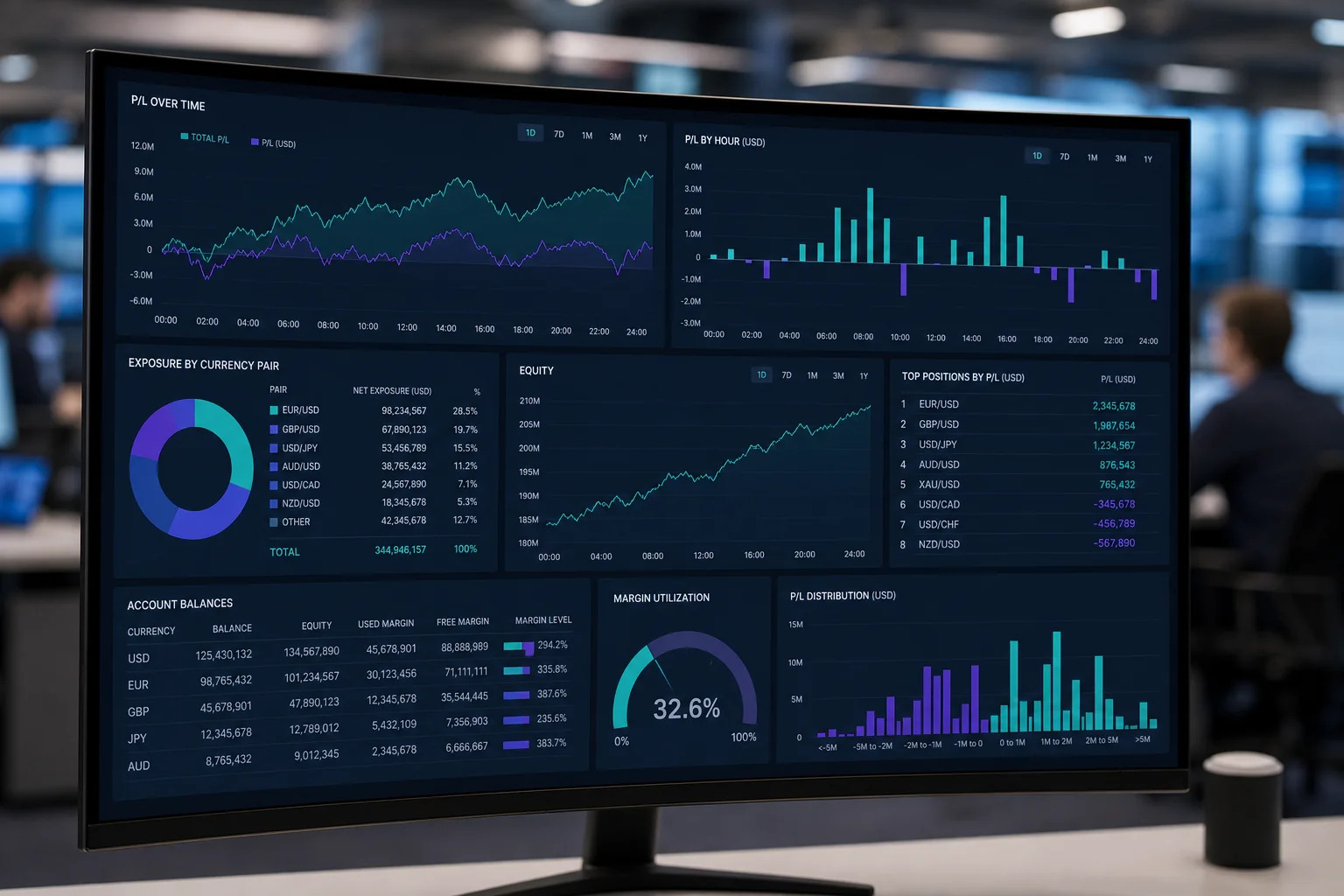
- Live P&L feeds: Updated in near real time, not on a delay measured in minutes.
- Multi-account aggregation: One screen showing exposure across every trader and every asset class simultaneously.
- Margin and leverage tracking: Automatic flags when a trader's margin usage crosses a defined comfort zone.
2. Automated Drawdown Alerts and Kill Switches
This is the feature prop firms ask about first, and for good reason. A drawdown alert system should let risk managers set daily, weekly, and maximum drawdown thresholds per trader or per account tier, then act on breaches automatically rather than waiting for a human to notice and respond. Firms running funded trader challenges, where traders must stay within strict loss limits to keep their funded status, depend on this working without exception.
The better systems separate two behaviors clearly: soft alerts that ping a risk manager's dashboard or phone, and hard stops that automatically freeze new trade entries or force-close positions once a threshold is hit. Which behavior applies should be configurable per rule. A firm might want a warning at 3% daily loss but an automatic account freeze at 5%, with no manual override available to the trader.
The difference between an alert and an enforced kill switch is often the difference between a bad day and a firm-ending event. Alerts require someone to be watching. Kill switches don't.
3. Rule-Based Trading Limits and Compliance Enforcement
Beyond drawdown, prop firms need granular control over what a trader is allowed to do in the first place. That means enforceable limits by trader, by strategy, and by instrument, set once and applied automatically rather than policed manually. A firm running a scalping desk and a swing-trading desk under the same roof needs different rule sets for each, and the software should apply them without requiring a risk manager to remember which trader belongs to which bucket.
Rule enforcement also covers prohibited behaviors. Many funded trader programs explicitly ban strategies like martingale position sizing, grid trading, or latency arbitrage because they distort the risk profile the firm signed up for. A rules engine that can detect and block these patterns automatically, rather than relying on a manual trade review weeks later, closes a gap that off-the-shelf CRM systems frequently miss.
- Per-trader position sizing caps tied to account tier or experience level.
- Per-instrument exposure limits to prevent overconcentration in one currency pair or commodity.
- Strategy detection rules that flag or block martingale, grid, and hedging patterns that violate program terms.
4. Exposure and Correlation Analytics
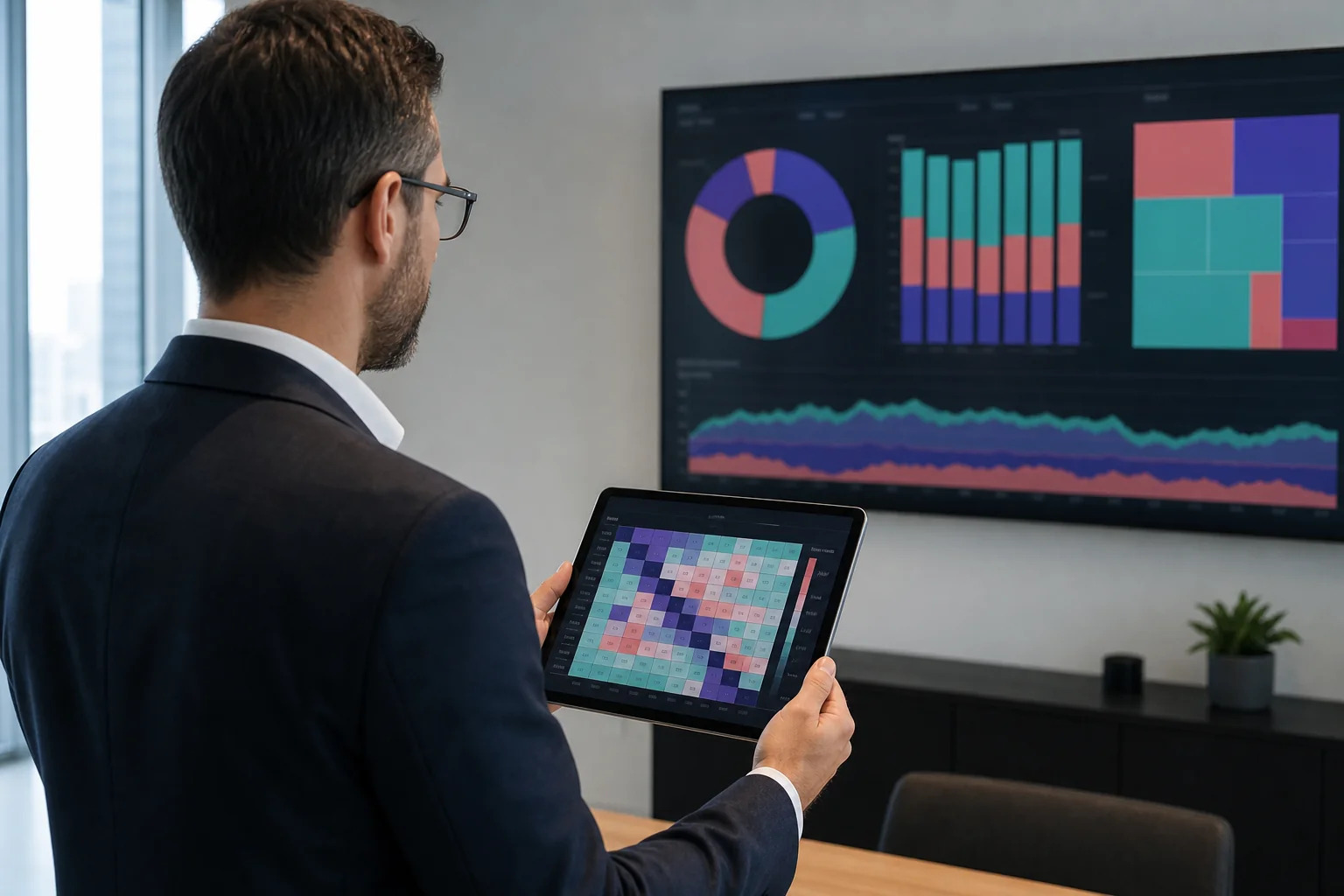
A trader who looks perfectly within limits on paper can still be a hidden risk if three "different" positions are all exposed to the same underlying move. EUR/USD, GBP/USD, and EUR/GBP positions can compound losses in a way that per-instrument limits alone won't catch. This is where correlation and exposure analytics become essential rather than optional.
Good risk software calculates cross-asset correlation in near real time and flags concentration risk at the desk or firm level, not just the individual trader level. Some platforms go further and run stress tests, simulating how the current book would perform under a defined shock, like a 2% overnight move in a major currency or a sudden liquidity gap, so risk managers can see potential damage before it happens rather than after.
For firms trading beyond forex into indices, commodities, or crypto, correlation analytics get more complex, and more necessary. This is a common gap in generic tools built primarily around single-asset accounts, and one reason firms building out a proprietary trading desk across multiple asset classes tend to need purpose-built exposure tooling rather than a retrofit.
5. Integration With Trading Platforms and Liquidity Providers
Risk software is only as good as the data feeding it. If the platform can't pull live data from MT4, MT5, or a proprietary execution engine, the risk manager is working from stale numbers, which defeats the entire premise of real-time monitoring. Integration depth matters more than most buyers initially realize during the sales process.
Many firms also integrate their risk engine with Forex CRM Software to centralize trader onboarding, account management, permissions, and operational workflows.
For firms operating a multi-asset setup covering stocks, commodities, and forex under one roof, the risk engine needs to reconcile positions across each venue's data feed into a single unified view. It also needs to account for liquidity provider data, since exposure calculated purely from internal books can miss the reality of how a position would actually execute in a fast-moving market. Firms that have struggled with liquidity provider integration issues elsewhere in their tech stack often see the same friction resurface in risk reporting if the underlying data pipes aren't solid.
- MT4/MT5 bridge connectivity for live position and account data.
- Multi-asset platform compatibility covering equities, commodities, and digital assets.
- Liquidity provider feed reconciliation so exposure numbers reflect real executable prices, not stale internal quotes.
6. Reporting, Audit Trails, and Regulatory Readiness
Real-time alerts protect capital today. Reporting and audit trails protect the firm tomorrow, when a regulator, auditor, or capital partner asks why a specific risk action happened at a specific time. Every alert, override, and account freeze should generate an immutable log entry: who was notified, what threshold was breached, what action the system took, and whether a human intervened.
This matters more than many prop firm operators initially assume. Firms operating across the United States, United Kingdom, Canada, Australia, and other jurisdictions in Alpharive's service footprint face different disclosure and recordkeeping expectations, and US-based firms in particular are watching closer scrutiny of the funded trader model from bodies like the Commodity Futures Trading Commission, which oversees derivatives markets and related risk practices. Reporting dashboards that convert raw logs into readable summaries for management, investors, and auditors save enormous time compared to manually assembling that history after the fact.
7. Scalability and Multi-Entity Support
A risk platform that works well for 10 traders can fall apart at 100. Prop firms scaling their funded trader programs or opening new regional entities need software architected to handle growing data volume and more complex organizational structures, not a tool that was only ever tested at small scale. This is one of the most common reasons firms outgrow an off-the-shelf tool within 18-24 months of adopting it.
Look for an API-first architecture that lets the risk engine plug into new trading platforms, new liquidity providers, or a new regional back office without a rebuild. Multi-entity support, the ability to segment risk rules and reporting by office, jurisdiction, or brand, becomes essential once a firm operates in more than one region, which is increasingly common as US and UK-based prop firms expand into Canada, Australia, and the Middle East.
Custom-Built vs Off-the-Shelf Risk Management Software
This is the decision most prop firm operators eventually face: license an existing platform or commission a custom build. Neither answer is universally right. It depends on trading strategy complexity, headcount, growth trajectory, and how much the firm's rules deviate from generic industry defaults.

Factor | Off-the-Shelf Software | Custom-Built Software |
|---|---|---|
Time to deploy | Days to a few weeks | Typically 2-6 months depending on scope |
Upfront cost | Lower initial cost, recurring license fees | Higher upfront investment, no per-seat licensing |
Customization | Limited to vendor's configuration options | Fully tailored to firm's specific rules and strategies |
Integration flexibility | Depends on vendor's pre-built connectors | Built to match exact platform and liquidity stack |
Scalability | Can hit ceilings as trader count or complexity grows | Architected for the firm's growth plan from day one |
Ownership of data/logic | Vendor-controlled, harder to migrate away from | Firm owns the system and its rule logic outright |
Best fit | Small prop desks with standard rule sets | Multi-strategy, multi-asset, or scaling firms |
Off-the-shelf tools make sense for a small prop desk just getting started, where the trading rules are straightforward and the firm needs something running quickly without a large development budget. The tradeoff shows up later: as the firm adds strategies, asset classes, or a funded trader program with its own unique rule structure, the rigid configuration options of a packaged tool start forcing compromises on the risk rules themselves, not just the interface.
Custom development becomes the stronger option once a firm's risk logic gets specific enough that no vendor's standard configuration covers it well. That's often the case for firms combining forex, commodities, and equities under one risk framework, or firms running multiple funded trader tiers with different rule sets per tier. A custom platform, integrated directly with the firm's existing trading infrastructure and liquidity providers, closes the gaps that generic tools leave open, and it's a build supported by Alpharive's Forex Trading Software Development expertise.
How Prop Firms in the US and Beyond Are Approaching Risk Tech in 2026
The funded trader model has pulled proprietary trading further into public view than it was a decade ago, and firms based in the United States are under closer scrutiny as a result. Capital providers and prospective funded traders alike are asking sharper questions about how risk is actually enforced, not just what the marketing page claims. A firm that can point to real-time monitoring, automated drawdown enforcement, and a clean audit trail has a credibility advantage that a spreadsheet-based operation simply can't match.
That pressure isn't limited to the US. Prop firms and funded trading programs operating across the United Kingdom, Canada, Australia, Saudi Arabia, and other markets in Alpharive's service area face their own mix of regulatory expectations and competitive pressure from firms that have already modernized their risk stack. The common thread across every region is the same: firms are moving away from manual, spreadsheet-driven risk tracking and toward dedicated software, whether custom-built or carefully selected off-the-shelf, because the cost of a single unmonitored trader has gotten too high to justify the old way of doing things.
Firms evaluating this shift are also weighing it against related infrastructure decisions, like FINRA's guidance on trading practices for US-based operations, multi-asset platform support, and copy trading risk controls for firms running signal-following programs. Getting the risk layer right early avoids a costly rebuild later, especially for firms planning to scale their trader pool or expand into new asset classes within the next year or two.
Frequently Asked Questions
What does risk management software for prop trading firms actually do?
It tracks live positions, profit and loss, and exposure for every trader and desk, compares that activity against pre-set limits, and either alerts a risk manager or automatically enforces the limit, such as freezing an account or blocking new trades, the moment a threshold is breached. It also maintains an audit trail of every action for compliance and internal review.
Is custom software worth it for a small prop firm?
Not always immediately. A small desk with straightforward rules and a handful of traders can often start with an off-the-shelf tool. Custom development tends to pay off once the firm's rule sets get more complex, adds asset classes, or scales past the point where a packaged tool's configuration options start limiting how the firm actually wants to manage risk.
How does drawdown alerting work with funded trader programs?
Funded trader programs typically set strict daily and overall drawdown limits as a condition of keeping funded status. The software monitors each funded account against those limits in real time and can be configured to send a warning at an early threshold, then automatically restrict trading or close positions once the account hits the program's hard limit, removing the need for manual policing of every account.
Can risk management software integrate with MT4/MT5 and multi-asset platforms?
Yes, when built or configured correctly. A properly integrated system pulls live position and account data directly from MT4/MT5 bridges and from multi-asset trading platforms covering equities, commodities, and crypto, so the risk engine reflects a firm's true exposure across every venue rather than just one slice of it.
Choosing the right risk management software isn't a checkbox exercise. It's the system that decides whether a bad trading day stays a bad day, or becomes a firm-ending one. If your current setup relies on spreadsheets, delayed reports, or a rigid off-the-shelf tool that can't enforce your actual rules, it's worth a closer look before your next growth phase makes the gaps more expensive.Every proprietary trading firm has its own trading rules, risk policies, and operational requirements. A custom-built risk management platform should support the way your firm operates today while remaining flexible enough to scale as your business grows. Book a consultation with the Alpharive team to discuss the right approach for your firm.