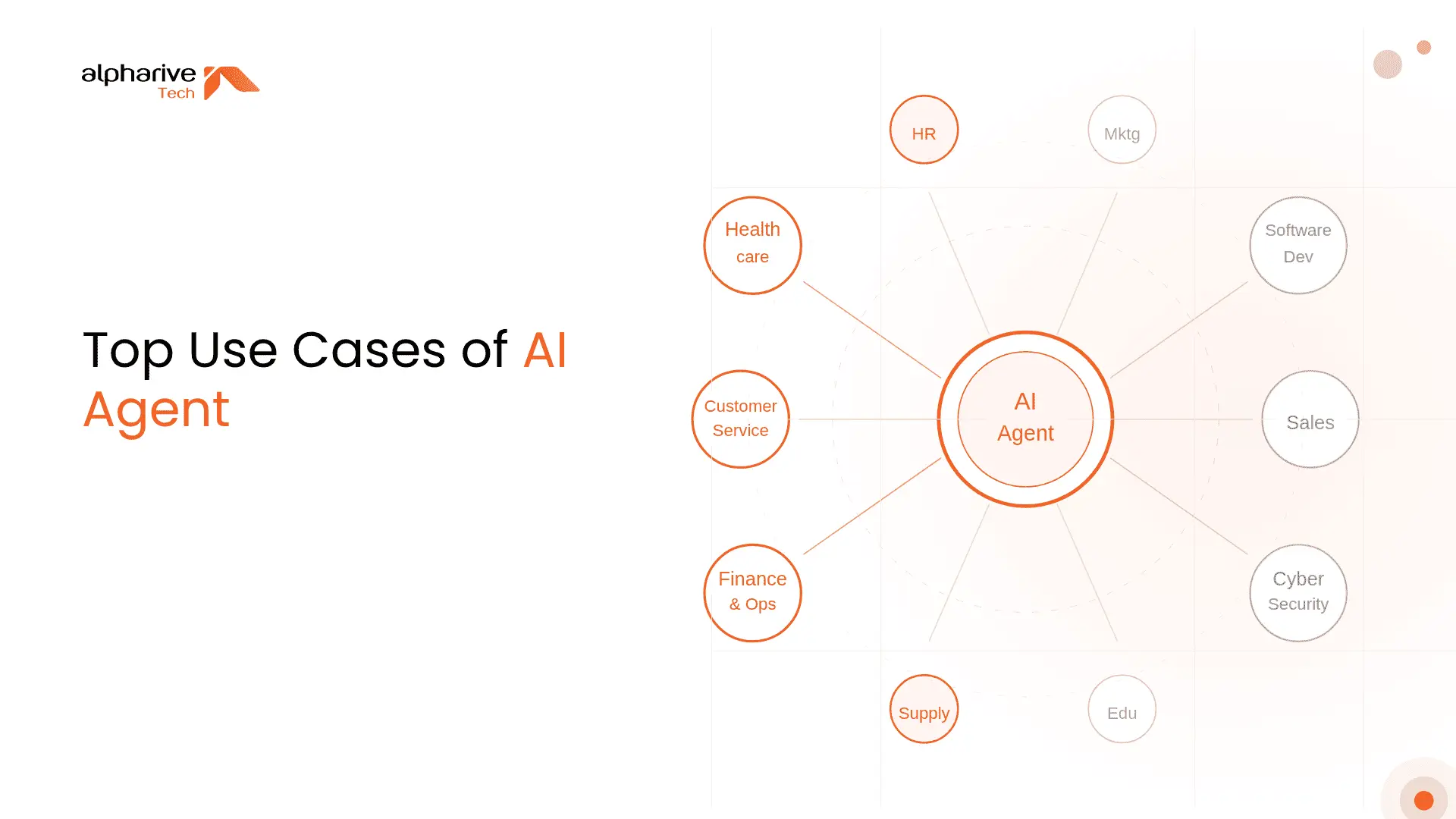
AI agents are quickly moving from experimentation to real business adoption, with Gartner predicting that 40% of enterprise applications will include AI agents by 2026. This shift is changing how companies operate, making systems more autonomous, responsive, and capable of handling complex decisions without constant human input. From customer service to software development, AI agents are becoming a core part of modern digital infrastructure.
In this guide, we break down 10 proven AI agent use cases with real-world examples, measurable ROI insights, and practical ways to implement them. Whether you are leading innovation, managing engineering teams, or exploring AI for business growth, this blog will give you a clear view of where AI agents deliver the most value today.
What Are AI Agents and Why do they Outperform Traditional Automation?
AI agents are intelligent systems designed to perceive data, make decisions, and take actions autonomously, which sets them apart from traditional automation tools. Unlike rule-based systems that follow fixed instructions, AI agents can adapt to changing inputs, learn from interactions, and handle complex workflows across different business environments. This makes them especially valuable in scenarios where decision-making, personalization, and continuous improvement are required.
At the same time, the growing adoption of agentic AI is driven by its ability to go beyond simple task execution and deliver outcomes. Businesses are no longer just automating repetitive processes; they are building systems that can think, respond, and evolve over time. This shift is why AI agents are becoming a key part of enterprise strategies, offering both operational efficiency and smarter, data-driven decision-making.
AI Agents vs. Traditional Automation vs. Generative AI Chatbots: Key Differences
AI agents differ from traditional automation and generative AI chatbots in how they operate, learn, and deliver results. Traditional automation relies on predefined rules and cannot adapt beyond its programming, while generative AI chatbots focus mainly on conversation without taking real actions. In contrast, AI agents combine intelligence with execution, allowing them to complete tasks, make decisions, and improve continuously.
This difference becomes critical in real-world applications where businesses need more than just responses, they need actual outcomes. For example, while a chatbot may answer a customer query, an AI agent can resolve the issue end-to-end by accessing systems, updating records, and triggering workflows without human intervention.
How AI Agents Work: Perception → Reasoning → Action → Learning
AI agents operate through a continuous loop of perception, reasoning, action, and learning, which enables them to function independently in dynamic environments. They first collect data from various sources such as user inputs, databases, or sensors, and then process this information to understand the context and intent behind it.
Once the context is clear, the agent makes decisions using predefined goals, machine learning models, or business logic, and then takes appropriate actions. Over time, the system learns from outcomes and feedback, improving its accuracy and efficiency with each interaction, making it more effective as it continues to operate.
The State of AI Agents in 2026: Market Data That Demands Attention
The state of AI agents in 2025 shows a rapid shift from early experimentation to large-scale enterprise adoption across industries. What once started as simple automation tools has now evolved into intelligent systems that can independently manage workflows, analyze data, and make decisions in real time. Businesses are investing heavily in agentic AI because it directly impacts efficiency, cost savings, and revenue growth in measurable ways.
Recent industry data highlights just how fast this space is growing and why organizations are prioritizing AI agent adoption. The global AI agents market is projected to grow from $7.38 billion in 2025 to over $100 billion by 2030, with a CAGR of more than 45%. Gartner also predicts that 40% of enterprise applications will integrate AI agents by 2026, while McKinsey estimates that AI could unlock up to $4.4 trillion in annual economic value. At the same time, nearly 62% of organizations are already experimenting with AI agents, signaling that this is no longer a future trend but a present-day competitive advantage.
Use Case #1: Customer Service & Support Automation
How Customer AI Agents Work
AI agents in customer service operate as autonomous systems that can understand queries, analyze intent, and resolve issues without constant human involvement. These agents connect with CRM platforms, knowledge bases, and ticketing systems to provide real-time support across multiple channels like chat, email, and voice.
Instead of simply responding to questions, they can take complete actions such as processing refunds, updating account details, or escalating complex cases when needed. With capabilities like sentiment detection and context awareness, AI agents deliver more personalized and efficient customer experiences at scale.
Real-World Example: Zendesk + Outcome Stat
Zendesk reports that 81% of consumers now expect AI to be a core part of customer service, reflecting how quickly expectations have evolved. Companies using AI-powered agents have been able to automate a large portion of support interactions while maintaining quality and consistency.
For example, businesses deploying AI agents in support workflows have seen faster resolution times and reduced dependency on human agents for repetitive queries. This allows support teams to focus on high-value interactions while routine issues are handled instantly by intelligent systems.
Business Impact & Implementation Considerations
AI agents in customer service bring measurable impact by reducing operational costs, improving response times, and ensuring 24/7 availability. Organizations can automate up to 60-80% of repetitive support queries, significantly lowering workload on human teams while maintaining service quality.
However, successful implementation requires proper integration with existing systems, well-structured data, and clear escalation paths for complex scenarios. Companies that start with high-volume use cases like FAQs or ticket triaging often see faster returns and smoother adoption across their support ecosystem.
Use Case #2: Software Development & Code Generation
How Software AI Agents Work
AI agents in software development are designed to assist across the entire development lifecycle, from writing code to testing and debugging. These agents can understand requirements, generate code snippets, review existing code, and even identify bugs by analyzing patterns and logic in real time.
Beyond basic assistance, they integrate with development environments, version control systems, and CI/CD pipelines to automate repetitive engineering tasks. This allows teams to move faster, reduce manual effort, and maintain higher code quality without increasing workload.
Real-World Example: GitHub Copilot + Outcome Stat
Tools like GitHub Copilot have demonstrated how AI agents can significantly improve developer productivity by assisting in real-time code generation. According to industry findings, developers using AI-powered coding assistants can complete tasks faster with fewer errors.
In enterprise environments, organizations have reported up to a 40% reduction in manual code review time, as AI agents can automatically detect issues and suggest improvements. This not only speeds up development cycles but also ensures more consistent coding standards across teams.
Business Impact & Implementation Considerations
AI agents in software development help teams deliver products faster while maintaining quality and consistency. By automating tasks like code generation, testing, and debugging, organizations can reduce development time and optimize resource utilization across projects.
At the same time, successful adoption requires proper governance, code validation processes, and alignment with existing workflows. Teams that begin with controlled use cases such as test automation or code reviews often see quicker results before expanding into more advanced autonomous development capabilities.
Use Case #3: Finance & Accounting Operations
How Finance AI Agents Work
AI agents in finance and accounting are built to automate data-heavy processes such as invoice handling, transaction monitoring, and financial reporting. These agents can extract data from documents, validate entries, and process transactions with high accuracy while ensuring compliance with financial regulations.
They also integrate with ERP systems, banking platforms, and accounting tools to manage workflows in real time. By continuously analyzing financial data, AI agents can detect anomalies, flag risks, and support better decision-making across finance teams.
Real-World Example: Druid AI + Outcome Stat
Organizations using AI agents in finance have reported significant improvements in processing efficiency and accuracy. For instance, AI-powered invoice processing systems can achieve over 90% accuracy, reducing the need for manual verification and corrections.
According to industry insights, companies leveraging AI agents in accounting operations have seen up to a 70% reduction in processing costs, especially in areas like accounts payable and expense management. This shift allows finance teams to focus more on strategic planning rather than repetitive tasks.
Business Impact & Implementation Considerations
AI agents in finance bring strong business value by improving accuracy, reducing operational costs, and accelerating financial workflows. Tasks that once took hours or days can now be completed in minutes, enabling faster reporting and better financial visibility.
However, implementation requires careful attention to compliance, data security, and auditability. Organizations should start with well-defined processes such as invoice automation or fraud detection, where structured data and clear rules make adoption smoother and more effective.
Use Case #4: Healthcare & Clinical Decision Support
How Healthcare AI Agents Work
AI agents in healthcare are designed to assist medical professionals by analyzing patient data, supporting diagnoses, and automating administrative workflows. These agents can process electronic health records, lab results, and clinical notes to provide insights that help doctors make faster and more informed decisions.
They also play a key role in operational efficiency by managing appointment scheduling, patient communication, and prescription workflows. With the ability to continuously learn from medical data, AI agents improve accuracy over time while supporting better patient outcomes across healthcare systems.
Real-World Example: MIT Cancer Case + Outcome Stat
Research highlighted by MIT shows how AI agents are being used to support cancer diagnosis by analyzing large datasets and identifying patterns that may not be immediately visible to clinicians. These systems help doctors detect conditions earlier and recommend more personalized treatment plans.
In practical use, AI-driven diagnostic support has led to up to a 50% reduction in diagnostic time, allowing healthcare providers to act faster in critical situations. This not only improves patient care but also reduces the workload on medical professionals handling complex cases.
Business Impact & Implementation Considerations
AI agents in healthcare deliver strong impact by improving diagnostic speed, reducing administrative burden, and enhancing patient engagement. Hospitals and clinics can streamline workflows while ensuring that medical staff focus more on patient care rather than manual processes.
At the same time, implementation requires strict compliance with healthcare regulations, data privacy standards, and system reliability. Organizations often begin with non-critical use cases like scheduling or patient support before expanding into advanced clinical decision support systems.
Use Case #5: Sales & Revenue Operations
How Sales AI Agents Work
AI agents in sales and revenue operations are designed to automate and optimize the entire sales pipeline, from lead generation to deal closure. These agents can analyze customer data, qualify leads, prioritize opportunities, and even suggest the next best action for sales teams based on real-time insights.
They also integrate with CRM systems, email platforms, and marketing tools to manage outreach, follow-ups, and pipeline updates automatically. By handling repetitive tasks and providing intelligent recommendations, AI agents allow sales teams to focus more on building relationships and closing deals.
Real-World Example: McKinsey Insights + Outcome Stat
According to McKinsey, companies that adopt AI-driven sales solutions have seen a 3-15% increase in revenue along with a 10-20% improvement in sales ROI. These results highlight how AI agents can directly impact business growth by improving targeting and conversion strategies.
In practice, organizations use AI agents to automate lead scoring, personalize outreach campaigns, and track customer interactions across channels. This creates a more efficient and data-driven sales process, helping teams engage prospects at the right time with the right message.
Business Impact & Implementation Considerations
AI agents in sales operations help businesses increase revenue while reducing manual effort across the sales cycle. By automating tasks like CRM updates, follow-ups, and reporting, organizations can improve efficiency and maintain better visibility into pipeline performance.
However, successful implementation depends on data quality, CRM integration, and alignment between sales and marketing teams. Starting with focused use cases like lead qualification or email automation often delivers quick wins before expanding into more advanced, fully autonomous sales workflows.
Use Case #6: Supply Chain & Procurement Management
How Supply AI Agents Work
AI agents in supply chain and procurement are used to manage complex workflows such as demand forecasting, supplier selection, and inventory optimization. These agents analyze historical data, market trends, and real-time inputs to make accurate predictions and automate procurement decisions.
They also connect with ERP systems, logistics platforms, and supplier networks to streamline operations from sourcing to delivery. By continuously monitoring supply chain activities, AI agents can identify disruptions early and recommend corrective actions before issues escalate.
Real-World Example: IBM Supply Chain + Outcome Stat
IBM has demonstrated how AI-powered agents can improve supply chain visibility and efficiency by enabling real-time inventory tracking and predictive analytics. Organizations using such systems can respond faster to demand fluctuations and reduce operational delays.
In real-world deployments, companies leveraging AI agents for supply chain management have achieved significant improvements in inventory accuracy and reduced stockouts. This leads to smoother operations, better resource planning, and improved customer satisfaction.
Business Impact & Implementation Considerations
AI agents in supply chain operations help businesses reduce costs, improve forecasting accuracy, and enhance overall efficiency. By automating procurement and inventory management, organizations can minimize waste and maintain optimal stock levels across locations.
However, implementation requires strong data integration across systems, reliable supplier data, and clear visibility into logistics workflows. Companies often begin with demand forecasting or inventory optimization before expanding into fully automated procurement ecosystems.
Use Case #7: HR, Recruiting & Employee Onboarding
How HR AI Agents Work
AI agents in HR and recruiting are designed to streamline hiring processes, employee onboarding, and workforce management. These agents can screen resumes, match candidates to job roles, schedule interviews, and manage communication with applicants throughout the hiring journey.
They also support onboarding by guiding new employees through documentation, training modules, and internal systems. By integrating with HR platforms and talent management systems, AI agents help organizations manage employee lifecycles more efficiently and consistently.
Real-World Example: AI Hiring Systems + Outcome Stat
Organizations using AI agents in HR have significantly improved hiring efficiency by automating repetitive tasks like resume screening and interview coordination. Many companies now rely on AI to handle the initial stages of recruitment, reducing manual workload for HR teams.
In practice, businesses have reported up to a 50% reduction in hiring cycle time, allowing them to fill positions faster while maintaining candidate quality. This also improves the overall candidate experience by ensuring quicker responses and smoother communication.
Business Impact & Implementation Considerations
AI agents in HR operations help reduce administrative workload, improve hiring speed, and enhance employee experience from the very first interaction. By automating repetitive HR tasks, organizations can focus more on strategic initiatives like talent development and retention.
However, implementation requires careful handling of candidate data, bias mitigation in AI models, and alignment with organizational policies. Starting with recruitment automation or onboarding workflows often provides quick results before expanding into broader HR management systems.
Use Case #8: Marketing & Content Operations
How Marketing AI Agents Work
AI agents in marketing and content operations are used to automate campaign management, personalize customer experiences, and streamline content production. These agents analyze user behavior, preferences, and engagement data to create targeted campaigns and deliver the right message at the right time.
They also integrate with marketing platforms, analytics tools, and content management systems to manage workflows such as email automation, ad optimization, and SEO content generation. This allows teams to scale marketing efforts while maintaining consistency and relevance across channels.
Real-World Example: AI Personalization + Outcome Stat
Companies using AI-driven personalization have reported measurable improvements in customer engagement and revenue growth. By leveraging AI agents, businesses can deliver highly tailored content and recommendations based on individual user behavior.
Industry data shows that organizations implementing AI personalization strategies have achieved 5-8% revenue growth, as more relevant messaging leads to higher conversion rates and stronger customer relationships. This makes AI agents a powerful tool for modern marketing teams.
Business Impact & Implementation Considerations
AI agents in marketing help businesses improve campaign performance, increase customer engagement, and optimize content strategies at scale. By automating repetitive tasks and providing data-driven insights, teams can focus more on creative and strategic initiatives.
However, successful implementation depends on quality data, clear audience segmentation, and alignment between marketing tools and business goals. Starting with use cases like email automation or content personalization often delivers quick wins before expanding into fully automated marketing ecosystems.
Use Case #9: Cybersecurity & Threat Detection
How Cybersecurity AI Agents Work
AI agents in cybersecurity are designed to continuously monitor systems, detect anomalies, and respond to potential threats in real time. These agents analyze network activity, user behavior, and system logs to identify unusual patterns that may indicate security risks or breaches.
They also integrate with security tools, firewalls, and monitoring platforms to automate responses such as isolating affected systems or triggering alerts. By operating 24/7, AI agents provide a proactive layer of defense that reduces the time between threat detection and response.
Real-World Example: Autonomous Threat Detection + Outcome Stat
Organizations using AI agents in cybersecurity have significantly improved their ability to detect and respond to threats faster than traditional systems. These agents can process vast amounts of data in real time, identifying risks that might otherwise go unnoticed.
At the same time, industry reports highlight that 74% of IT leaders consider AI agents both a security advantage and a potential new attack vector. This shows that while AI enhances protection, it also requires careful implementation to avoid introducing new vulnerabilities.
Business Impact & Implementation Considerations
AI agents in cybersecurity help businesses strengthen their defense systems, reduce response times, and minimize the impact of security incidents. By automating threat detection and response, organizations can improve resilience without significantly increasing security team workload.
However, implementation requires strong governance, regular monitoring, and secure system design to prevent misuse or exploitation. Companies should start with controlled environments such as threat monitoring before expanding into fully autonomous security operations.
Use Case #10: Education & Corporate Training
How Education AI Agents Work
AI agents in education and corporate training are designed to deliver personalized learning experiences and automate training workflows. These agents can assess individual learning styles, track progress, and adapt content in real time to match the needs of each learner.
They also integrate with learning management systems, internal knowledge bases, and training platforms to guide users through courses, simulations, and assessments. This makes training more interactive, scalable, and effective across both academic and corporate environments.
Real-World Example: AI Learning Platforms + Outcome Stat
Organizations using AI-driven training solutions have improved learning outcomes by tailoring content to individual users. AI agents can simulate real-world scenarios, provide instant feedback, and continuously adjust learning paths based on performance.
For example, companies implementing AI-based training programs have reported higher engagement and faster skill development, especially in roles that require continuous learning. This helps employees gain practical knowledge more efficiently compared to traditional training methods.
Business Impact & Implementation Considerations
AI agents in education and training help organizations improve learning efficiency, reduce training costs, and deliver consistent knowledge across teams. By automating content delivery and tracking performance, businesses can scale training programs without increasing operational complexity.
However, successful implementation depends on quality learning data, well-structured content, and alignment with training objectives. Starting with focused areas like employee onboarding or skill development programs often creates a strong foundation for broader adoption of AI-driven learning systems.
AI Agent ROI by Industry: A Data-Backed Comparison
AI agent ROI by industry highlights how different sectors are achieving measurable value through automation, intelligence, and faster decision-making. While the core technology remains the same, the impact varies depending on use case complexity, data availability, and implementation maturity. This makes it important for businesses to evaluate where AI agents can deliver the fastest and most meaningful returns.
Below is a simplified comparison to help understand how AI agents perform across key industries based on time to value, cost savings, and revenue impact.
Industry | Use Case | Cost Reduction | Revenue Impact |
|---|---|---|---|
Customer Service | Support Automation | 30-60% | Improved retention |
Software Dev | Code Generation & Testing | 20-40% | Faster product releases |
Finance | Invoice Processing & Fraud Check | 50-70% | Better financial control |
Healthcare | Diagnostics & Scheduling | 20-35% | Improved patient outcomes |
Sales | Lead Qualification & Outreach | 15-30% | 3-15% revenue growth |
Supply Chain | Inventory & Procurement | 25-50% | Reduced stock losses |
HR | Hiring & Onboarding | 20-40% | Faster hiring cycles |
Marketing | Personalization & Campaigns | 10-25% | 5-8% revenue growth |
Cybersecurity | Threat Detection | Risk reduction focused | Loss prevention |
Education | Training & Learning Automation | 15-35% | Faster skill development |
At the same time, these numbers are not fixed outcomes but realistic ranges based on industry trends and adoption patterns. Businesses that start with high-impact, data-rich use cases often achieve faster ROI, while more complex implementations may take longer but deliver deeper long-term value.
How to Get Started with AI Agents: A 4-Step Framework for Enterprise Teams
Getting started with AI agents requires a clear strategy that aligns business goals with the right technology and implementation approach.
- Identify High-Value Use Cases
Begin by identifying high-impact areas where AI agents can deliver immediate value, such as repetitive workflows, data-heavy tasks, or customer-facing operations. This helps prioritize efforts and ensures faster returns from initial deployments.
- Choose Build vs Partner
Decide whether to build AI agents in-house, use existing platforms, or partner with an experienced development team based on your technical capabilities, timelines, and long-term scalability requirements.
- Pilot Targeted Solutions
Start with a focused pilot in one business function to test performance, measure outcomes, and refine workflows before expanding AI agent adoption across multiple departments or enterprise-wide systems.
- Measure and Optimize Continuously
Track performance metrics, monitor outcomes, and continuously improve AI agents through feedback loops, ensuring systems evolve with changing business needs and deliver sustained long-term value.
At Alpharive as an custom AI agent development company, we help businesses move from AI agent strategy to real-world deployment with a structured and practical approach, ensuring faster adoption and measurable results. Build your solution with us.