
Launching a brokerage today is easier than ever. White-label trading platforms, liquidity providers, and payment gateways have made it possible to enter the forex market without building everything from scratch.
However, attracting traders is only the first step. As your brokerage grows, so do the operational challenges. Every new client needs to register, complete KYC verification, fund their account, start trading, receive support, and stay compliant with regulatory requirements.
Managing these activities efficiently depends on one important system—your CRM.
Many forex brokers begin with a generic CRM because it's affordable, familiar, and quick to implement. It works well for capturing leads, managing customer information, and tracking sales conversations.
But running a brokerage requires a reliable forex brokerage infrastructure, not just customer relationship management.
This is where the comparison between a Generic CRM and a Forex CRM becomes important.
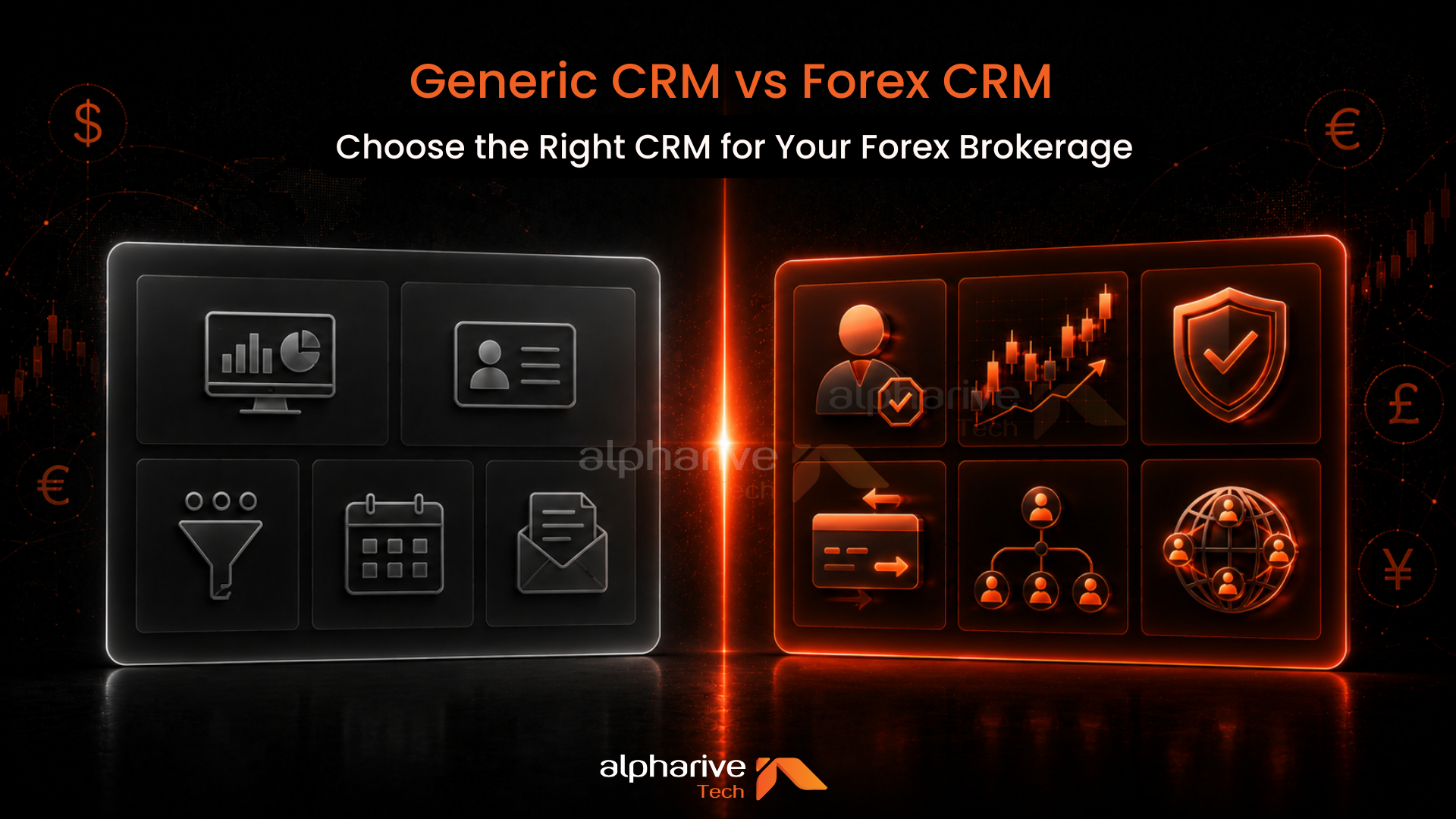
While both systems help organize client data, they are built for completely different purposes. One is designed for sales and customer management, while the other is built specifically to manage brokerage operations.
In this guide, we'll compare Generic CRM vs Forex CRM, explore where generic CRM platforms begin to fall short, and help you decide which Forex CRM software is the right fit for your brokerage.
Why Do Brokers Start with a Generic CRM?
For most startup brokerages, speed and budget are the biggest priorities.
Generic CRM platforms such as Salesforce, HubSpot, and Zoho are popular because they're easy to deploy and already include the tools needed to manage leads and customer communication.
They typically offer features like:
- Lead management
- Contact management
- Email automation
- Sales pipeline tracking
- Customer communication
- Reporting dashboards
During the early stages of a brokerage, these features are often enough.
When you're managing a small number of prospects, a generic CRM helps organize your sales process and keeps customer information in one place.
For a business that's focused on acquiring its first traders, it's a practical starting point.
The challenge begins once those prospects become active traders.
Why Generic CRMs Become Limiting for Forex Brokers
A Generic CRM isn't the wrong choice.
It's simply designed for businesses where the customer journey ends after a sale.
A forex brokerage works differently.
Every trader continues interacting with your business long after opening an account. They deposit funds, execute trades, request withdrawals, complete compliance checks, contact support, and may join through affiliates or Introducing Brokers.
These ongoing activities create operational requirements that most generic CRM platforms aren't built to manage.
Let's look at the biggest limitations.
Trading Data Stays Separate
A generic CRM can tell you when a client registered or when your sales team last contacted them.
What it usually can't tell you is:
- Has the trader funded their account?
- Are they actively trading?
- How many trading accounts do they have?
- What's their current balance?
- Have they submitted a withdrawal request?
Because trading data lives inside MT4 or MT5, your team has to switch between multiple systems just to answer a simple customer query.
This slows down support, sales, and account management.
Compliance Requires More Manual Work
Compliance is a core part of every forex brokerage.
Each trader must complete Know Your Customer (KYC) verification, while Anti-Money Laundering (AML) requirements require continuous monitoring.
With a generic CRM, these workflows are usually managed through separate verification platforms or manual processes.
As your client base grows, so does the administrative workload.
Compliance teams spend more time collecting documents, verifying identities, and updating records instead of focusing on risk management.
Multiple Teams Work in Different Systems
As brokerages expand, different departments often begin using separate software.
For example:
Team | Software Used |
|---|---|
Sales | Generic CRM |
Trading | MT4 or MT5 |
Compliance | KYC Platform |
Finance | Payment Gateway |
Support | Help Desk |
Marketing | Email Platform |
As your brokerage grows, different teams often rely on different software to do their jobs. Sales uses a CRM to manage leads, traders use MT4 or MT5, the compliance team works in a KYC platform, finance manages payments through a payment gateway, and support handles customer queries in a help desk system.
When a trader contacts your brokerage, no single team has the complete picture. Support may need to check with finance for payment status, compliance for KYC verification, and the trading platform for account activity before resolving the issue.
This constant switching between systems slows response times, creates duplicate work, and makes it harder to deliver a smooth customer experience.
Affiliate & IB Management Becomes Harder
Many brokerages rely on affiliate marketers and Introducing Brokers (IBs) to attract new traders.
While a generic CRM can record referrals, it usually isn't designed to automate commission tracking or partner management.
As your affiliate network grows, teams often depend on spreadsheets or third-party software to calculate commissions and monitor partner performance.
This increases manual work and creates more opportunities for errors.
Operations Become More Complex
Every new tool you add solves one problem but creates another.
You may use:
- One platform for customer management
- Another for trading
- Another for compliance
- Another for payments
- Another for support
Instead of improving efficiency, your business becomes dependent on disconnected systems that don't communicate effectively with each other.
As a result, everyday tasks take longer, reporting becomes more complicated, and teams spend more time searching for information.
Why More Forex Brokers Are Switching to a Forex CRM ?
As your brokerage grows, the limitations of a generic CRM become more apparent. Teams spend more time switching between platforms, manual processes slow down operations, and delivering a seamless experience for traders becomes increasingly difficult. A Forex CRM is designed to solve these challenges by bringing your entire brokerage into one centralized platform.
Here's how a dedicated Forex CRM helps growing brokerages operate more efficiently.
Connect Your Entire Brokerage in One Place
One of the biggest challenges of using a generic CRM is that critical information is spread across multiple systems. Sales teams work in the CRM, traders use MT4 or MT5, finance manages payments separately, and compliance relies on independent verification tools.
A Forex CRM eliminates these silos by connecting every department through a single platform. With access to the same real-time information, teams can collaborate more effectively, resolve customer issues faster, and make better business decisions.
Automate Compliance and Client Onboarding
Manual KYC verification and compliance checks become increasingly difficult as your client base grows.
A Forex CRM streamlines the onboarding process by automating document collection, identity verification, approval workflows, and compliance tracking. This reduces administrative work, speeds up account activation, and helps brokerages maintain regulatory compliance without slowing growth.
Simplify Payments and Account Management
Managing deposits, withdrawals, trading accounts, and client requests across different platforms often creates delays and unnecessary complexity.
A Forex CRM centralizes these processes, allowing brokers to manage client accounts and payment activities more efficiently while providing traders with a smoother experience from registration to active trading.
Scale Your Affiliate and IB Program with Confidence
Introducing Brokers (IBs) and affiliate partners are valuable growth channels for many forex brokerages. However, tracking referrals and calculating commissions manually becomes difficult as partner networks expand.
A Forex CRM automates referral tracking, commission calculations, reporting, and partner management, making it easier to scale acquisition channels while reducing manual errors and payment disputes.
Improve Productivity Across Every Team
When routine tasks are automated and information is centralized, every department becomes more productive.
Sales teams can focus on converting qualified leads, compliance teams spend less time on manual verification, finance teams process payments more efficiently, and support teams resolve customer issues with complete visibility into each trader's account.
The result is a brokerage that operates more efficiently, delivers a better customer experience, and is better prepared to scale.
As these advantages show, the difference between a Generic CRM and a Forex CRM goes beyond features. It's about choosing a platform that's designed to support the complete lifecycle of a trader rather than simply managing customer relationships. The easiest way to understand this difference is to compare what a Generic CRM and a Forex CRM are actually built to do.
Generic CRM vs Forex CRM: What's the Real Difference?
The biggest difference isn't the interface or the number of features.
It's what each CRM is designed to manage.
A Generic CRM is built to help businesses generate leads, nurture prospects, and maintain customer relationships.
A Forex CRM is designed to manage the complete trader lifecycle—from registration to trading, compliance, payments, and long-term retention.
Instead of acting as just a sales tool, it becomes the operational hub of your brokerage.
Generic CRM vs Forex CRM: Side-by-Side Comparison
Area | Generic CRM | Forex CRM |
|---|---|---|
Primary Purpose | Customer relationship management | Brokerage operations management |
Lead Management | ✔ | ✔ |
MT4 & MT5 Integration | Limited or Custom | Native Integration |
Trader Account Management | ✖ | ✔ |
KYC & AML Workflow | Manual or Third-Party | Built-in |
Client Portal | ✖ | ✔ |
Deposit & Withdrawal Management | ✖ | ✔ |
Wallet Management | ✖ | ✔ |
Affiliate & IB Management | Basic | Advanced |
Back Office | ✖ | ✔ |
Trading Reports | ✖ | ✔ |
Multi-Brand Support | Limited | ✔ |
Automation | Sales-focused | End-to-end brokerage automation |
The comparison highlights an important point.
A Generic CRM is excellent for managing customer relationships.
A Forex CRM is built to manage the daily operations of a brokerage.
A Real Brokerage Scenario
Imagine you've just launched a brokerage with 100 active traders.
A Generic CRM works well because your team mainly focuses on acquiring leads, answering questions, and onboarding new clients.
Now imagine your brokerage grows to 5,000 active traders.
Every day, your team manages:
- Hundreds of KYC submissions
- MT4 and MT5 account creation
- Deposit approvals
- Withdrawal requests
- Affiliate commissions
- Support tickets
- Compliance reviews
Handling these activities through separate systems quickly becomes inefficient.
Support teams struggle to access complete client information. Compliance teams spend more time on manual verification. Finance teams switch between payment gateways and spreadsheets. Managers wait longer for accurate reports.
This is the stage where many brokerages transition from a Generic CRM to a Forex CRM—not because the Generic CRM failed, but because the business has outgrown what it was designed to do.
Key Features Every Forex CRM Should Have
Here are the essential Forex CRM features every growing brokerage should look for.
1. MT4 & MT5 Integration
A good Forex CRM should provide seamless MT5 account integration, along with MT4 support, allowing brokers to manage trading accounts and client activity without switching platforms.
2. Automated KYC & AML
The CRM should simplify compliance by automating document collection, identity verification, and approval workflows.
3. Client Portal
A secure client portal should allow traders to register, upload documents, manage accounts, deposit funds, request withdrawals, and contact support.
4. Payment & Wallet Integration
Look for built-in payment gateway integration that simplifies deposits, withdrawals, and transaction management.
5. Affiliate & IB Management
The CRM should automatically track referrals, calculate commissions, generate reports, and manage partner payouts.
6. Back Office & Reporting
Choose a platform that provides real-time reporting on registrations, deposits, trading activity, revenue, and customer retention.
Which CRM Is Right for Your Brokerage?
Both Generic CRM and Forex CRM have their place. The right choice depends on your business stage and operational requirements.
A Generic CRM May Be Right If:
- You're launching a new brokerage.
- Your focus is generating and managing leads.
- You have a small client base.
- You don't require MT4 or MT5 integration.
- Compliance and payments are handled through separate systems.
A Forex CRM Is the Better Choice If:
- You have active traders.
- Your brokerage is growing quickly.
- You manage deposits and withdrawals daily.
- You need automated KYC and AML workflows.
- You work with affiliates or Introducing Brokers.
- You want one platform for sales, trading, compliance, payments, and reporting.
If your business has moved beyond lead generation and into managing thousands of traders, a Forex CRM becomes a necessity rather than an option.
When Should You Upgrade from a Generic CRM?
Many brokerages don't switch immediately.
Instead, they upgrade when operational challenges begin affecting productivity and customer experience.
Common signs include:
- Teams spend too much time switching between software.
- KYC verification is handled manually.
- MT4 or MT5 isn't connected to your CRM.
- Affiliate commissions are tracked in spreadsheets.
- Customer support takes longer because information is spread across multiple systems.
- Reporting requires collecting data from different platforms.
If you're facing several of these challenges, it's a good indication that your brokerage has outgrown a Generic CRM.
How to Choose the Right Forex CRM?
Not every Forex CRM offers the same capabilities.
Before making a decision, it's also worth understanding the differences between a custom vs white label Forex CRM to determine which approach best suits your brokerage.
- Does it support MT4 and MT5 integration?
- Can it automate KYC and AML verification?
- Does it include a client portal?
- Is payment gateway integration available?
- Does it support affiliate and IB management?
- Can it manage multiple brands or brokerages?
- Does it provide real-time reporting?
- Can it scale as your business grows?
- Does the provider offer customization and ongoing technical support?
Choosing the right CRM isn't just about today's requirements. It's about selecting a platform that can support your brokerage as it continues to grow.
Why Brokerages Choose Alpharive for Forex CRM Solutions?
Selecting the best Forex CRM is about more than features. You need a solution that fits your brokerage's workflow today and can scale as your business grows.
At Alpharive, we build Forex CRM solutions and provide forex trading app development services for modern brokerages. Our platform is designed to simplify trader onboarding, automate KYC and AML workflows, integrate seamlessly with MT4 and MT5, manage deposits and withdrawals, and support affiliate and IB programs from a single dashboard.
Whether you're launching a new brokerage or replacing disconnected systems, our team helps you implement a CRM that reduces operational complexity and improves the experience for both your staff and your traders.
With a focus on performance, customization, and ongoing technical support, Alpharive delivers CRM solutions that grow alongside your brokerage instead of limiting it.
Why Alpharive?
- Built specifically for forex brokerage operations
- Native MT4 and MT5 integration
- Automated KYC and AML workflows
- Client portal with payment management
- Affiliate and IB management
- Customizable workflows for different brokerage models
- Scalable architecture with dedicated technical support
Conclusion
A Generic CRM is a practical solution for managing leads and customer relationships during the early stages of a brokerage. However, as your business grows, managing traders, compliance, payments, and partner programs through separate systems becomes increasingly difficult.
A Forex CRM is purpose-built to handle these operational challenges. By bringing trader onboarding, MT4/MT5 integration, compliance, payments, affiliate management, and reporting into one platform, it helps brokers streamline operations, improve team efficiency, and deliver a better experience for traders.
If you're planning to scale your brokerage, choosing the right Forex CRM provider can reduce operational complexity and prepare your business for long-term growth. The best CRM isn't the one with the longest feature list—it's the one that supports the way your brokerage operates today and the way you want it to grow tomorrow.
Frequently Asked Questions
Can a Generic CRM be used for a forex brokerage?
Yes. A Generic CRM works well for managing leads and customer relationships in early-stage brokerages. However, growing brokerages often need a Forex CRM for trading, compliance, payments, and automation.
Why do forex brokers choose a specialized CRM?
Forex brokers choose a specialized CRM because it's built for brokerage operations. It combines trader onboarding, MT4/MT5 integration, compliance, payments, and affiliate management in one platform.
Does a Forex CRM integrate with MT4 and MT5?
Yes. Most Forex CRM solutions integrate with MT4 and MT5, allowing brokers to manage trading accounts, monitor client activity, and access trading data from a single dashboard.
Can startup brokerages use a Forex CRM?
Yes. A Forex CRM is suitable for startups and growing brokerages. Implementing it early helps streamline operations and reduces the need for migrating to another system later.
What's the biggest advantage of a Forex CRM?
The biggest advantage of a Forex CRM is centralization. It brings trader management, compliance, payments, reporting, and affiliate management together in one platform for greater operational efficiency.
What affects Forex CRM software cost?
Forex CRM software cost depends on customization, integrations, deployment model, and support requirements. White-label solutions are generally more affordable than fully custom-built Forex CRM platforms.