You’ve decided to build with AI agents, but the real challenge starts with choosing the right architecture. Should you rely on a single powerful agent or design a system where multiple agents work together? This decision directly affects your development speed, system performance, scalability, and long-term costs. In this guide, we break down both approaches in a practical way, helping you understand what works, what doesn’t, and how to choose the right path for your business.
Why This Decision Matters More Than Ever in 2026?
The agentic AI market is not slowing down. The global market was valued at over $7.5 billion in 2025 and is projected to reach $199 billion by 2034, growing at a compound annual rate exceeding 43%. Gartner forecasts that 40% of enterprise applications will include task-specific AI agents by the end of 2026, up from less than 5% in 2025.
But here is the reality check sitting alongside those numbers: over 40% of agentic AI projects are at risk of cancellation by 2027, according to Gartner, primarily due to poor architecture decisions, inadequate governance, and unclear ROI. The projects that succeed and those that fail are often using the same underlying models and frameworks. The difference is architectural thinking starting with the right system design for the right problem.
The decision between single-agent and multi-agent architecture is that kind of foundational choice. Get it wrong and you will spend months rebuilding a system that was never designed for the complexity it was asked to handle. Get it right and you will ship faster, scale cheaper, and build something your users actually trust.
What Is a Single AI Agent System?
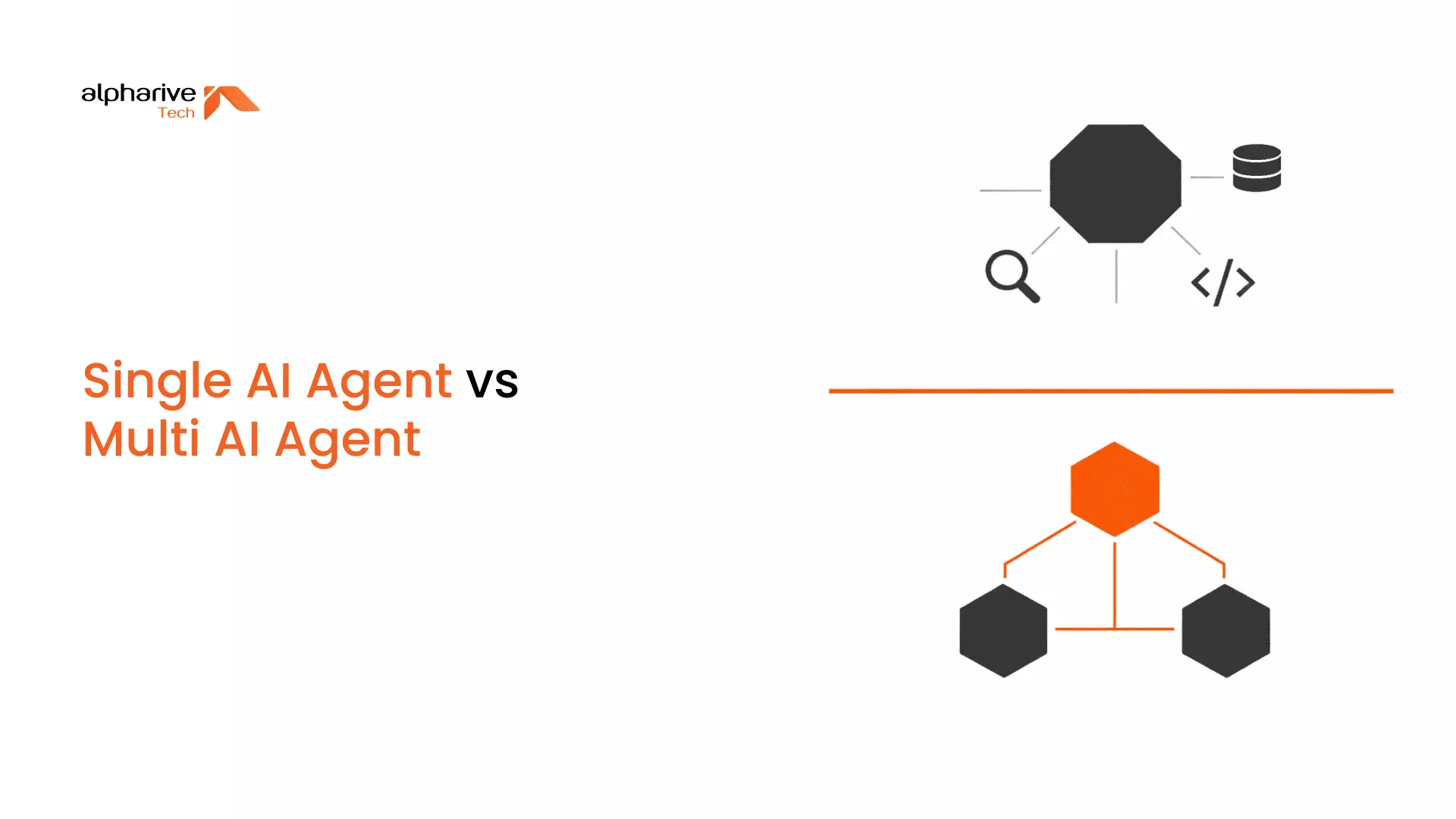
A single-agent AI system is exactly what it sounds like: one autonomous AI agent handling a task from start to finish. That agent has access to tools (search, databases, APIs, code execution), memory, and a reasoning loop but there is only one unified decision-maker in the system.
Think of it as a brilliant generalist. It perceives the user's goal, reasons through the steps required, calls whatever tools it needs, and returns an output. The whole process runs in a single context window with a single orchestration loop.
How Single-Agent Architecture Works
The typical single-agent workflow follows a tight loop: the agent receives a goal or user input, reads the available context and tools, plans its approach, executes actions (tool calls, API requests, database queries), reflects on the results, and iterates until the task is complete. Frameworks like LangChain, LangGraph in single-agent mode, and OpenAI's Assistants API are commonly used to build these systems.
Real-World Single-Agent Use Cases
• Customer support FAQ bots: One agent retrieves from a knowledge base and answers queries which is fast to build, cost-effective at scale for well-defined domains
• Code generation assistants: An agent that accepts a description, writes code, runs tests, and returns the result where the task is sequential and contained
• Document summarization: Ingest a document, apply a reasoning loop, return a structured summary and a clear input and output with no cross-domain complexity
• Email drafting and classification: Single-purpose, single-context tasks that benefit from speed over depth
• Personalized content recommendation: One agent processes user history and returns recommendations from a structured catalog
Advantages of Single-Agent Systems
• Simple to build and deploy: A working prototype can be live within hours to days
• Easy to debug: One reasoning trace, one log to follow where root cause analysis is straightforward
• Unified context: All information is in one place, reducing the risk of context fragmentation
• Low cost: One LLM context per task cycle means significantly lower token consumption
• Fast response times: No inter-agent communication overhead means lower latency
• Easier governance and auditability: One decision loop to monitor, one entity to explain
Limitations of Single-Agent Systems
• Context overload: As tasks grow more complex, the single agent's context window gets crowded, degrading reasoning quality
• No parallel execution: Sequential processing means long-running complex tasks cannot be split across simultaneous workstreams
• Single point of failure: If the agent makes a wrong decision early in its reasoning loop, there is no check or correction mechanism
• Limited specialization: One agent cannot be an expert at everything it will be mediocre across multiple domains
• Scalability ceiling: The architecture becomes a bottleneck at high volume or high complexity
What Is a Multi-Agent AI System?
A multi-agent AI system deploys several independent AI agents, each assigned a specific role or domain, coordinated by an orchestrator to collectively complete a larger task. Rather than one generalist working alone, you have a team of specialists handing work to each other in a structured workflow.
The analogy that holds it is not a single brilliant employee, it is a well-run team. A project manager (orchestrator) receives the overall goal, delegates sub-tasks to domain experts (specialized agents), collects their outputs, and synthesizes a final result.
Multi-Agent Architecture Patterns
• Hierarchical: A central orchestrator agent directs sub-agents and collects their outputs. Google DeepMind research found that this pattern outperforms uncoordinated multi-agent systems by a significant margin.
• Sequential pipeline: Each agent processes the output of the previous one — research agent, then curator agent, then writer agent, then reviewer agent.
• Parallel execution: Multiple agents work simultaneously on independent sub-tasks, with an aggregator synthesizing results where the pattern that delivers the greatest speed gains.
• Hybrid (recommended for enterprise): A single-agent front door routes and classifies requests, then hands off to specialized sub-agents based on task type.
Real-World Multi-Agent Use Cases
• Enterprise customer service: Klarna's multi-agent system handled 2.3 million conversations in a single month which is the equivalent of 700 full-time human agents with resolution time dropping from 11 minutes to under 2 minutes.
• Financial fraud detection: One agent analyzes transactions, a second reviews customer history, a third aggregates findings, a fourth validates before anything reaches a human analyst.
• Content production pipelines: Search agent, curation agent, writing agent, and editorial review agent working in sequence with feedback loops.
• Healthcare diagnostics: Mayo Clinic deployed a multi-agent system with specialists for radiology, patient history, drug interactions, and diagnostic synthesis achieving 89% accuracy on complex cases.
• Supply chain management: Demand forecasting, supplier risk, inventory management, and logistics routing agents sharing state across a unified orchestration layer.
Advantages of Multi-Agent Systems
• Specialization: Each agent is optimized for a narrow domain, improving depth and accuracy within that domain
• Parallel execution: Independent sub-tasks run simultaneously, dramatically reducing total processing time for complex workflows
• Fault tolerance: If one agent fails, the system can route around it there is no single point of failure
• Scalability: Individual agents can be scaled independently based on their load without affecting the whole system
• Security isolation: Compliance and regulatory requirements can mandate that certain data never leaves a specific agent boundary
• Better performance on complex tasks: A Cornell University study found coordinated multi-agent systems completed complex planning tasks at a 42.68% success rate compared to 2.92% for a single GPT-4 agent on the same benchmark.
Challenges and Risks of Multi-Agent Systems
• Coordination overhead: Every inter-agent handoff adds latency. More agents means more handoffs, and that overhead compounds.
• Error propagation: Google DeepMind research found that unstructured multi-agent networks amplify errors up to 17.2 times compared to single-agent baselines. This is not 17% worse, it is 17 times worse. The key word is 'unstructured' this failure mode is architectural, not inevitable.
• Higher cost: Each agent makes independent API calls and processes its own context. Token consumption scales with agent count.
• Debugging complexity: When the final output is wrong, tracing the error back through multiple agents requires centralized logging and observability tooling at every step.
• Longer time to build: Multi-agent systems require architecture design, orchestration logic, communication protocols, and inter-agent testing which takes typically weeks to months rather than days.
Single Agent vs Multi-Agent AI: Side-by-Side Comparison
The table below compares both architectures across the dimensions that matter in production. Use it as a reference when evaluating your specific use case.
Dimension | Single AI Agent | Multi-Agent System |
|---|---|---|
Complexity | Low - single reasoning loop | High - orchestration layer required |
Setup Time | Hours to days | Days to weeks |
Best For | Linear, sequential tasks | Parallel, cross-domain workflows |
Cost | Low (one LLM context) | Higher (multiple API calls) |
Scalability | Limited - bottlenecks at scale | High - agents scale independently |
Fault Tolerance | Low - single point of failure | High - isolated agent failures |
Debugging | Simple - single trace path | Complex - multi-agent logging needed |
Task Accuracy (Complex | Low (2.92% on planning benchmarks*) | High (42.68% on same benchmarks*) |
Latency | Fast - no coordination overhead | Higher - handoff latency stacks |
Security Isolation | Not possible in one agent | Enforced per-agent boundaries |
Use Case Examples | FAQ bots, email drafting, code gen | Fraud detection, supply chain, R&D |
Context Window Risk | High - overload on complex tasks | Distributed - each agent focused |
How to Choose: The Architecture Decision Framework
The question is not 'which architecture is better?' it is 'which architecture fits your specific problem?' Use the framework below to make that decision based on your actual requirements, not assumptions.
Choose Single Agent When | Choose Multi-Agent When |
|---|---|
Task is linear & well-defined | Task involves multiple domains |
Fast time to deploy needed | Parallel workstreams are required |
Single team manages it | Separate teams own sub-systems |
Budget is constrained | Compliance requires data isolation |
Low maintenance overhead preferred | System must scale independently |
Debugging simplicity is priority | Fault tolerance is non-negotiable |
The Decision Trigger Test
If you can answer 'yes' to two or more of the following questions, a multi-agent system is likely justified. If you answer 'yes' to fewer than two, start with a single agent and validate your assumptions before investing in orchestration.
• Does the task require work across more than two distinct knowledge domains simultaneously?
• Do different parts of the task need to run in parallel to meet performance requirements?
• Does the system need to continue operating if one component fails?
• Do compliance or security requirements mandate data isolation between parts of the workflow?
• Will different teams or organizational units own different parts of the system's logic?
• Does the task involve more than five to seven sequential reasoning steps that each require specialized context?
The Hybrid Architecture: Best of Both Worlds
In practice, the most mature enterprise AI systems in 2026 do not choose between single-agent and multi-agent they use both, deliberately layered.
The pattern that has emerged as the dominant enterprise approach is what practitioners call the 'single-agent front door, multi-agent back room.' A lightweight orchestrator agent receives incoming tasks, classifies them, and routes them to specialized sub-agents based on complexity and domain. Simple tasks are handled by the orchestrator directly. Complex, multi-domain tasks are handed off to the appropriate specialist team.
This pattern gives you the governance simplicity of single-agent design at the entry point easy to monitor, easy to audit, easy to explain to stakeholders combined with the capability depth of multi-agent systems when the task genuinely requires it.
LangGraph, CrewAI, and AutoGen all support this hybrid pattern natively. If you are starting a new agent project in 2026, this is the architecture worth designing, even if you begin with just the single-agent routing layer and add specialist agents incrementally.
Tools and Frameworks: What the Market Uses in 2026
Your architecture choice will influence which tools and frameworks you can realistically use. Here is a practical overview of the current landscape.
For Single-Agent Systems
• LangChain + LangGraph: Most widely adopted. Strong tool-use support, active community, good observability via LangSmith.
• OpenAI Assistants API: Fast to build, managed infrastructure, built-in thread management and tool calls. Limited flexibility for complex workflows.
• Anthropic Claud: Excellent for reasoning-heavy tasks. Strong at following complex instructions and multi-step tool use within a single context.
• Semantic Kernel : Enterprise-grade, strong Azure integration, good for teams already in the Microsoft ecosystem.
For Multi-Agent Systems
• LangGraph: State-machine approach to agent orchestration. Stateful, fault-tolerant, production-ready. The framework behind Klarna's 2.3M conversation system.
• CrewAI: Role-based agent framework. Excellent for teams new to multi-agent design — intuitive abstractions, clear agent role definitions.
• AutoGen: Research-oriented, strong for collaborative agent patterns and multi-turn agent conversations. Good for code generation pipelines.
• Vertex AI: Managed multi-agent infrastructure on GCP. Strong for teams already in the Google Cloud ecosystem.
• Amazon Bedrock: AWS-native multi-agent orchestration. Strong enterprise security, IAM integration, and compliance controls.
Industry-Specific Architecture Guidance
The right architecture often varies by industry, shaped by data sensitivity, workflow complexity, and compliance requirements.
Financial Services
Multi-agent is typically required. Compliance mandates separation of duties like a transaction analysis agent cannot be the same agent that approves a transaction. Parallel processing of customer history, risk scoring, and compliance checks is a functional requirement, not an optimization. Start with a hierarchical pattern with a strict orchestrator.
Healthcare
Multi-agent with human-in-the-loop checkpoints. Diagnostic workflows span radiology, pharmacology, patient history, and clinical reasoning where each requires specialized depth. Human oversight is non-negotiable at high-stakes decision points. Fault tolerance is critical: a single point of failure in a clinical workflow is unacceptable.
E-Commerce
Start with a well-designed single agent if the product catalog and query scope is bounded. Move to multi-agent when queries consistently span multiple domains (order management + returns + product recommendations + payment disputes). Klarna's use case is the benchmark: the volume and multi-domain nature of customer service at scale justifies the multi-agent investment.
SaaS
Hybrid is the default. A single orchestrating agent for task routing and planning, with specialist sub-agents for code generation, code review, test writing, deployment validation, and documentation. The sequential nature of the development pipeline maps naturally onto a multi-agent pipeline with clear handoff contracts.
Research and Content Production
Multi-agent pipeline: search and retrieval agent, relevance and curation agent, synthesis and writing agent, fact-checking and review agent. Each step requires different depth and different tools, and the sequential dependency between steps maps cleanly onto a pipeline architecture.
The Compound Reliability Problem: A Warning for Multi-Agent Builders
Before committing to a multi-agent system, every team should run the compound reliability calculation. It is the single most important piece of arithmetic in agentic AI architecture.
If a single agent completes each step with 95% reliability, a strong result for most AI tasks and you chain 10 sequential steps, your overall success rate drops to 0.95^10 = 59.8%. That means 4 in 10 end-to-end task completions will fail somewhere in the pipeline. At 90% per-step reliability, chaining 10 steps yields just 34.9% overall success.
This is not an argument against multi-agent systems. It is an argument for architectural discipline. The teams that ship successful multi-agent systems in production share three characteristics: they define explicit input/output contracts at every agent boundary, they design for graceful failure and recovery (not just success paths), and they instrument every agent interaction with logging and observability from day one not as an afterthought. Need to talk to AI experts and reach out to the experts of Alpharive for your Custom AI agent Development.